 jakiro
Author: Planet Xiaohua

In the past two years, prediction markets (Prediction Markets) have rapidly entered the mainstream technology venture capital and financial capital horizons from a fringe concept in the encryption circle.
Compliance upstart Kalshi recently completed a US$1 billion Series E round of financing, with its post-money valuation rising to US$11 billion. The investment lineup includes Paradigm, Sequoia, a16z, Meritech, IVP, ARK Invest, CapitalG, Y Combinator and other capitals with the most say.
Polymarket, the leader in the field, received strategic investment from ICE at a valuation of US$9 billion, and a US$150 million round of financing led by Founders Fund at a valuation of US$12 billion. It is currently continuing to raise funds at a valuation of US$15 billion.
Capital is pouring in so intensively, but whenever we publish in-depth articles on market predictions, the comment section still inevitably says: “It’s just a gambling reskin.”
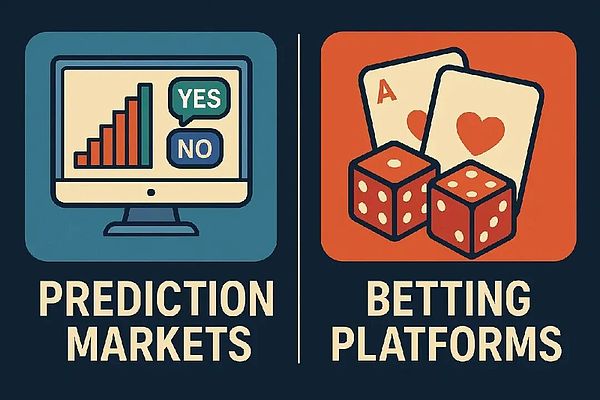
It is true that in sports and other fields that are easily compared, prediction markets and betting platforms do have similarities in their superficial gameplay.But at a more essential and broader level, the two exist in operational logic.structural differences.
The deeper reality is: with the entry of first-tier capital, they will push to write this “structural difference” into regulatory rules and become a new industry language.Capital is not betting on gambling;Event Derivatives Exchange (DCM)The infrastructure value of this new asset class.
From the perspective of regulatory logic:
The gambling market in the United States = state-level regulation (with great individual differences), high taxes (even an important source of finance for many states), extremely heavy compliance, and extremely many restrictions;
New prediction market = financial derivatives exchange, federally regulated (CFTC/SEC), nationally accessible, unlimited in scale, and with a lighter tax regime.
In a nutshell: the boundaries of asset classes have never been academic discussions and philosophical definitions, but the distribution of power between regulation and capital.
What is the structural difference?
Let’s first clarify the objective facts: Why is prediction market not gambling?Because they are two completely different systems in terms of their underlying mechanisms.
1. Different price formation mechanisms: market vs. banker
In essence, transparency is different: the prediction market has a public order book and the data is auditable; the internal calculation of betting odds is not visible and the platform can be adjusted at any time.
-
Prediction market:Prices are matched by the order book and market-based pricing of financial derivatives is adopted.,It is up to the buyer and seller to determine the price.The platform does not set probabilities and does not assume risks, but only charges transaction fees.
-
Gambling platform:The odds are set by the platform and have a built-in house edge.Regardless of the outcome of the event, the platform usually maintains a safe profit margin in the probabilistic design.The platform’s logic is “win in the long run.”
2. Difference in use: entertainment consumption vs economic significance
The real data generated by the prediction market has economic value and can be used for risk hedging in financial decisions. It may even have a reverse effect on the real world, such as media narratives, asset pricing, corporate decisions, and policy expectations.
-
prediction market: The prediction market can generate data-based products: for example, it can be used to judge the probability of macro events, public opinion and policy expectations, enterprise risk management (weather, supply chain, regulatory events, etc.), probabilistic reference targets of financial institutions, research institutions, and media, and can even be used as the basis for judgment of arbitrage and hedging strategies.
The most well-known case is of course the U.S. election, when many media cited Polymarket data as one of the polling references.
-
Gambling platform:Pure entertainment consumption, betting odds ≠ real probability, no data spillover value.
3. Participant structure: speculative gamblers vs. information arbitrageurs
The liquidity of gambling is consumption, and the liquidity of prediction markets is information.
-
Prediction market:Users include data model researchers, macro traders, media and policy researchers, information arbitrageurs, high-frequency traders, and institutional investors (especially in compliance markets).
This determines that the prediction market has a high information density and is forward-looking (such as election night, before the CPI is released).Liquidity is “active and information-driven”, and participants come for arbitrage, price discovery, and information advantages.The essence of liquidity is “informational liquidity.”
-
Gambling platform:Mainly ordinary users, prone to emotional betting and driven by preferences (loss chasing/gambler fallacy), such as supporting “their favorite players”, betting is not based on serious predictions, but on emotion or entertainment.
Liquidity lacks directional value, and odds will not be more accurate because of “smart money”, but because of the bookmaker’s algorithm adjustment.Without price discovery, the gambling market is not to discover the true probability, but to balance the banker’s risk. The essence is “entertainment consumption liquidity”.
4. Regulatory logic: financial derivatives vs regional gaming industry
-
Prediction market:Kalshi is recognized as an event derivatives exchange (DCM) by the CFTC in the United States. Financial supervision focuses on market manipulation, information transparency, and risk exposure. The prediction market follows the financial product tax system.At the same time, the prediction market, just like the encryption trading platform, is naturally globalized.
-
Gambling platform:Gambling falls under state gaming regulators, and gaming regulation focuses on consumer protection, gambling addiction, and the creation of local tax revenue.Gambling is subject to gaming tax, state tax.Gambling is strictly subject to regional licensing systems and is a regional business.
2. The easiest example to “look similar”: sports predictions
Many articles talk about the difference between prediction and gambling. They always focus on predicting political trends, macro data and other examples with social attributes. This part is completely different from gambling platforms, and it is easy for everyone to understand.
But in this article, I would like to give an example that is most easily criticized, which is the “sports prediction” mentioned at the beginning. In the eyes of many fans, prediction markets and betting platforms seem to be the same in this part.
But in fact, the contract structures of the two are different.
The current prediction market is YES / NO binary contracts, such as:
Will the Lakers win a championship this season?(Yes/No)
Will the Warriors win more than 45 games in the regular season?(Yes/No)
Or discrete intervals (range contracts):
“Did the player score >30?” (Yes/No)
Essentially standardized YES/NO, each binary financial contract is an independent market with limited structure.
The contracts of the betting platform can be infinitely subdivided and even customized, such as:
For example, the specific score, half time vs. full time, number of free throw line shots taken by the number of players, total three-pointers, two-on-one, three-on-one, custom combination, handicap, size, odd or even, player’s personal performance, number of corner kicks, number of fouls, red and yellow cards, injury time, ive betting (real-time minute handicap)…
Not only is the event tree infinitely complex, but it is also highly fragmented. It is essentially infinitely parameterized fine-grained event modeling.
Therefore, even on this seemingly identical theme, differences in mechanisms have resulted in the four major structural differences we mentioned earlier.
Regarding sports events, the essence of the prediction market is still an orderbook, formed by buyers and sellers, driven by the market, and is essentially more like an options market.Only official statistics are used in settlement rules.
In the betting platform, the odds are always: banker setting/adjustment, built-in house edge, and the goal is to “balance risks and ensure banker income.”The settlement has the right to interpret the handicap, the odds have room for ambiguity, and even the results of different platforms may be different in fragmented events.
3. The ultimate question: a redrawing of powers regarding regulatory ownership
The reason why capital is betting billions of dollars quickly on prediction markets is not complicated: it is not looking at “speculative narratives”;A global event derivatives market that has yet to be formally defined by regulation——A new asset class with the potential to rank alongside futures and options.
What traps this market is an old and vague historical question: Are prediction markets considered financial instruments or gambling?
If this line is not clearly drawn, the market will not be able to run.
Regulatory ownership determines the scale of the industry. This is the old logic of Wall Street, but it has just been applied to this new track.
The ceiling for gambling is at the state level, which means fragmented regulation, heavy tax burdens, inconsistent compliance, and the inability of institutional funds to participate.Its growth path is inherently limited.
The ceiling of the prediction market lies in the federation.Once incorporated into the derivatives framework, it can reuse all the infrastructure of futures and options:Globally popular, scalable, indexable, and institutionalizable.
At that point, it will no longer be a “forecast tool” but a set of tradable event risk curves.
That’s why Polymarket’s growth signals are so sensitive.During 2024–2025, its monthly trading volume will break through many timesUS$2-3 billion, sports contracts have become one of the core areas of growth.This isn’t “cannibalizing the betting market” but directly competing for the attention of traditional sportsbook users –In financial markets, attention migration is often a precursor to scale migration.
State regulators are extremely resistant to bringing prediction markets under federal regulation because it would mean two things happening at the same time:Gambling users are being siphoned off, and the state government’s gambling tax base is being directly intercepted by the federal government.This is not just a market issue, but a financial issue.
Once prediction markets fall under the CFTC/SEC, state governments not only lose regulatory authority but also lose one of the “easiest and most stable” local taxes.
Recently, this game has begun to become public.Southern District of New York LawThe court has accepted a class-action lawsuit accusing Kalshi of selling sports contracts without obtaining any state gaming license and questioning its market-making structure that “allows users to essentially bet against the bookmaker.”Days earlier, the Nevada Gaming Control Board also said Kalshi’s sports “event contracts” were essentially unlicensed gambling products and should not enjoy the regulatory shield of the CFTC.Federal Judge Andrew Gordon said bluntly during the hearing:“Before Kalshi, no one would have thought sports betting was a financial commodity.”
This is not a product dispute, it is a conflict between regulatory authority and financial interests and a battle for pricing power.
For capital, the underlying question is not whether the prediction market can grow; it is how much it will be allowed to grow.