 jakiro
Author:Anthony Pompliano, founder and CEO of Professional Capital Management, compiled by: Shaw Bitcoin Vision
Federal Reserve Chairman Jerome Powell and the Federal Open Market Committee (FOMC) begin a two-day meeting, and the market is closely watching whether the central bank will cut interest rates.
Odds on a 25 basis point rate cut rise to 95% on Polymarket, while the probability of it remaining unchanged is 5%.
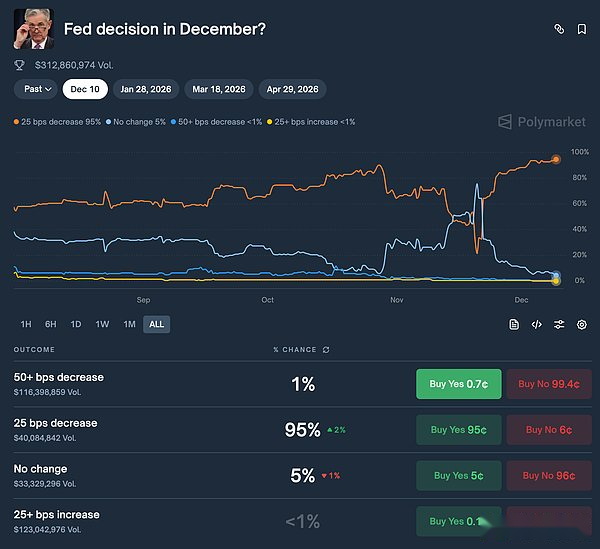
If the Fed cuts interest rates, it would be the third consecutive rate cut this year(Following the 25 basis point rate cut in September and the 25 basis point rate cut in October), even if inflation remains high, the rate cut will act as “insurance” against intensifying labor market risks.
But I want to lay out the case for the Fed to actually cut interest rates by 50 basis points tomorrow.First, we knowThe labor market is weakening, raising fears of an overall economic slowdown or even recession if not proactively addressed.
Nonfarm employment increased by only 119,000 in September, a sharp slowdown from the post-epidemic average and lower than expected.Affected by this, the unemployment rate rose slightly to 4.4%.
The number of layoff announcements has soared to 1.17 million so far this year, the highest level since the outbreak began in 2020.Meanwhile, hiring plans have reportedly fallen to their lowest levels since the end of the financial crisis.
Finally, private sector indicators such as the ADP employment data and the Challenger layoff report weakened further in November.These trends indicate thatEmployment growth is insufficient to match the expansion of the labor force.Given the conditions in the labor market, the argument for a 50 basis point rate cut is thatA bigger rate cut would help employment and prevent a vicious cycle of lower consumption and further hiring freezes.
But the case for a 50 basis point cut doesn’t just hinge on the labor market.
I thinkThe inflation indicators released by the government seriously overestimate the level of inflation, which also provides support for a larger interest rate cut..Core personal consumption expenditures (PCE) inflation is currently around 3% (about 1% above target), but deflationary factors mitigate the risk of another acceleration in inflation.This should free up the Fed to focus on the employment goals of its dual mandate.
Critics claim that commodity prices remain high due to tariffs and fiscal stimulus, butFalling crude oil prices, rental oversupply and falling house prices pose deflationary risks, which in my opinion gives the green light for a deeper rate cut.
In addition to the above factors, the Fed’s forecast and the market’s implicit inflation expectations are both stable at around 2%.That’s clearly lower than the closer to 4% predicted by consumer surveys, but we know those surveys are biased and could be further off than the market consensus.The 50 basis point interest rate cut is in line with the Fed’s October statement that “if risks arise, policy will be adjusted as appropriate.” Therefore, the Fed can interpret a larger interest rate cut as directional support rather than a policy shift.
So we have a soft labor market and an inflationary environment, but ultimately, the decision to cut rates by more than 25 basis points still needs to be made by the members of the FOMC.
Thankfully, there are some pragmatic people within the Fed who seem to believe that deeper rate cuts would be beneficial.We know that there are serious differences within the Federal Reserve, which may pave the way for an unexpected and large interest rate cut.
Federal Reserve Board Governor Stephen MilanThey have expressed opposition the last two times and advocated a 50 basis point interest rate cut.He said in November that a sharp interest rate cut in December would be “appropriate” to address labor risks.At the time, he said the December rate cut would be “at least 25 basis points, but without new information … 50 basis points would be appropriate.”
Milan is not alone in this view.New York Fed President John WilliamsandSan Francisco Fed President Mary DalyThey also expressed support for loose monetary policy.Williams made clear that he viewed rate cuts as “insurance” against a decline in the labor market without jeopardizing the inflation target.
So, what do analysts think will change within the Fed?
Analysts at Nomura Securities predict that Milan will take a dovish stance and advocate a 50 basis point rate cut, while other members may take a hawkish stance and even oppose a 25 basis point rate cut.This highlighted a rare disagreement among committee members over the issue of policy easing.
This kind of internal dynamic is rare because in the past 35 years we have almost never seen such a wide range of opinions.That could prompt policymakers to take bolder action or cut interest rates more deeply.
So what are my expectations?
I think it will only end up being a 25 basis point cut.I would like to cut interest rates by 50 basis points, but I really can’t see that there is enough power within the Fed to take more radical measures.Market dynamics suggest that rate cuts should be deeper.The economy would also benefit from deeper interest rate cuts.Unfortunately,The Fed’s strategy is too conservative.They are afraid to face themselves, let alone make bold decisions.
Now we are all waiting for the results.The Federal Reserve holds an FOMC meeting.Trillions of dollars will be betting on what Jerome Powell will say at his press conference tomorrow.
The world will continue to move, the U.S. economy will continue to strengthen, and the stock market will rise sharply in the coming months.The Fed cannot stop this trend, no matter how bad they are at managing monetary policy.