 jakiro
On December 1, 2025, HashKey, a licensed digital asset trading platform in Hong Kong, passed the hearing and disclosed the post-hearing information set through the Hong Kong Stock Exchange. It is only one step away from becoming the first crypto-compliant stock in Hong Kong.This IPO is jointly sponsored by JPMorgan Chase, Cathay Haitong and Guotai Junan International. Its prospectus not only shows the growth trajectory of regional crypto platforms, but also reflects the deep changes in the global crypto asset market——From wild growth to compliance competition, from retail dominance to institutional entry, the industry is standing at a new crossroads.
As the first crypto trading platform in Asia to hold a full license from the Hong Kong Securities and Futures Commission,HashKey’s business data, financial performance and ownership structure are important samples for interpreting the current encryption market.This article will combine the core information of the prospectus, dismantle the macro characteristics of the market, predict the future direction of the industry, and reveal the opportunities and risks hidden behind it.
1. Looking at the three macro characteristics of the encryption market from HashKey data
The HashKey prospectus covers the entire business from 2022 to the first half of 2025. From transaction volume, user structure to revenue structure, each set of data corresponds to the deep changes in the encryption market.
1. Compliance has become a barrier to regional competition, and the global landscape presents “head monopoly + regional fragmentation”
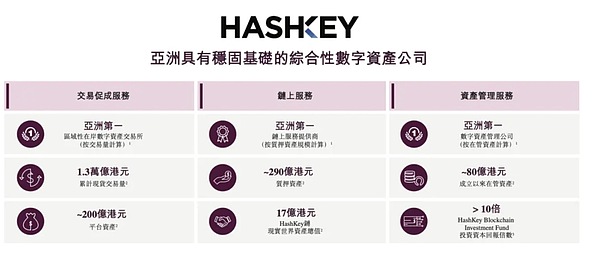
With the implementation of regulatory policies in various countries, compliance qualifications have become a core barrier to platform competition.As one of the first institutions in Hong Kong to obtain a virtual asset trading platform license (VDTA), HashKey quickly seized the regional market with its compliance advantages.The prospectus shows that its market share in Hong Kong’s crypto trading market will exceed 75% in 2024, making it the largest local crypto asset platform and the largest regional onshore platform in Asia.Its digital asset exchange has promoted a cumulative spot trading volume of HK$1.3 trillion. From 2022 to 2024, the trading volume soared from HK$4.2 billion to HK$638.4 billion, an increase of more than 150 times in three years, confirming the explosive potential of compliance platforms in areas with clear supervision.
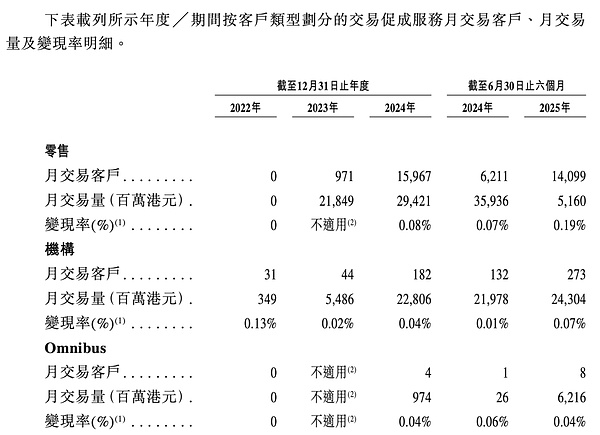
However, from a global perspective, there is a huge gap between regional compliance platforms and traditional leading exchanges.In the first half of 2025, the average monthly trading volume of HashKey’s institutional customers was HK$24.304 billion, and the average monthly trading volume of retail customers was HK$5.16 billion. Compared with leading global platforms such as Binance and OKX, there is still an order of magnitude gap.This pattern of “regional monopoly and global weakness” reflects that the encryption market has entered the “era of compliance fragmentation”. Regional compliance platforms have local advantages, but it is still difficult to shake the status of traditional leading platforms in terms of global financial attraction and user base.This pattern of “regional monopoly and global weakness” confirms that the encryption market has entered the “era of compliance segregation.”
2. Income depends on trading business, and the risk of market cycle fluctuations is highlighted.
Although HashKey has built three major business segments: “transaction facilitation + on-chain services + asset management”, its revenue structure is highly dependent on the transaction business.In the first half of 2025, transaction facilitation service revenue accounted for 68%, and this business has turned from a loss to a profit – jumping from a loss of HK$14.915 million in 2022 to a profit of HK$518 million in 2024.
But this dependence also makes its performance deeply tied to the market cycle.During the bull market in 2024, its revenue surged 247% year-on-year; in the first half of 2025, the market was sluggish, with transaction volume plummeting from HK$347.6 billion to HK$214.1 billion in the same period last year, and revenue subsequently dropped 26% year-on-year.What deserves more attention is the high sensitivity of retail customers: in the first half of 2025, the monthly trading volume of retail customers fell from HK$35.936 billion to HK$5.16 billion, a drop of more than 85%, while the monthly trading volume of institutional customers increased from HK$21.978 billion to HK$24.304 billion, becoming a “stabilizer” in market fluctuations.This reveals that retail investors are the “amplifiers” of market sentiment. Bull markets flock to the market and bear markets leave quickly, which also exposes the platform to the risk of “depending on the weather.”
3. The trend of institutionalization deepens, and staking and RWA become new growth engines
The encryption market is accelerating from “retail-led” to “institution-driven”. HashKey’s user data clearly shows this change: institutional monthly trading customers increased from 31 in 2022 to 273 in the first half of 2025, Omnibus customers (accessed through partners) expanded from 1 in the first half of 2024 to 8, and the proportion of institutional customer trading volume increased to 68% in the first half of 2025.
At the same time, institutional demand is also driving the market’s transformation from “transaction-driven” to “service-driven”, with staking and real-world asset (RWA) tokenization becoming new growth engines.As of September 2025, HashKey’s pledged assets have reached HK$29 billion, ranking first in Asia and the eighth largest pledge service provider in the world. The independently developed HashKey Chain has achieved HK$1.7 billion in RWA token issuance, covering real estate, supply chain finance and other fields.The pledge service provides stable passive income and is the core of attracting money in the bear market; RWA connects traditional finance and encryption ecology, opening up a new market space.
2. Judgment of the four major future trends of the encryption market
Based on the characteristics revealed in the HashKey prospectus, combined with global regulatory and technological trends, four major judgments can be made about the future of the encryption market.
1. Compliance is irreversible, and regulatory differences intensify market differentiation.
The rise of HashKey proves that compliance is the “moat” for the long-term development of the industry.In the future, the compliance process of the global encryption market will accelerate. More countries and regions will learn from Hong Kong’s regulatory model and introduce a clear framework. Small platforms without compliance qualifications will gradually be eliminated. Regions with clear regulations such as Hong Kong and Singapore are expected to become regional crypto asset hubs.
However, differences in regulatory policies will intensify market differentiation. China’s central bank recently reiterated its ban on virtual currency speculation transactions and restricted the participation of mainland customers; the U.S. SEC continues to strengthen supervision of encryption platforms; and the European Union’s MiCA regulations have come into effect.Such differences may increase operational risks for cross-regional operations.
2. Business diversification is the key to breaking through, with RWA and pledge leading new growth
Currently, encryption platforms generally face the problem of a single income structure. HashKey transaction commissions still account for a large proportion of income. This model has high returns in the bull market but weak risk resistance in the bear market.In the future, the focus of industry competition will shift from “transaction volume competition” to “business diversification competition.”
From the perspective of HashKey’s layout, RWA and staking are the two most promising directions.RWA tokenizes traditional assets, lowers investment thresholds and improves liquidity. It is predicted that the global RWA market size may exceed US$10 trillion in 2028, becoming the largest incremental market.The pledge service is the “stabilizer” of the bear market. When HashKey’s transaction volume declined in the first half of 2025, the scale of pledged assets continued to grow.In the future, platforms that can provide high-security, high-yield staking products will have an advantage in the competition.
3. Institutionalization continues to deepen, and the retail market needs to be activated by ecological innovation
Institutional clients have become the dominant force in the market, and the trend will continue to deepen.In the future, the platform will launch more customized custody, block trading algorithms and other services for institutions, and there will be more crypto derivatives to meet the risk management needs of institutions.
In contrast, the transformation problem in the retail market is outstanding.HashKey had 1.4469 million registered users in June 2025, but there were only 138,500 asset customers, and real transaction users accounted for less than 10%. The core reason is that the product threshold is high and the application scenarios are single. Breakthroughs in the retail market require ecological innovation.
4. Be wary of three risks: price, supervision and platform operation
Despite the positive trends in the market, multiple risks remain.One isPrice fluctuation risk, crypto assets still have speculative attributes, and investors need to view return risks rationally.The second isRegulatory policy risks, regulatory rules in various countries are still changing rapidly, and policy tightening may lead to restrictions on platform business and plummeting asset prices.The third isPlatform operation risks, HashKey, as a regional leader, has not yet achieved profitability. If the capital chain is broken during the market downturn, it may face an operational crisis.When investors choose a platform, they need to take into account both compliance qualifications and financial status.
write at the end
HashKey’s prospectus is the epitome of the encryption industry’s transition from “barbaric growth” to “standardized development.”Nowadays, the crypto market is no longer a playground for retail investors to speculate, but has gradually become a new battlefield for institutional layout. Compliance, institutionalization, and diversification are reshaping the underlying logic of the industry.For investors, participating in the market requires more rational judgment, not only seeing the growth potential in new directions, but also being wary of various risks;For practitioners, compliance qualifications and business innovation are core competitiveness.The crypto market is still in its early stages of development, and challenges and opportunities coexist. Only participants who respect regulation, value risks, and continue to innovate can seize the dividends of industry development.