 jakiro
Author: James Butterfill, Source: CoinShares Research, Compiler: Shaw Bitcoin Vision
In the past two years,Digital Asset Treasury (DAT) companies have become one of the most talked about sectors in the cryptocurrency market.Since CoinShares operates a blockchain stock index, this is a topic we often dive into.As the DAT sector and its credibility grow rapidly, its positioning becomes increasingly blurred.The recent market correction has put pressure on some large DATs, so weIt is necessary to re-examine the original intention and development history of DAT, as well as what the recent market downturn and shrinking net asset value mean for its future development.
The original intention and core positioning of DAT
To understand the current situation, we need to look back at the original motivations for creating DAT.DAT’s core goal is to serve multinational companies with multiple currency sources of revenue and the need to manage capital and foreign exchange risks..For these companies, Bitcoin offers an attractive hedge against the risks of quantitative easing, rising government debt, and longer-term currency devaluation.Adding Bitcoin to the balance sheet is not speculation, but a money management strategy, as evidenced by Strategy’s first announcement in August 2020.It also coincides with growing interest among businesses in distributed ledger technology and the efficiencies that can be achieved by integrating blockchain infrastructure into existing operations.
Strictly speaking, DAT simply refers to companies that hold Bitcoin or other crypto assets on their balance sheets.The market has gradually set an implicit threshold: publicA company must hold a significant proportion of cryptocurrency (generally above 40% of net asset value) to be classified as DAT.As cryptocurrency purchases accelerate and valuations soar, they often obscure a company’s core business.Strategy is the most obvious example:What started out as a move to diversify your funds actually turned into a leveraged Bitcoin investment vehicle.Many new entrants have followed a similar approach, issuing shares not to develop their business but to accumulate more digital assets.Over time, however, this has eroded interest and funding inflows into the field, while also raising questions about the sustainability of these strategies.Subsequently, these companies began to use various financing channels as much as possible to rapidly increase the number of cryptocurrency holdings, hoping that rising prices would make up for the lack of growth in their core businesses.
DAT behavioral logic and challenges under market correction
The recent cryptocurrency market correction has exposed these structural flaws.Several factors contributed to this decline, including the lack of a solid operating business to support its money management strategy, the shift of funds to other blockchain-related stock investments (such as mining operations), and the overall decline in cryptocurrency prices.For many of these companies, their traditional businesses are loss-making, which may bring some selling pressure, although these selling pressures are generally small relative to their digital asset holdings.Bitmine (BMNR) is a case in point: In its last fiscal quarter, the company had operating cash outflows of just $5 million, while its Ethereum (ETH) reserves were worth over $10 billion.Japan-based Metaplanet’s operating cash flow is similarly minuscule compared to its $2.7 billion worth of Bitcoin holdings.
On the other hand,Dividend and interest payments may lead to more pressing need to sell, especially when liquid legal currency resources are scarce.However, most DATs are financed by issuing shares and have relatively low debt loads.The only exception is Strategy, which has $8.2 billion in outstanding debt and issued $7 billion in dividend-paying preferred stock.Strategy’s liabilities generate annual cash flow commitments of approximately $800 million, which the company has funded through further financing.To allay concerns about its solvency, Strategy once again used its issuance-to-market (ATM) mechanism to issue $1.4 billion in reserves to pay preferred stock dividends and interest.DAT companies will use every available means to avoid selling their digital asset reserves, and so far the major DAT companies we follow have not made any large sales this year.
However, the question remains: What happens when mNAV (market capitalization to net asset value) falls below 1x?Contrary to what most people think, the situation is not completely hopeless.Companies holding cryptocurrencies can still boost their cryptocurrency holdings per share by reversing their accumulation strategies.In this case, the company sells cryptocurrency and buys back shares, thereby increasing its per-share token holdings.While this approach makes sense, we believe that management teams struggling to scale their operations are unlikely to proactively reduce their cryptocurrency holdings, which could lead to stagnant growth in their holdings until funding conditions improve.Finally, companies that trade below their cryptocurrency net asset value may become attractive acquisition targets, as deeper-pocketed businesses may view them as a way to acquire digital assets below cost.
Has the DAT bubble burst?
In many ways, it is.Many of these companies were trading at 3, 5 or even 10 times their net asset value in the summer of 2025, and are now hovering at 1x or even lower.Next, the market direction will diverge:Either the price drop triggers disorderly selling, leading to a market crash, or companies continue to hold assets and wait for prices to recover.We prefer the latter, especiallyGiven the improving macroeconomic backdrop and the potential for a rate cut in December, this will support the cryptocurrency market more broadly.
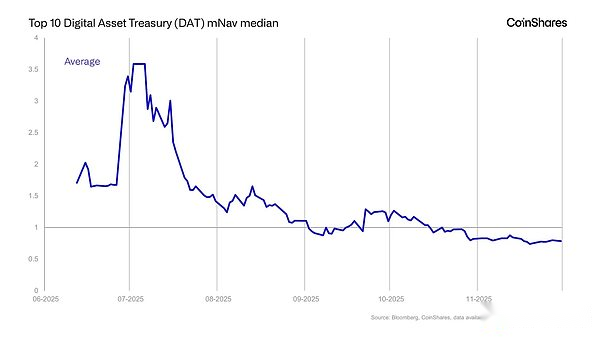
However,In the long term, the DAT model needs to evolve and change.Investors will be less tolerant of dilution and high concentration of assets without substantial revenue streams.The original intention of high-quality companies to diversify fiat risk has been overshadowed by a large number of companies using the public stock market to build huge assets rather than develop real businesses, which has undermined the credibility of the entire industry.
Encouragingly, a group of stronger companies are beginning to include Bitcoin on their balance sheets for strategic purposes.However, under the current informal definition, these companies should not be considered DAT at all.Ironically, companies that best fit the original intent of the currency hedging/FX management strategy model, such as Tesla, Trump Media Group, and Block Inc, are currently excluded from this label.
The future direction of the DAT concept
The bursting of the DAT bubble does not mean the end of the DAT concept.Instead, we expect a market readjustment.Investors will increasingly distinguish between:
-
Speculative DAT: The core business is secondary and its value depends almost entirely on token holdings.
-
Asset reserve-oriented DAT: Use Bitcoin or other digital assets as part of a serious foreign exchange and treasury strategy.
-
Token investment company: A business holding a diversified portfolio of tokens, likely similar to a closed-end fund rather than a traditional company.
-
strategic enterprise: Adding Bitcoin to the balance sheet as a macro hedge but not seeking to be classified as a DAT.
The past year has shown that the word “DAT” can mean everything and nothing at the same time, so the industry will move toward clearer classification.
Conclusion
DAT was born from a reasonable concept:Companies diversify their capital reserves from fiat currencies to digital assets.However, rapid expansion of token reserves, dilution, and the pursuit of growth in the number of tokens per share at all costs have undermined this original intention.As the bubble bursts, the market is re-evaluating which companies truly fit the DAT model and which are just riding the wave.
The future of DAT lies in returning to basic principles:Rigorous financial management, a solid business model, and realistic expectations about the role of digital assets on corporate balance sheets.The next generation of DAT companies will be closer to the model originally envisioned: stable, global businesses that use digital assets strategically rather than speculatively.