
 jakiro
Author: YQ, in-depth researcher of encryption infrastructure; Translation: xz@bitchainvision
In 1994, Marc Andreessen made a major mistake that he would later admit: Netscape failed to embed payments into the browser.Due to regulatory risks and the conservative attitude of financial institutions, the cooperation between Netscape and Visa, and Microsoft and Mastercard ultimately failed.This has resulted in the Internet’s default business model being dominated by the advertising surveillance system for thirty years—a trillion-dollar industry built on all-round behavioral tracking rather than direct value exchange.
Today, AI agents are breaking this balance.Autonomous systems won’t watch ads, can’t be psychologically profiled, and have no monetizable attention.Content publishers face a binary choice: either allow parasitic crawling that destroys creative incentives, or establish a direct payment mechanism.The x402 protocol is the most reliable attempt to activate the dusty “402 Payment Required” status code in the HTTP standard. By combining blockchain settlement and cryptographic authorization, it reshapes the value exchange paradigm for the AI era.
The time seems ripe.The blockchain infrastructure has been improved: the Layer 2 network achieves hierarchical transaction costs and sub-second finality, and the circulation of stablecoins on more than 20 chains exceeds US$42 billion.Google’s A2A agreement more clearly plans the intelligent ecosystem of “service payment and charging”.However, after in-depth study of the v1 specification, v2 revision proposal and early ecological progress, we found thatIts architecture has fundamental limitations, and it may be difficult to achieve large-scale application without major adjustments..
This article carries out a systematic critique based on distributed system principles, payment protocol economics and actual deployment cases, and then proposes an architectural transformation plan to support Internet-level deployment.
1, understandx402Architecture
The protocol utilizes the EIP-3009 transferWithAuthorization() mechanism to implement stablecoin transfers without gas fees.The client constructs a cryptographically signed authorization certificate that allows a third party (i.e., the relay party) to perform transfers on its behalf.
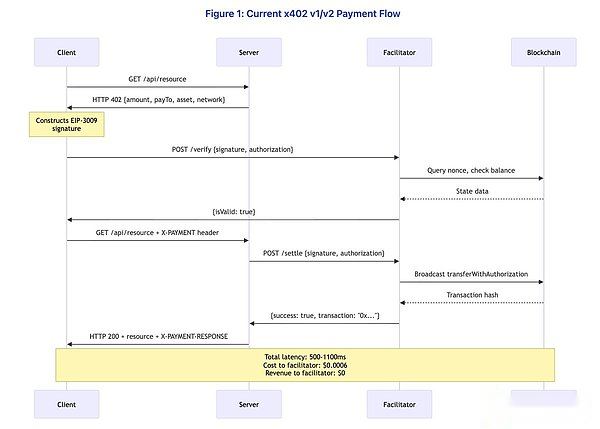
Key observations:The design enables cryptographic payment verification without requiring merchants to handle private keys or directly manage blockchain infrastructure.Settlement takes place on networks such as Base (Ethereum L2), with finality of approximately 200 milliseconds and gas cost of less than $0.0001.The protocol appears simple and elegant, but this superficial simplicity masks several profound architectural issues that only become apparent under closer inspection.
2, several architectural issues that were covered up
Problem 1: The relayer’s economic model is flawed
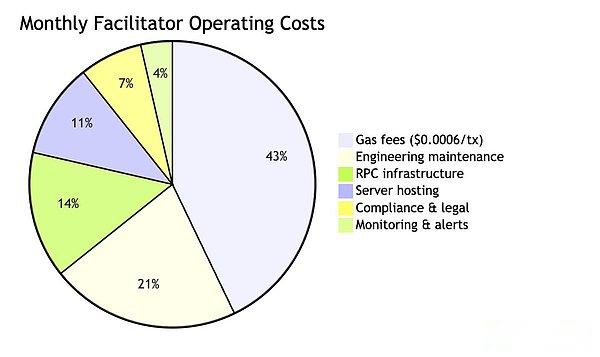
The relay party assumes three functions: EIP-3009 signature verification, blockchain transaction broadcast, and API infrastructure provision.However, the protocol layer does not provide any economic compensation mechanism.Let’s calculate the costs precisely:
Coinbase’s CDP relay party currently implements free service fees for USDC transactions on the Base chain.Each transaction consumes approximately US$0.0006 in gas fees from the relay party.When processing 1 million transactions per month, the gas cost alone will reach US$600 (excluding servers, RPC nodes, monitoring systems, compliance expenses and engineering maintenance costs).Relay parties lack cost recovery pathways at the protocol level.
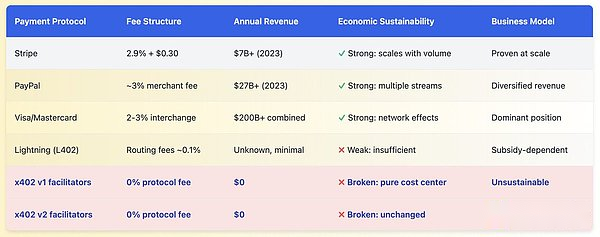
Key findings:Compared with all successful payment protocols in the history of the Internet, Stripe charges 2.9% + $0.3 per transaction, PayPal charges about 3% merchant fees, and the credit card network obtains 2-3% revenue through merchant discount rates.These protocols capture value because they create value, establishing sustainable business models that scale with transaction size.The x402 relay party provides real value, but cannot obtain any value in return.
Problem 2: The two-stage settlement mechanism causes delays and atomic failures
The current architecture requires two separate blockchain interactions:Verification phase(check signature validity and nonce status) withsettlement stage(Perform the actual transfer).This design introduces both performance penalties and correctness issues.
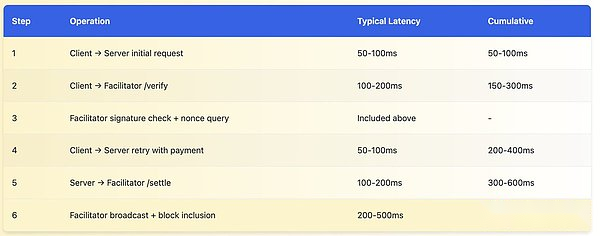
The delay of a single request of 500-1100 milliseconds is acceptable, but in actual application scenarios it will produce an exponential superposition effect:
independent research agencyFetching data from 100 x402 protected APIs: payment overhead accumulates 50-110 seconds;
trading robotPosition updates via 50 real-time data sources: Latency accumulates 25-55 seconds;
AIAssistantCalling 20 tools in a conversation: Interaction latency increased by 10-22 seconds.
Violates core principles of distributed systems:This is not a hypothetical concern, but an inevitable result of splitting atomic operations (payments) into a two-phase protocol.Distributed systems research has made it clear since the 1970s that two-phase protocols are inherently fragile in the presence of atomic schemes.Two-phase commit (2PC) in the database world has well-proven its vulnerability to coordinator failures.x402 must avoid repeating the mistakes of the past.
Question three:EIP-3009Exclusivity fragments the token ecosystem
The protocol mandates the use of the EIP-3009 transferWithAuthorization() method for payment settlement.In principle, this allows any EIP-3009 compliant token to be x402 compatible.However, the reality is that the number of tokens that meet this criteria are far fewer than economically relevant stablecoins.
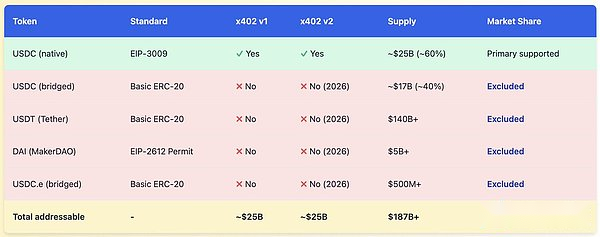
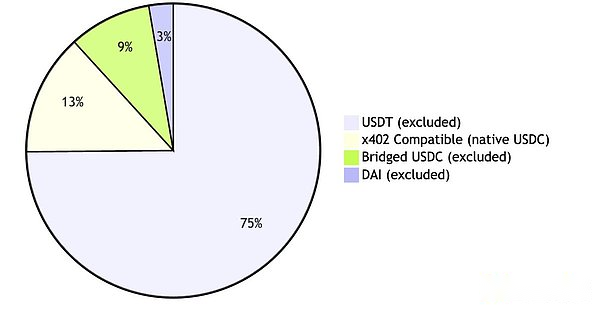
this meansx402 v1version with its primary target coin40%There are compatibility issues with the varieties.The compatibility situation of other stablecoins is even more severe: Tether (USDT), as the largest stablecoin with a circulation of over 140 billion US dollars, has never supported the EIP-3009 standard and has no relevant plans.DAI stablecoin adopts the EIP-2612 licensing standard. Although the functions are similar, the interface differences lead to incompatibility at the protocol layer.
Problem 4: Multi-chain support is not worthy of its name
The protocol specification claims that x402 supports “Base, Solana, and any EVM network via self-hosted relays”, seemingly with chain-agnostic flexibility.However, a closer look at the implementation details reveals that its multi-chain support capabilities are far lower than what is claimed on the surface.
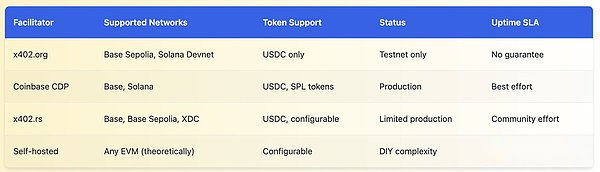
Each relayer supports a different subset of the network, and there are differences in configuration requirements, token lists, and operational maturity.The protocol lacks a discovery mechanism for clients to query “which chains this merchant supports.” The server can only specify a single network in the 402 response, forcing the client to either have funds on a specific chain or abandon the transaction.
Problem 5: The relay party is actually an unnecessary middle layer
We need to look at the basic premise of this architecture: why is a relay necessary in the design?Traditional explanations are questionable.
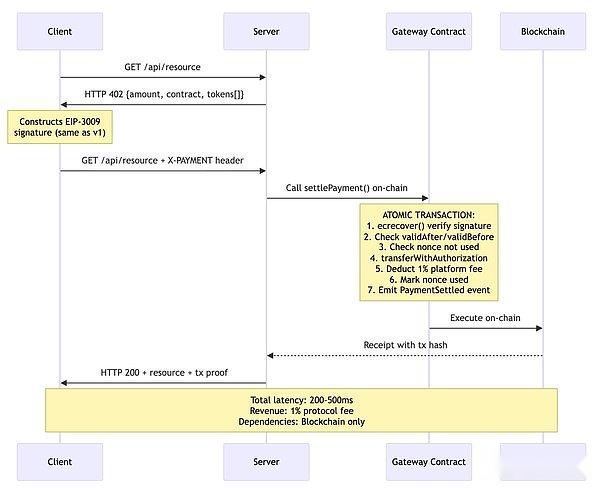
This alternative design has multiple advantages:
Atomicity:Verification and settlement are completed in a single on-chain transaction;
Latency reduction:Reduce one network round trip (200-500 milliseconds vs 500-1100 milliseconds);
Reliability:There is no need to rely on the relay party’s online status or API availability;
Economic sustainability:The protocol fee (1% platform fee) is directly deducted from the chain;
Transparency:All settlement logic is auditable on-chain.
3,v2Proposal: Improvements and legacy issues
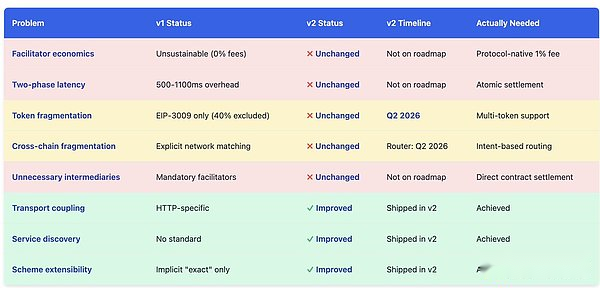
The x402 team has released the v2 specification branch in an attempt to address some v1 limitations through “transport layer-independent redesign.”After reviewing the v2 update log, roadmap and specification documents, the author believes that although v2 has achieved incremental improvements, it has failed to solve the above-mentioned fundamental architectural problems.
v2Major updates:
Transport layer abstraction: split the protocol into type (data structure), logic (scheme) and presentation layer (HTTP, MCP, A2A);
Solution scalability: Standardize the “accurate billing” solution and support new models (based on usage, commercial authorization, etc.);
Service discovery mechanism: Added Bazaar API to retrieve resources that support x402.
v2Main remaining issues that have not been improved:
Follow the relay party architecture (client→relay party/verification→relay party/settlement→merchant);
Maintain a zero-fee economic model (the relay party still has no income);
The two-stage settlement model is retained;
Insist on EIP-3009 exclusivity (token support postponed to Q2 2026);
Continue explicit network matching (no cross-chain abstraction layer);
Relay party intervention is still mandatory.
4, conditions required to achieve internet-scale adoption
Based on thirty years of research on distributed systems and payment protocols, I have summarized the following architectural principles:
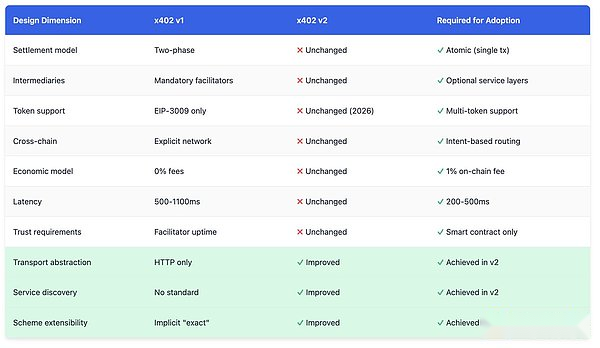
Economic sustainability driven by protocol fees:1% settlement fee is deducted on the chain to generate continuous income;
Atomic settlement through smart contracts:A single on-chain transaction eliminates race conditions;
Token Flexibility:Simultaneously supports EIP-3009, EIP-2612 license and standard ERC-20;
Chain abstraction:Implement intent-based routing through Circle CCTP and Across protocols;
Minimize trust dependencies:A direct settlement mechanism without forcing the intervention of relay parties.
5, conclusion
x402 v1 has made a substantial breakthrough in solving this problem that has plagued the industry for thirty years.Thanks to the maturity of blockchain infrastructure, micropayments have become economically feasible.The rise of the agent economy has created an urgent need for machine-native payment protocols.Coinbase’s endorsement and integration with Google A2A provide institutional-level credibility to the protocol.Its basic technical path (HTTP 402 status code + blockchain settlement + cryptographic authorization) has solid design rationality.
However, good intentions and corporate endorsement do not guarantee the success of an agreement.The relay party model creates an unsustainable economic system in which critical infrastructure suffers permanent operating losses.The delays and atomic failures caused by the two-stage settlement architecture could have been avoided through an atomic solution.The exclusivity of EIP-3009 has fragmented the token ecosystem, not only excluding 40% of the USDC circulation, but also shutting out almost all competitive stablecoins.Multi-chain support only remains on the surface, but directly exposes the fragmentation problem of blockchain to end users.In scenarios where direct settlement by smart contracts can provide better features, the relay party actually plays the role of an unnecessary middle layer.
Although the v2 proposal has made improvements in transmission abstraction, service discovery mechanism and solution scalability, it does not touch on core issues such as relay party economic model, two-stage settlement, token restrictions and cross-chain fragmentation.The roadmap delays key fixes until the second quarter of 2026.An autonomous Internet requires an autonomous payment system—x402 v1 demonstrates technical feasibility. Although v2 has achieved progressive optimization, it still has a long way to go before truly meeting demand.