 jakiro
Introduction: Credit Rating System and the Current Situation in the United States
Credit rating is an important tool in the international financial system to assess the solvency of sovereign countries, and is responsible for the three major rating agencies – Standard & Poor’s (S&P), Moody’s (Moody’s) and Fitch (Fitch).These agencies divide ratings into multiple levels, of which AAA (or Aaa) is the highest level, indicating that the borrower has a strong ability to repay debts and has almost no default risk.The rating results directly affect the country’s borrowing costs, investor confidence and global financial status.For the United States, as the world’s largest economy, credit ratings are not only a barometer of fiscal health, but also a symbol of its role as a global financial anchor.
However, the United States has gradually lost its former “gold standard” status.In August 2011, S&P lowered the long-term sovereign credit rating of the United States from AAA to AA+ for the first time, citing the debt ceiling crisis caused by political deadlock and the lack of a credible long-term debt relief plan.Afterwards, on August 1, 2023, Fitch lowered the rating from AAA to AA+, blaming irresponsible fiscal policy, lack of cooperation between political parties, and declining governance effectiveness.On May 16, 2025, Moody’s further downgraded the rating from Aaa to Aa1. This is the first time that the three major agencies have all divested the top US ratings.Moody’s emphasized that the U.S. debt burden has risen to 98% of GDP, and net interest expenses are expected to reach US$950 billion in fiscal year 2025. Political differences have exacerbated the difficulty of fiscal adjustment.
As of December 2025, the total U.S. national debt has reached $38.4 trillion, equivalent to approximately 119.4% of GDP.This scale not only set a new historical record, but also triggered market concerns: Is further rating downgrade inevitable?Expert analysis shows that if the fiscal deficit continues to expand between 2026 and 2027, the debt/GDP ratio may exceed 130%, and rating agencies may take action again.Based on the latest data and expert opinions, this article analyzes the causes of U.S. debt, the impact of rating downgrades, and potential solutions, aiming to reveal the profound impact of this crisis on the economy and society.
Historical Review: From AAA Peak to Multiple Downgrades
The evolution of the U.S. credit rating reflects long-term imbalances in its fiscal policy.As early as 1917, Moody’s gave the United States an Aaa rating for the first time. For nearly a hundred years since then, the United States has maintained its top rating by virtue of its strong economic size, the U.S. dollar’s reserve currency status and sound institutions.The three major institutions have a combined market share of about 95%. Although their rating standards are slightly different (for example, Moody’s pays more attention to the expected value of default), they all emphasize debt sustainability, political stability and economic growth.
The turning point came in 2011.At that time, fierce debate in Congress over the debt ceiling led to a “last-minute” agreement, which S&P saw as a signal of governance failure and downgraded its rating.Since then, the debt/GDP ratio has climbed from about 100% in 2011 to 122% in 2023, with Fitch specifically citing “fiscal deterioration” and “recurring debt ceiling crises” in the downgrade.In November 2023, although Moody’s did not immediately downgrade, it adjusted the outlook to negative, warning that divisions in Washington hindered responsible management.
The landmark event of Moody’s downgrade in 2025 is more warning.The rating was downgraded from Aaa to Aa1, and the outlook changed to stable, but Moody’s emphasized that debt/GDP is expected to reach 156% in 2035, and interest expenses will exceed US$1.8 trillion.This adjustment ended the century-old era of top ratings in the United States and triggered fluctuations in the bond market: the 10-year Treasury bond yield once touched 4.6%, and the 30-year Treasury bond yield exceeded 5%.Historical data shows that each downward revision is accompanied by short-term market turbulence, but the long-term impact depends on the policy response.After the S&P cut in 2011, the Dow Jones plunged 6%, but the Fed intervened to stabilize the situation.The Fitch cut in 2023 is relatively mild, and the market regards it as a “priced” risk.Now, all three agencies have made downward adjustments, and combined with political events in 2025 (such as the debt ceiling increase of US$5 trillion in July), the probability of further downward adjustments has risen to a high level.
Current data: Debt size and interest burden surge
The core of the U.S. debt crisis is the out-of-control scale and rigid interest payments.As of December 3, 2025, total public debt reached US$38.4 trillion, an increase of US$2.23 trillion over the same period last year, with an average daily increase of US$6.12 billion.Among them, debt held by the public is approximately US$30.77 trillion, accounting for approximately 100% of GDP.This level has exceeded the peak after World War II. The Congressional Budget Office (CBO) predicts that if current policies are maintained, debt/GDP will reach 134% in 2035.
Interest payments are the “hidden killer” of debt.Net interest expenses in fiscal year 2025 will reach $970 billion, accounting for 19% of federal revenue, equivalent to a burden of $7,300 per household.Historical comparisons show this figure soaring from $345 billion in fiscal 2020 to $881 billion in 2024, with another 10% increase in 2025.Federal revenue will be $5.23 trillion in fiscal year 2025, and interest payments have exceeded defense ($917 billion) and Medicaid ($668 billion) combined.The average market-based debt interest rate rose to 3.382%, doubling from 1.635% in 2020.
For visual display, the following table lists net interest payment data for fiscal years 2019-2025 (unit: billion U.S. dollars):
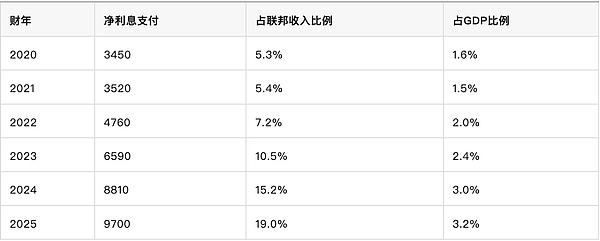
Data source: U.S. Treasury monthly financial reports and CBO projections.
Interest payments have become the second largest item in the budget, after Social Security, squeezing space for education, infrastructure and national defense.In October 2025, interest will exceed science, technology and environmental spending combined.
Debt is caused by various reasons: epidemic stimulus spending, tax reform and revenue reduction, and expansion of aging benefits.The deficit in fiscal year 2025 is US$1.8 trillion, a slight decrease of 2% from the previous year, but it is still high after adjusting for timing effects.CBO predicts that the deficit will reach US$1.7 trillion (5.5% of GDP) in 2026. If the tax reform is made permanent, the cumulative deficit in ten years will increase to US$28.5 trillion.
Political and Institutional Factors: Disagreements Exacerbate Fiscal Loss
The U.S. debt crisis is rooted in political gridlock.The 43-day government shutdown from October 1 to November 12, 2025, became the longest event in history, affecting 1.4 million federal employees without pay and causing an economic loss of US$11 billion.The shutdown comes as Democrats block a Republican temporary appropriations bill to extend Affordable Care Act subsidies, while Republicans insist on cutting non-defense spending.This incident highlights the differences in Congress: Debt ceiling negotiations have repeatedly approached the brink of default. After raising the debt ceiling by US$5 trillion in July 2025, CBO warned that resources may be exhausted in August 2025.
The deeper problem is the lack of long-term planning.The Social Security (OASI) and Disability Insurance (DI) trust funds are expected to be depleted in 2033, at which time benefits will be automatically cut by 23%.The Social Security Equity Act of 2025 accelerates this process and is expected to increase spending by $168.6 million over ten years.The Medicare trust fund is also under pressure, with CBO predicting it will be exhausted by 2034.Political polarization hinders reform: Republicans advocate spending cuts and Democrats emphasize tax increases on the wealthy, but both parties avoid touching core benefits.
In addition, debt is growing faster than the economy: GDP will grow by 1.9% in 2025, but debt will increase by $2.23 trillion.This is not just a matter of numbers, but of behavior: Ratings agencies focus on whether governments demonstrate responsibility, not simply debt levels.
The impact of a rating downgrade: rising borrowing costs and economic knock-on effects
Rating downgrades are not abstract events, but directly push up borrowing costs.Treasury yields serve as a benchmark that affects mortgages, auto loans and business financing.After Moody’s cut in 2025, the 30-year mortgage rate rose to above 7%, and the 10-year Treasury yield reached 4.6%.Experts estimate that each time the rate is lowered, the government’s additional interest payments will increase by tens of billions of dollars, which will be passed on to consumers.
The economic impact is multidimensional: First, growth slows down.High interest rates inhibit investment, and CBO predicts GDP growth of 1.8% in 2026.The second is market volatility: on the day of the downgrade, the S&P 500 fell by more than 1%, and bond prices were under pressure.The third is inflation risk: If the Federal Reserve intervenes in money printing, the depreciation of the US dollar will push up prices, and inflation will reach 3.2% in 2025.
For the people, the impact is more direct.For every 1% increase in mortgage interest rates, annual household expenses increase by $2,000; credit card interest rates have exceeded 20%.Corporate borrowing slows down, hiring decreases, and the employment rate may rise by 0.25 percentage points.At the global level, the status of the United States as a “safe haven” has been shaken, and foreign investors have reduced their holdings of national debt, with the proportion of foreign holdings falling to 25% in 2025.Stanford University finance professor Darrell Duffie warned: “Excessive debt will force Congress to increase revenue or reduce spending, otherwise the economy will be in a quagmire.”
Expert opinion: Probability of further reduction and warning signs
Experts are cautiously optimistic about a reduction in 2026-2027, but the consensus is that risks are high.Moody’s analysts said that if the deficit is not controlled, Aa1 may further drop to A1.David Wessel, a senior fellow at the Peterson Institute for International Economics, believes: “The downward adjustment is a wake-up call. If the political deadlock continues, the market will punish the United States.” Former Federal Reserve Governor Ben Bernanke reiterated: “The debt threshold is unknown, but the rapid rise has endangered prosperity.”
Optimists such as UBS economists point out that the U.S. system is highly resilient and the hegemony of the U.S. dollar can cushion the impact.But the CSIS report warns: Debt may erode global leadership, with interest payments reaching $1.8 trillion in 2035, squeezing defense and diplomacy.A model from the Wharton School of the University of Pennsylvania shows that without reform, the tax burden of future generations will increase by 10-15 percentage points.Generally speaking, experts regard the downward adjustment as a “controllable but inevitable” signal and call for cross-party action.
Solution Discussion: Tradeoffs and Challenges of Three Paths
Three paths are needed to repair the debt: spending cuts, tax increases or monetary financing, each with its own bottlenecks.
First, spending cuts are politically tricky.The One Big Beautiful Bill Act of 2025 promised $2 trillion in cuts, but only partially achieved it, with student loan reform saving $131 billion.Welfare programs such as social security account for 40% of expenditures and will lose votes if touched.CBO estimates that the ten-year deficit needs to be reduced by US$1.3 trillion to stabilize debt/GDP.
Second, tax increases are common proposals targeting the wealthy.In 2025, the total wealth of the Forbes 400 richest people is 6.6 trillion US dollars, and the top 100 people have more than 3 trillion US dollars (Elon Musk 428 billion, Jeff Bezos, etc.).However, the wealth of the first 100 people expropriated was only US$3 trillion, far less than the debt of US$38.4 trillion, and the annual deficit was US$2 trillion.Making the tax reform permanent may increase the deficit by 4.5 trillion.The Democratic plan emphasizes progressive taxation, while the Republican opposition calls it stifling growth.
Third, printing money is the easiest, but the riskiest.If the Federal Reserve intervenes, inflation may rise by 0.4%, and a weakening dollar will exacerbate inequality.History shows that quantitative easing in 2020 pushed up asset bubbles.
In summary, experts recommend a mixed path: gradual reform of social security (such as gradually raising the retirement age) and expansion of the closed-door tax base.The CRFB model shows that the 3.82% wage gap in 75 years needs to be closed.However, the political window is narrow, and the 2026 midterm elections may be a turning point.
Conclusion: Rebuilding fiscal sustainability from crisis
The U.S. debt crisis is not bankruptcy tomorrow, but a gradual recession: interest rates eat up the budget, political gridlock amplifies risks, and rating downgrades portend higher costs.38.4 trillion in debt, 970 billion in interest, and social security will be exhausted in 2033—these data warn that fiscal failure will be passed on to the people, pushing up mortgage loans, inhibiting growth, and eroding the hegemony of the U.S. dollar.
However, sustainability is not impossible.Social Security reform resolved a similar crisis in 1983, and a similar consensus is needed today: a cross-party committee, progressive tax reform, and spending caps.Rating agencies are not enemies, but mirrors that reflect needed changes in behavior.Otherwise, the reduction in 2026-2027 will become a reality, and the economic cost will be borne by generations.Policymakers must act to restore the United States’ credibility as a global financial beacon to avert danger.