 jakiro
Deng Tong, Bitcoin Vision
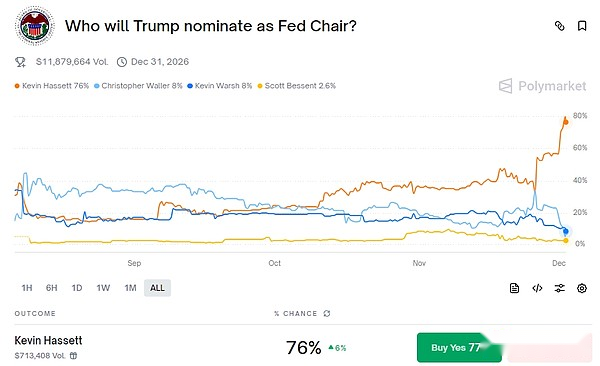
On November 30, Hassett, director of the White House National Economic Council, said that if US President Trump nominates him to serve as chairman of the Federal Reserve, he “will be very happy to serve.”According to Polymarket data, Hassett’s probability of being elected chairman of the Federal Reserve has risen to 76%.
Who is Hassett?Will it have a positive impact on the crypto industry after taking office?Will the Fed’s independence be affected?What impact will it have on the future economy?
1. Hasset himself
Hassett is the director of the White House National Economic Council and an American economist.He served as senior advisor and chairman of the Council of Economic Advisers from 2017 to 2019.During Trump’s first term, Hassett served as the 29th Chairman of the Council of Economic Advisers from September 2017 to June 2019.
Hassett joined the American Enterprise Institute (AEI) in 1997 as a resident scholar.His research areas include tax policy, fiscal policy, energy issues and stock market investments.He has collaborated with R. Glenn Hubbard on budget surpluses, income inequality, and tax reform.Hassett has published papers and articles on capital taxes, tax policy coherence, energy efficiency investment returns, corporate tax, telecommunications competition, tax effects on wages, dividend tax and carbon tax.
In 2003, Hassett was appointed director of economic policy research at the American Enterprise Institute (AEI).Hassett has written columns for newspapers including The New York Times, The Washington Post and The Wall Street Journal.He writes a monthly column for National Review and, since 2005, a weekly column for Bloomberg.
In November 2024, after Trump won the election, Trump announced that Hassett would serve as director of the National Economic Council (NEC).Politico magazine reported that Hassett “will take on broader responsibilities, becoming the president’s senior adviser on economic affairs and playing a key role in coordinating policy and strategy across government departments.” In January 2025, at the beginning of Trump’s second term, Hassett officially took over as director of the National Economic Council.
In October 2025, U.S. Treasury Secretary Scott Bessent confirmed that Hassett was one of five candidates President Trump was considering to succeed Federal Reserve Chairman Jerome Powell, whose term ends in May 2026.
2. Will Hassett benefit the encryption industry after taking office?
Despite the lack of clear public statements, Hassett is widely considered a supporter of cryptocurrencies.In June, he disclosed that he held at least $1 million in Coinbase shares and was paid at least $50,001 for his role on the exchange’s academic and regulatory advisory committees, giving him unusually close ties to the cryptocurrency industry that are rare for a potential Fed chair.
The National Economic Council (NEC), where he serves as director, oversees the development of the White House Digital Asset Task Force, which earlier this year published a document outlining the administration’s cryptocurrency policy.
The Fed does not regulate securities or commodities, so its policy changes cannot affect cryptocurrency regulation.But a crypto-friendly Fed could still have a positive impact on the industry in multiple ways.
First, lower interest rates generally mean better cryptocurrency prices.Juan Leon, senior investment strategist at Bitwise, said: The impact on the market is “very positive.”He called Hassett an “aggressive ‘dove’ who has publicly criticized current interest rates as being too high and advocated for deeper and faster rate cuts.”
Zach Pandl, director of research at digital asset investment platform Grayscale, said: “From a marginal effect, Hassett’s impact on cryptocurrencies should be viewed as positive news.”
Caitlin Long, founder and CEO of Wyoming-based Custodia Bank and a well-known advocate of crypto-friendly regulations, noted: “If this comes to pass and Hassett does become Fed chairman, the anti-crypto people who are still in senior positions within the Fed will eventually step down (at least most of them). The Fed will usher in major changes.”
The Fed also regulates banks, particularly bank holding companies, access to payment systems, reserve requirements, and liquidity and risk rules.Tightening or loosening these rules could affect cryptocurrency companies’ access to a number of services, including:
-
Cryptocurrency custody;
-
Cryptocurrency-backed loans;
-
Access payment channels;
-
Requirements for stablecoin issuers vis-à-vis banking regulations;
-
Settlement rules.
However, the White House has not yet formally nominated a candidate.Treasury Secretary Scott Bessent announced in late October that Hassett was one of five candidates to succeed Jerome Powell.Other candidates include former Fed governor Kevin Warsh, current Fed governors Christopher Waller and Michelle Bowman, and BlackRock executive Rick Reed.Final nominees are expected to be announced before Christmas.
3. Will the independence of the Federal Reserve be affected?
1. The independence of the Federal Reserve
The independence of the Federal Reserve is mainly based on three institutional arrangements:
1) Independent term of office
-
The terms of the Fed Chairman and Governors are long (4 years for the Chairman and 14 years for the Governors), which is much longer than the presidential term.
-
The president cannot fire the Fed chairman and can only decide whether to renew his term at the end of his term (with rare exceptions).
This prevents the White House from easily applying pressure by removing officials who “disagree with monetary policy.”
2) Financial independence
-
The Federal Reserve operates its own operations, and its income mainly comes from interest on the U.S. Treasury bonds it holds and income from financial operations.
-
It does not rely on congressional appropriations, so neither the executive branch nor the legislative branch can influence their decisions through budgetary means.
3) Independent in decision-making
-
Monetary policy is determined by the FOMC (Federal Open Market Committee).
-
No presidential or Treasury approval is required.
The Council on Foreign Relations has praised the Fed’s independence and said it “protects the Fed from inappropriate political influence, such as White House pressure to lower interest rates before an election, which may provide short-term political gain but cause long-term economic harm.”
The Fed’s independence also “enhances the Fed’s credibility,” giving the market more confidence in its decisions.”Crucially, it also gives the Fed the power to take difficult but necessary actions, even if they are unpopular.”
2. Is Hassett a political loyalist?
But since taking office, Trump has been trying to tighten control of the Federal Reserve to exert greater influence on his preferred monetary policy.
Earlier this year, he tried to fire Fed Governor Lisa Cook.Cook refused to resign, and the case eventually went to the Supreme Court, which has now allowed her to stay in office.In court filings, Cook’s attorney, Abe Lowell, called the attempt a “violent attack on the Fed’s century-old independence.”
Hassett is seen by supporters as a prominent policymaker and, as longtime ally and former Trump adviser Stephen Moore puts it, a “hard currency” expert who will defend the U.S. dollar.However, in the eyes of some former colleagues, as a presidential adviser, he has morphed into something more worrisome: a political loyalist willing to sacrifice agency independence and objective truth to please his boss.
This time, Hassett has emerged as one of Trump’s staunchest economic backers.He noted that if he were in charge of the Fed now, he would “cut interest rates immediately” because “the data shows we should do that.”He also predicted that Trump’s reduction of domestic factory corporate tax rates and the launch of new industrial policies will promote “absolute breakthrough progress” in GDP and employment growth in 2026.
He also echoed Trump’s attacks on the Fed and the statistics it relies on: accusing Fed officials of “putting politics ahead of their duties”; saying the Fed has been “sluggish” in cutting interest rates; and suggesting there was a partisan “pattern” in employment data released by the Bureau of Labor Statistics.When Trump fired Bureau of Labor Statistics Director Erica McEntarver, accusing her of “manipulating” data, a smiling Hassett went on television to describe the move as motivated by accuracy and procedural concerns.
Hassett has become a regular on cable news, defending Trump’s policy priorities, downplaying adverse data and echoing the White House’s stance on everything from inflation to the legality of federal statistics.In early November, the National Economic Council director insisted that inflation had come down “significantly” and that price trends were “very good” despite official data showing the consumer price index had risen for five consecutive months.
The selection of Hassett “seems to be a move about loyalty, with Trump believing that nominating Jerome Powell eight years ago was a huge mistake,” wrote Bloomberg senior markets editor and columnist John Authers. Waller, Wash and Riedel are all likely to establish their independence from the administration in different ways.
George Pollack, senior U.S. policy analyst at Signum Global Advisors, said Trump nominated Hassett “because he believes Hassett is the candidate most likely to support the priorities of this administration.”
If the Fed becomes just another branch of government, it could be good for the cryptocurrency market in the short term, but it could have disastrous consequences for other areas.Interest rates lower than actually needed may generate cheap political capital, but they can lead to higher inflation.
“Rate rates will be based on well-researched data, not political whims, giving the world confidence that the U.S. economy will remain relatively stable and its markets will remain rational,” the Center for American Progress explains.
4. Impact on the future economy
Jon Hilsenrath, senior advisor at StoneX and former Wall Street Journal Fed reporter, pointed out that the immediate rise in the 10-year U.S. Treasury yield is significant.
He posted on LinkedIn that higher yields indicate bond traders are betting that a Fed led by Hassett may adopt a more dovish policy on inflation, so higher long-term yields are needed to compensate for this risk.While a yield of nearly 4% may seem acceptable, it is actually “unusually low” given that inflation remains above the Fed’s 2% target and the budget deficit is approaching $2 trillion.If bond markets lose confidence in the Fed’s independence, this disconnect could trigger a violent market reaction that could send interest rates soaring.