 jakiro
FusakaThe name comes from the execution layer upgradeOsakaand consensus layer versionFula Starcombination.This upgrade is expected to be activated at 21:49 UTC on December 3, 2025.
This upgrade includes 12 EIPs, coveringData availability,Gas/block capacity,Security optimization,signature compatible,Transaction fee structureetc., is a systematic upgrade to achieve L1 expansion, reduce L2 costs, reduce node costs, and improve user experience.
1. Fusaka’s two core goals: improving Ethereum performance and improving user experience
Goal 1: Significantly improve the underlying performance and scalability of Ethereum
Core keywords:
-
Data availability expansion
-
Node burden reduced
-
Blobs are more flexible
-
Improved execution capabilities
-
A more efficient and secure consensus mechanism
In short: further improve Ethereum performance.
Goal 2: Improve user experience and promote next-generation wallet and account abstraction
Core keywords:
-
Block pre-confirmation
-
P-256 (device native signature) support
-
Helpless word wallet
-
A more modern account system
The essence is: Ethereum is moving closer to the experience of mainstream Internet software.
2. Five key changes in Fusaka
1. PeerDAS: Reduce the data storage burden of nodes
PeerDAS is the core new feature of Fusaka upgrade.Currently Layer2 nodes use blobs (a temporary data type) to publish data to Ethereum.Before Fusaka was upgraded, every full node had to store every blob to ensure data existed.As blob throughput increases, downloading all this data becomes extremely resource intensive and becomes overwhelming for the node.
PeerDAS uses data availability sampling, so that each node does not need to store all data blocks, but only a part of the data blocks.In order to ensure the availability of data, any part of the data can be reconstructed from 50% of the existing data. The reconstruction method can reduce the probability of incorrect or missing data to a cryptographically negligible level.
The implementation principle of PeerDAS: Apply Reed-Solomon style erasure coding to blob data.In the traditional field, DVD also uses the same encoding technology – even if the DVD disc is scratched, the player can still read it; there are also QR codes, even if part of it is blocked, the complete information can still be recognized.
Therefore, through the PeerDAS solution, it can not only ensure that the hardware and bandwidth requirements of the nodes are within an acceptable range, but also achieve blob expansion, thereby undertaking more and larger Layer 2 at a lower cost.
2. Elastically increase the number of blobs on demand: adapt to changing L2 data needs
In order to coordinate a consistent upgrade of all node, client and validator software, which must be carried out in a step-by-step manner, a mechanism for blob-parameter-only forks has been introduced to more quickly adapt to the changing needs of layer 2 blobs.
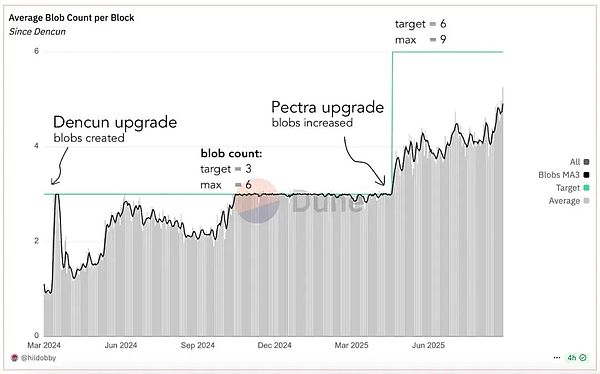
When blobs were first added to the network in the Dencun upgrade it was 3 (max 6), later increased to 6 (max 9) in the Pectra upgrade, and after Fusaka will be able to be added at a sustainable rate without the need for another major network upgrade.
3. Support historical record expiration: reduce node costs
In order to reduce the disk space required by node operators as Ethereum continues to grow, clients are required to start supporting the function of partial history expiration.In fact, the client can already implement this function in real time at any time, but it is just taking advantage of this upgrade that it is clearly included in the to-do list.
4. Implement block pre-confirmation in advance: make transaction confirmation faster
With EIP7917, the beacon chain will be able to sense the next epoch’s block proposer.Knowing in advance which validators will propose future blocks enables pre-confirmation.A commitment is made with the initiator of an upcoming block that guarantees that user transactions will be included in that block without waiting for the actual block to be generated.
This feature benefits client implementation and network security because it prevents corner cases such as validators manipulating proposer schedules.Additionally, lookahead capabilities reduce implementation complexity.
5. Native P-256 signature: Ethereum directly aligns with 5 billion mobile devices
Introduces a built-in passkey-like secp256r1 (P-256) signature checker at fixed addresses, which is the native signature algorithm used by Apple/Android/FIDO2/WebAuthn and other systems.
For users, this upgrade unlocks the device’s native signature and pass key functions.The wallet provides direct access to Apple Secure Enclave, Android Keystore, Hardware Security Module (HSM), and FIDO2/WebAuthn—no mnemonic phrases required, a smoother sign-up process, and a multi-factor authentication experience comparable to modern apps.This will result in a better user experience, easier account recovery, and account abstraction patterns that match the existing capabilities of billions of devices.
For developers, it accepts 160 bytes of input and returns 32 bytes of output, making it very easy to port existing libraries and L2 contracts.It includes point-to-infinity and modulo comparison checks under the hood to eliminate tricky edge cases without breaking valid callers.
3. The long-term impact of the Fusaka upgrade on the Ethereum ecosystem
1. Impact on L2: Capacity expansion enters the second curve.With PeerDAS and Blob quantity increasing on demand, and a fairer data fee mechanism,Data availability bottlenecks are resolved,Fusaka has accelerated the decline in L2 costs.
2. Impact on nodes: Operating costs continue to decrease.Storage requirements are reduced and synchronization times are shortened, reducing operating costs.At the same time, in the long run, it can ensure the sustainable participation of weak hardware nodes, thereby ensuring the continued decentralization of the network.
3. Impact on DApp: More complex on-chain logic becomes possible.More efficient mathematical operation codes and more predictable block proposal schedules are likely to promote high-performance AMMs, more complex derivatives protocols, and fully onchain applications.
4. Impact on ordinary users: Finally, blockchain can be used like Web2.P-256 signature means – no mnemonic words are required, the mobile phone is a wallet, more convenient login, simpler recovery, and natural integration of multi-factor verification. This is a revolutionary change in user experience and one of the necessary conditions to promote 1 billion users to join the chain.
4. Summary: Fusaka is a key link towards DankSharding and large-scale user adoption
Dencun opened the Blob (Proto-DankSharding) era, Pectra optimized execution and the impact of EIP-4844, and Fusaka made Ethereum take a key step in the direction of “sustainable expansion + mobile first”.
TLDR:
This upgrade will include 12 EIPs, mainly including:
EIP-7594: Use PeerDAS to reduce the data storage burden of nodes
This is a key foundation for expanding the data capacity of Ethereum. PeerDAS has built the infrastructure required to implement Danksharding. Future upgrades are expected to increase data throughput from 375kb/s to several MB/s; and directly implement Layer 2 expansion, allowing nodes to efficiently process more data without overwhelming a single participant.
EIP-7642: Launched history expiration function to reduce disk space required by nodes
This amounts to changing the way receipts are handled, removing old data from node syncs, saving approximately 530GB of bandwidth during syncs.
EIP-7823: Set the upper limit of MODEXP to prevent consensus vulnerabilities
This limits each input length of MODEXP cryptographic precompilation to 1024 bytes. MODEXP has been a source of consensus vulnerabilities due to previously unlimited input length.By setting practical limits that cover all real-world application scenarios, the scope of testing is reduced, paving the way for future replacement with more efficient EVM code.
EIP-7825: Introducing a transaction gas limit to prevent a single transaction from consuming most of the block space
This move introduces a cap of 167777216 gas for a single transaction, preventing any single transaction from consuming most of the block space.This ensures a fairer distribution of block space, thereby improving network stability and defense against DoS attacks, and enabling more predictable block verification times.
EIP-7883: Increase the gas cost of ModExp encrypted precompilation to prevent potential denial of service attacks due to underpricing
To address the issue of underpricing operations, the gas cost of ModExp crypto precompilation has been increased.The minimum cost is increased from 200 gas to 500 gas, and the cost doubles for large inputs over 32 bytes.Improve the economic sustainability of the network by ensuring that cryptographic precompilers are priced appropriately and prevent potential denial-of-service attacks caused by underpricing.
EIP-7892: Support elastically increasing the number of blobs on demand to adapt to the changing needs of Layer 2
Adjust blob storage parameters by creating a new lightweight process.Ethereum does not need to wait for a major upgrade to make smaller, more frequent adjustments to blob capacity to adapt to the changing needs of Layer 2.
EIP-7917: Implement block pre-confirmation and improve the predictability of transaction sequence
Currently, validators have no way of knowing who will propose a block until the next epoch begins, which introduces uncertainty to MEV mitigation and pre-confirmation protocols.This change precomputes and stores proposer schedules for future epochs, making them deterministic and accessible to applications.
EIP-7918: Address the block fee market by introducing a blob base fee tied to execution costs
This scheme solves the block fee market problem by introducing reserve prices linked to execution costs.This prevents the block fee market from failing at 1 wei when the second-tier execution cost is much higher than the block cost.
This is critical for L2, ensuring sustainable blob pricing reflects true costs and maintaining effective price discovery as L2 usage scales.
EIP-7934: Limit RLP execution blocks to a maximum of 10MB to prevent network instability and denial of service attacks
Currently, block sizes can be very large, which slows network propagation and increases the risk of temporary forks.This limit ensures that block sizes remain within a reasonable range that the network can efficiently process and propagate.This move improves network reliability and reduces the risk of temporary forks, resulting in more stable transaction confirmation times.
EIP-7935: Increase the default Gas limit to 60M to expand L1 execution capabilities
The proposal proposes increasing the gas limit from 36M to 60M to expand L1 execution capabilities.While this change does not require a hard fork (the gas cap is a parameter chosen by validators), extensive testing is required to ensure the network’s stability under high computational loads.Therefore, including this EIP in the hard fork ensures that this work is prioritized and continued.
This is the most direct way to scale L1 execution capabilities by directly increasing overall network throughput by allowing more calculations per data block.
EIP-7939: Add CLZ opcode to make on-chain calculations more efficient
This update adds a new CLZ (Count Leading Zeros) opcode to the EVM for efficiently counting the number of zeros at the beginning of a 256-bit number.It can significantly reduce the gas cost of mathematical operations that require bit operations, improve computing efficiency, and enable more complex on-chain calculations; this can enable cheaper and more efficient mathematical operations, benefiting DeFi protocols, game applications, and any contracts that require complex mathematical calculations.
EIP-7951: Add precompiled secp256r1 curve support to improve user experience
This update adds support for the widely used cryptographic curve secp256r1 (also known as P-256) to Ethereum.Currently, Ethereum only supports the secp256k1 curve for signing, but many devices and systems use secp256r1.This update enables Ethereum to verify signatures from iPhones, Android phones, hardware wallets, and other systems using this standard curve, making it easier to integrate with existing infrastructure.