 jakiro
Written by: 0xjs
Kamino Finance and Jupiter (especially its newly launched Jupiter Lend product) are the two leading DeFi protocols in the Solana ecosystem, focusing on lending and aggregation/liquidity management respectively.
In early December 2025, they erupted into a public debate centered on risk disclosure, product isolation and competitive conduct.This “civil war” has attracted widespread attention in the Solana community, and even forced Solana Foundation President Lily Liu to publicly intervene, calling on both parties to stop fighting each other and instead focus on ecological growth.
Although the dispute is fierce, it has not yet caused major economic losses (Jupiter Lend TVL still exceeds 1 billion US dollars). It is more of a test of ecological trust and transparency.
1. Focus of debate: What are you arguing about?
1. Jupiter Lend’s “zero risk” promotion controversy:
-
Jupiter Lend launches in August 2025 and has grown rapidly to $1 billion in TVL.It promotes that its “vaults” have “isolated risk” and “zero contagion risk” and claims “no cross-contamination” between different trading pairs to attract user deposits.
-
Competitors such as Kamino have accused this of misleading advertising.The actual mechanism uses rehypothecation: user collateral (such as SOL) will be reused across vaults, which means that losses in one vault may indirectly affect others, leading to potential contagion risks.Kamino founder Marius Ciubotariu publicly said this “destroyed confidence in Solana DeFi” and charted the “full cross-asset exposure.”
-
Jupiter COO Kash Dhanda acknowledged that the early statement was “inadequately accurate,” deleted the tweet in question, and promised to update the documentation after the Breakpoint meeting.But they defended it by saying the segregation only refers to the allocation level and that the protocol performed well during the October market crash.
-
Kamino quietly modified its contract to prevent users from directly migrating/refinancing to Jupiter Lend (via Jupiter’s Refinance tool) after borrowing from Kamino.Kamino says this is to protect users from exposing their funds to “under-disclosed risks.”
-
Jupiter founder Luca Netz criticized this as “user-hostile behavior” that violates the open principles of DeFi and may force users into negative APY (annualized yield).The community also accuses Kamino of being “anti-competitive” and similar to traditional banks’ barriers.
-
The Solana lending market TVL is about $5 billion (much lower than Ethereum’s 50 billion), liquidity is tight (TVL continues to decline after the October crash), coupled with the rug pull incident, users are security-sensitive.
-
Kamino has been dominant for a long time (TVL exceeds 2.3 billion US dollars), and Jupiter Lend, as a newcomer, quickly erodes its share (from 0 to 1 billion), triggering concerns about a “vampire attack”.
-
Peripheral influence: Tushar Jain, a partner at Multicoin Capital (an investor in Kamino), added fuel to the fire by calling Jupiter “incompetent or malicious”; Fluid (Jupiter Lend’s backend provider) also got involved in the defense.
2. Kamino’s “blacklist” behavior:
3. Broader background: market competition and ecological pressure:
2. Timeline
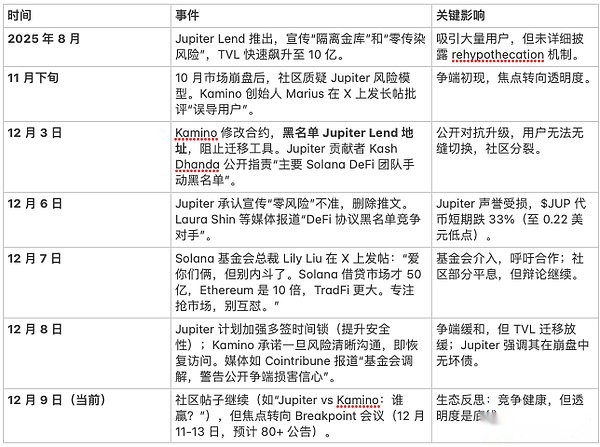
3. Impact and Prospects
-
To users: short-term inconvenience (e.g. migration hurdle), but reminder to DYOR (do your own research).It is recommended to diversify liquidity and avoid a single protocol.
-
To the ecology: Exposing the “growing pains” of Solana DeFi – innovation is fast, but governance relies on social reputation.The foundation hopes to use this to promote clearer risk standards and seize Ethereum/TradFi share.
-
Who “wins”?Currently tied: Kamino strengthens its “safety” image (KMNO up 2.5%), Jupiter fights back with growth and product iteration (e.g., high APY) (JUP rebounds 5%).In the long run, this may lead to better agreements, but if infighting continues, it will scare away institutional funds.
The dispute is the epitome of Solana’s “high growth, low maturity”: fierce competition, but more collaboration.