 jakiro
Shaw, Bitcoin Vision
December 11,The Federal Reserve ended the year with an interest rate cut, lowering the benchmark interest rate by 25 basis points to 3.50%-3.75%., the third consecutive meeting to cut interest rates, in line with market expectations, with a cumulative 75 basis points of interest rate cuts during the year.This time the Federal Reserve’s FOMC statement lowered interest rates at a regular pace, butReveals biggest divisions within voting decision-makers in six years, hints at slower pace of action next year, may not take action in the near future.Federal Reserve Chairman Powell’s press conference speech was later dovish than expected.After the announcement of the Federal Reserve’s decision, major markets around the world had mixed reactions.U.S. stocks, short-term U.S. bonds, and gold rose during the session, while the U.S. dollar fell. Bitcoin fluctuated and once rose to $94,500 during the session, but has since fallen significantly..
The Federal Reserve ended the year by cutting interest rates by 25 basis points, but why are internal differences still intensifying?The dot plot and Powell’s press conference information were more dovish than market expectations. What are the reasons behind this and how to interpret it?Where will the market go in the future?
1. The Federal Reserve has cut interest rates at the end of the year. It is still uncertain whether it can continue next year.
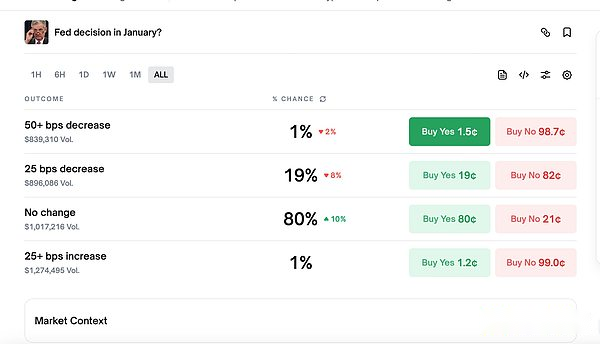
In the early hours of this morning, the Federal Reserve announced its last interest rate decision of the year, lowering the benchmark interest rate by 25 basis points to 3.50%-3.75%. This was the third consecutive rate cut at the meeting, in line with market expectations. A total of 75 basis points have been cut during the year.The subsequent FOMC statement showed thatFor the first time since 2019, the Fed’s interest rate decision was opposed by three votes, exposed the biggest divisions within voting decision-makers in six years, suggesting a slowdown in action next year and possible inaction in the near future.U.S. interest rate futures show a 78% chance that the Federal Reserve will suspend interest rate cuts at its meeting in January next year, compared with 70% before the FOMC resolution.The latest CME “Fed Watch” shows that,The probability that the Fed will cut interest rates by 25 basis points in January next year is 22.1%, and the probability of keeping interest rates unchanged is 77.9%.The probability of a cumulative 25 basis point interest rate cut by March next year is 40.7%, the probability of keeping interest rates unchanged is 52%, and the probability of a cumulative 50 basis point interest rate cut is 7.4%.Prediction market Polymarket data shows that the market is betting on the Federal Reserve’s interest rate decision in January next year.After the resolution is announcedThe market expects that the probability of keeping interest rates unchanged in January has risen to 80%.The probability of betting on a 25 basis point rate cut has dropped to 19%.
After the interest rate decision was announced, major global asset markets had mixed reactions.U.S. stocks hit a daily high during the session. Near the end of Powell’s press conference, the S&P’s gains narrowed from 1.2% to 0.7%. The two-year U.S. bond yield fell 7.5 basis points on the day. Spot gold rose 0.6%, setting a new daily high and approaching $4,239.Dollar posts worst performance in nearly three months.The U.S. dollar index closed down 0.4%, its biggest drop since September 16.Bitcoin once rose to $94,500, a new daily high, but then fluctuated significantly and fell significantly, briefly falling below $90,000..
At the Federal Reserve’s last interest rate decision of the year, the market had already expected a 25 basis point interest rate cut.But thenInformation such as the FOMC statement and dot plot exposed the growing disagreements within the Federal Reserve, causing the market to have some concerns about the Fed’s next policy path. There are also doubts about whether it can continue to cut interest rates next year..
2. The FOMC statement highlights the intensification of differences, and the dot plot is more dovish than expected.
This time the Federal ReserveThe FOMC statement announced that it will begin purchasing Treasury securities on December 12 and will purchase $40 billion in Treasury securities over the next 30 days..The FOMC statement also announced that it will conduct standing overnight repurchase agreement operations at an interest rate of 3.75%, and conduct standing overnight reverse repurchase agreement operations at an operating interest rate of 3.50%, and set a daily limit of US$160 billion for each counterparty.Maintains adequate levels of reserves by increasing securities holdings in the system’s open market accounts through purchases of Treasury bills and, as necessary, other U.S. Treasury securities with remaining maturities of three years or less.The statement said that inflation has increased from the beginning of the year and is still at a relatively high level.Uncertainty about the economic outlook remains high, with downside risks to employment rising in recent months.In evaluating the need for the magnitude and timing of further adjustments to the target range for the federal funds rate, the Committee will carefully evaluate the latest data, the changing economic outlook, and the balance of risks.
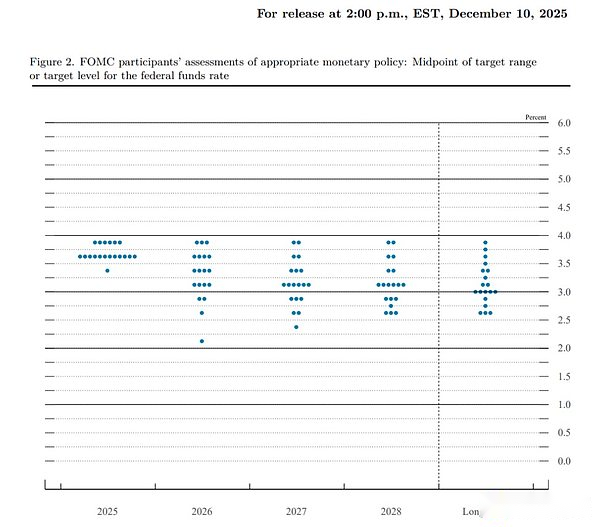
The dot plot chart released by the Federal Reserve after the meeting showed that among the 19 officials, 7 officials believed that interest rates should be cut in 2026, 4 officials believed that interest rates should be cut by 25 basis points cumulatively, 4 officials believed that interest rates should be cut by 50 basis points cumulatively, 2 officials believed that interest rates should be cut by 75 basis points cumulatively, 1 official believed that interest rates should be cut by 100 basis points cumulatively, and 1 official believed that interest rates should be cut by 150 basis points cumulatively.
The FOMC statement showed that for the first time since 2019, the Fed’s interest rate decision received three votes against.Federal Reserve Board Governor Stephen Milan(Stephen I. Miran) continues to advocate for a 50 basis point reduction in the federal funds rate target range at this meeting;Kansas City Fed President Schmid(Jeffrey Schmid) andChicago Fed President Goolsby(Austan Goolsbee) advocated keeping the federal funds rate target range unchanged at this meeting; other FOMC voting committees voted in support of this Federal Reserve interest rate resolution.
The Federal Reserve’s interest rate decision highlighted the biggest disagreement among internal voting policymakers in six years, suggesting that the pace of action will be slowed down next year, which further aroused market concerns about the Fed’s future policy path.
3. Powell’s press conference was more dovish than expected and he intended to stand on the “last duty”
Federal Reserve Chairman Powell subsequently explained the interest rate cut decision and the economic situation at a press conference, and answered reporters’ questions.Powell said available data suggested the outlook remained unchanged.The labor market appears to be gradually cooling and inflation remains high, consumer spending remains solid and data shows the economy is expanding at a moderate pace.Most long-term inflation expectations are consistent with the 2% target.If tariffs were removed, inflation would be in the low 2% range.The Fed is committed to achieving its 2% inflation target, but the labor market is also under pressure.Powell said that the increase in the 2026 growth forecast partly reflects the end of the government shutdown; a large amount of data will be obtained between now and the January FOMC meeting; the baseline expectation is that the economy will grow steadily next year.Powell believes thatAt present, raising interest rates is not anyone’s baseline expectation. The current policy disagreement is whether to keep interest rates unchanged or cut them.
Powell also said there is no zero-risk path for policy and that the balance of risks has shifted in recent months.The Fed has been adjusting towards a neutral interest rate and is currently at the high end of the neutral interest rate range. It has not yet made a decision on January.He emphasized,The Fed will make decisions meeting by meeting, and there is no predetermined path for monetary policy.; The scale of government bond purchases may remain high in the coming months.During the question session, Powell said that when he hands over the job to the next chairman, he wants to leave the economy in a very good state, hopes that inflation will be under control and falls back to 2%, and that the labor market will remain strong.Regarding his personal future, Powell said he has no new plans after his term as Fed chairman expires.
In his final months as Fed chairman, Powell tried to make a smooth transition.As Trump is about to announce his successor, the influence of the “shadow” Fed chairman is increasing day by day. Powell’s statement at this press conference is both expected and a helpless move..
4. How to interpret the Federal Reserve’s resolution
In response to the Federal Reserve’s last interest rate decision of the year,“Fed’s mouthpiece” Wall Street Journal reporter Nick Timiraos wrote an article, Federal Reserve officials cut interest rates for the third consecutive meeting, but there are unusual differences within the Fed over whether inflation or the job market should be the greater concern, so officials signaled that they are not willing to continue cutting interest rates.Public comments from Fed officials in recent weeks have shown that the committee is so divided that the final decision may depend on how Fed Chairman Jerome Powell wants to proceed.Powell’s term expires next May, meaning he will preside over only the next three rate-setting meetings.Firming price pressures are accompanied by a cooling labor market, creating an unpleasant trade-off for the Fed that it has not faced in decades.During the so-called “stagflation” period of the 1970s, when officials faced similar dilemmas, the Fed’s stop-start response allowed high inflation to become entrenched.
State Street analyst Marvin Loh said, the Fed cut interest rates as expected, but this can only be interpreted as a hawkish move because officials did not change their forecasts for the next two years.He pointed out: “This will allow interest rates to slide very slowly towards the theoretical neutral rate of 3%. Given the significant upward revision of gross domestic product (GDP) in the Summary of Economic Projections (SEP), the inclusion of the word ‘extent’ in the statement to describe additional policy adjustments suggests that some members of the FOMC are considering the actual necessity to achieve the current long-term ‘dot plot’ target of 3%.”
Charles Schwab analyst Richard Flynn said, by taking preemptive action, the Fed is signaling caution in the face of rising downside risks, especially as global growth remains subdued and policy uncertainty persists.For investors, this is a measured correction rather than a dramatic reversal.While this rate cut may provide short-term support for risk assets and potentially fuel a seasonal ‘Santa Claus run’, volatility is likely to remain elevated as markets need to assess its impact on future policy and the broader economic outlook.
Goldman Sachs analyst Kay Haigh said, the Federal Reserve has reached the end of its “precautionary interest rate cuts”.She believes: “The onus is then on to labor market data having to weaken further to justify additional near-term easing. The ‘hard dissent’ from the voting committee and the emergence of ‘soft dissent’ in the ‘dot plot’ highlight the Fed’s hawkish camp, and the return of the ‘extent and timing’ language about future policy decisions in the statement is likely to appease them. While this leaves open the possibility of future rate cuts, labor market weakness must reach a high threshold.”
Informa Global Markets commented on Powell’s latest speech:: The so-called “hawkish interest rate cut” is nothing more than that.Powell noted tensions between the Fed’s dual mandates but acknowledged not much has changed since the last meeting.His remarks were generally similar to those before.The most memorable sentence from this press conference is: “The current economy does not look like an overheated economy causing labor-driven inflation.”
Chris Grisanti, chief market strategist at MAI Capital Management in New York, commented on the Federal Reserve’s interest rate decision: “The initial reaction is that there were no surprises, rates were cut as expected. But when you look further back, there’s a lot of uncertainty. As we move from today’s rate cuts to 2026, the tailwind effect from rate cuts will no longer be so reliable. This may become a problem. Pushing it a bit further – with the Fed’s revised language emphasizing uncertainty about the ‘magnitude and timing’ of future rate cuts”The Fed is actually sending a message to the market not to take rate cuts for granted. In my opinion, that means we will only see more rate cuts if the economy slows significantly. As a stock investor, I hope that there will be no rate cuts in 2026, because that will mean that the economy is weakening rather than more rate cuts.”
Analyst Anna Wong said: “My assessment is that the overall tone of the policy statement and updated forecasts is dovish – although there are some hawkish undertones. On the dovish side, the committee upgraded the growth trajectory sharply while lowering the inflation outlook and leaving the ‘dot plot’ unchanged. The FOMC also announced the start of reserve management purchases. On the other hand, one of the policy statements”This is a signal that the committee is leaning towards a longer-term pause in rate cuts.”She continued: “While the ‘dot plot’ shows only one rate cut in 2026 – compared with the market’s expectation of two rate cuts – our view is that the Fed will ultimately cut rates by 100 basis points next year. This is because we expect weak employment growth and currently see no clear signs of inflation rekindling in the first half of 2026.”
Michael Rosen, chief investment officer of Angeles Investments, said:: “This rate cut was expected, so there were no surprises. The 25 basis point rate cut was also expected with a vote of 9 to 3, with Schmid and Goolsby supporting no rate cut, while Milan wanted a 50 basis point cut. Again, no surprises. Strong statementThis detail was captured by the market and suggests that the Fed may continue to ease policy, although the current easing expectations of only one 25 basis point rate cut next year have not changed.”
In addition,The Fed cuts interest rates by 25 basis points. For Trump, the Fed is not doing enough.Trump told a White House event on Wednesday afternoon that a quarter-point rate cut was “a pretty small number that could have been doubled – at least tripled.” He also reiterated his long-standing criticism of Fed Chairman Jerome Powell.
5. Where will the market go in the future?
After the Federal Reserve’s decision is announced, how will major asset markets, including cryptocurrencies, go in the future?Let’s take a look at the main analytical interpretations.
1. CryptoQuant analyst Axel posted on social media, Bitcoin has resumed its bullish structure after a pullback to $80,000.The move comes as markets are almost fully pricing in a third consecutive rate cut by the Federal Reserve, which would improve financial conditions and open the window for further asset gains without a surprise hawkish signal from Powell.Prices have been trending steadily upward over the past 14 days since the October peak back into the $80,000 range.
2. Fidelity Digital Assets, a subsidiary of Fidelity, issued a statement stating, with the change in macro expectations, Bitcoin has regained its upward momentum, and the current price is fluctuating in the range of $90,000.Trading data shows that the number of Bitcoin purchases near $85,500 (down about 32% from the historical high) has reached approximately 430,000, which means that this price will be an important support level. At present, market fluctuations have stabilized, and Fidelity will pay close attention to the market’s reaction to today’s Federal Reserve meeting.
3. Matrixport releases chart analysis saying, Bitcoin’s implied volatility continues to fall, and with it the likelihood of a significant upside breakout at the end of the year.Today’s FOMC meeting is the last big catalyst, but once it’s over, volatility will likely continue its downward trend into the holidays.Without new Bitcoin ETF inflows to drive directional momentum, the market may return to range-bound territory.This outcome is often associated with further decay in volatility.In fact, this adjustment process is already underway, with implied volatility continuing to decline, and the market gradually reducing the possibility of an upside surprise at the end of December.
4. XWIN Research Japan research shows, institutional investors are actively adjusting their positions.On-chain data shows that BTC balances on major exchanges have declined, while USDT and USDC reserves have increased, indicating that institutions are reducing risk exposure and accumulating stablecoins.Research points out that this pattern is similar to the period from August to October 2025: funding rates soared before the FOMC meeting and fell sharply after the announcement, while Bitcoin prices peaked and fell.The current open interest of CME futures contracts is stagnant and the spot positions of large investors are stable, which further proves that professional funds are preparing for fluctuations.Analysts advise investors not to blindly chase pre-meeting rebounds but to manage risks in advance, as market volatility around the FOMC usually expands sharply.
5. Binance founder Changpeng Zhao said at the Bitcoin Middle East Conference, Bitcoin’s “four-year cycle” may no longer be applicable, and mentioned that as institutional participation increases, the market may enter a “super cycle.”The so-called super cycle refers to the impact of institutional and regulatory capital flows on the market, which is stronger than the price cycle centered on the traditional halving event.Changpeng Zhao also said that discussions about national-level Bitcoin reserves may spread.He suggested that if the United States starts discussions on strategic reserves, other countries may follow suit.
6. Cathie Wood, founder of ARK Invest, said, Bitcoin’s four-year cycle will be broken, and we may have seen the lowest point of this cycle.
7. Yi Lihua, founder of Liquid Capital, issued a statement:, for long-term spot investments, a few hundred dollars makes no difference.The reason why ETH is currently far undervalued is that from a macro perspective, it is due to expectations of interest rate cuts and continued crypto-friendly policies.From an industry perspective, stablecoins have long-term growth and financial on-chain trends.The fundamentals of ETH are completely different, and these factors are also the reasons for the heavy position of WLFI/USD1.The remaining delivery time after the position is full will not be traded in the short term.Finally, I once again say that the spot fluctuations are large enough, so try not to play with contracts. First, most people are not professional in technology and psychology.Second, as a nine-lose-one-win game, the contract will drain people’s energy. If you have this energy, it is better to expand off-site business.