 jakiro
Author:Anthony Pompliano, Founder and CEO of Professional Capital Management; Compiled by: Shaw Bitcoin Vision
In a conversation yesterday with Max Branzburg, Coinbase’s head of consumer and commercial products, he mentioned a“DeFi Mullet” model, which is described as “The front end is the convenient Coinbase experience, the back end is DeFi“.
This comment got me thinking about what is happening at the intersection of cryptocurrencies and traditional finance.First, obviously,Ten years from now “cryptocurrency” will no longer be a separate thing.Everything will be “financial” and you won’t be able to differentiate between centralized or decentralized infrastructure.
This is similar to the development process of the Internet.In the past, there were Internet companies and non-Internet companies.People used to think you were edgy if you used the internet, but now if you don’t use the internet you’re seen as a fool.The same thing is happening in the cryptocurrency space.
Whether it’s something like RobinhoodEmerging financial technology companies, or something like BlackRocktraditional company, all realize that this new technology must be embraced in various ways.No one would call BlackRock a Bitcoin company, and I don’t think many investors would view Robinhood as a cryptocurrency company.But these details don’t change the fact:Every company is using this new technology to gain an advantage in the market and better serve their customers.
The decline in importance of the “cryptocurrency” industry is a good sign.This means technology is becoming the standard and expected.This convergence can be seen perfectly in the development of exchanges.Coinbase, Kraken, and many other crypto-native exchanges are racing to list public stocks through tokenized securities.Fintech companies like Robinhood, Public.com, eToro, and WeBull are rapidly adding various crypto assets to their platforms.Even the Intercontinental Exchange (ICE), Chicago Board Options Exchange (CBOE), and Nasdaq are looking to list various crypto products or companies on their exchanges.
There will be no distinction between cryptocurrency exchanges and non-cryptocurrency exchanges in the future.The final situation is,The exchange will integrate listed stocks, crypto assets and prediction markets into one platform.This is why Coinbase has publicly stated that they want to become a “universal exchange,” while Intercontinental Exchange (ICE) has invested billions in prediction markets and crypto products.
These companies are competing fiercely to become the premier place for investors to buy and sell assets in the future, regardless of asset form.The winner stands to earn tens of billions of dollars in profits.No wonder these exchanges are acting as if they are in an all-out war for market share.
But this doesn’t happen only on exchanges.
It seems like every day brings new headlines about the adoption of stablecoins by traditional financial players.Yesterday, we saw Coinbase announce a new partnership with Citibank aimed at “making it easier for Citi institutional clients to enter and exit the cryptocurrency market.”As part of the announcement, Coinbase CEO Brian Armstrong said: “This is no longer a bone of contention – cryptocurrencies and stablecoins are the tools that will update the global financial system.”
I think it’s hard to argue with his logic now.
Large financial institutions like Citi are not the only ones trying to create shareholder value by adopting stablecoins within traditional systems.Western Union said it is piloting a stablecoin settlement system to speed up cross-border payments and reduce reliance on SWIFT.
Their CEO Devin McGranahan said the company “views stablecoins as an opportunity rather than a threat.”This seems reasonable, but the real question is whether these traditional companies can move quickly to avoid being hit.
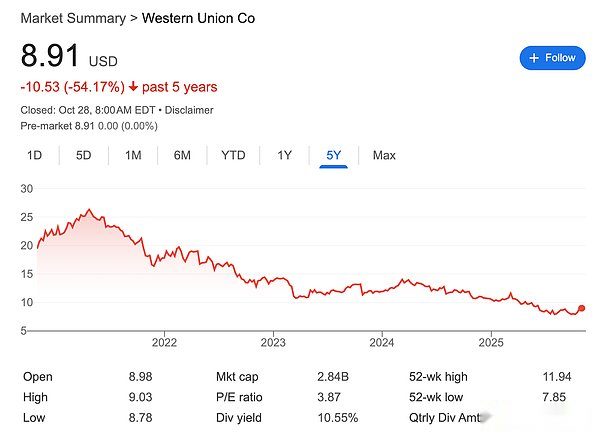
Given that Western Union’s share price has fallen by more than 50% over the past five years, it is more likely that the market will believe that Western Union will become one of the casualties left by the competition from stablecoins and native cryptocurrency payment rails.
But there’s one caveat when it comes to stablecoins: now you have to be a native cryptocurrency user to use these assets.You need to know what a wallet is.You need to know the differences between USDT, USDC, USDe, and many other stablecoins.You have to understand how wallet addresses work, but also make technical decisions like which blockchain to use to process transactions.
Ordinary people don’t do this.They just want to send, receive and hold dollars.This is where the “DeFi Mullet” comes into play.The user interface must be familiar and trustworthy, while the infrastructure and underlying architecture can be fully upgraded.
Victor Yaw has a great description of what might happen in the future.He wrote: “Stablecoins will disappear from the channels of the financial system. Money will flow across borders the same way data flows through networks: instantaneously, programmably, and without the detection of middlemen.”
This sounds amazing.Users get a better experience without having to learn any new technologies.Add to that the fact that large institutions like BlackRock, JPMorgan Chase, Citi, Venmo, and PayPal will all offer these services, so adoption will only increase over time.
We’ve seen Bitcoin succeed in traditional systems, with companies packaging the digital currency in traditional forms, such as exchange-traded funds (ETFs) or public companies.Now, we will see something similar happen with stablecoins, but instead of ETFs and public companies, it will be payment services and trading platforms bringing this technology to their users.
The “DeFi Mullet” era is coming, who will be the biggest winner?
Whoever seizes this opportunity will be rewarded with trillions of dollars.