 jakiro
Author: Max Wang @IOSG
Over the past few months of 2025, the on-chain TCG (trading card game) scene has gained tremendous traction.Off-chain, especially since 2019, TCG’s popularity has generally increased rapidly – however, few people know that TCG has been around for over 50 years and the ecosystem is actually very mature, comparable in size to the sneaker/watch market.This article will introduce you to the latest situation in the TCG field, early-stage startups in this field and their respective sizes, and aims to provide readers with a better perspective on the development of the on-chain card market.
Main Points/TLDR;
#TCG is a real asset class, not a short-term fad.
The global TCG market has reached US$8-10 billion, equivalent to sneakers and smaller than watches, with a CAGR of about 8% and 25+ years of cultural depth (Pokémon, MTG, Yu-Gi-Oh!).
#The on-chain TCG market structure is skewed and driven by the gray market.
The supply flow goes from publishers → distributors → hypermarkets/traditional stores → gray market → retail.Serious collectors rarely touch MSRP; approximately 50+% of volume/price discovery occurs in the gray market, driving the cost of teardowns ever higher.
#Card grading is a huge, centralized “pick and shovel” business.
-
About 1.5 million units per month, about 18 million units per year, at about $40 per unit: This is an industry of about $720 million per year, with PSA having about 77% of the market.
-
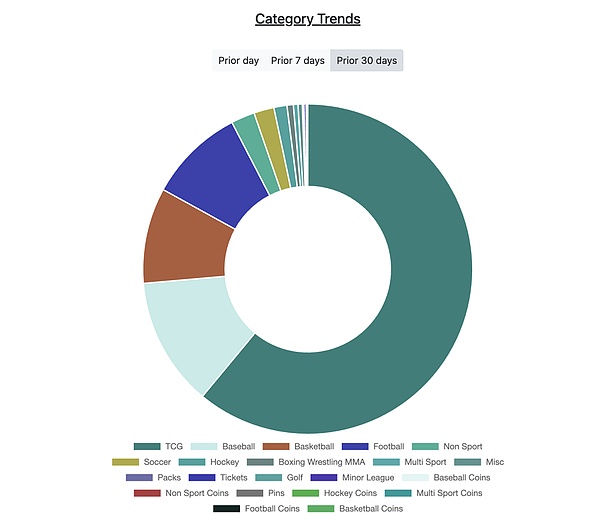
Approximately 65% of graded volume is TCG, and packaged card grading is the financialization layer that turns cards into tradable “assets.”
#Market size for sealed packs/products dwarfs Gacha
-
Just for Pokémon: ~10 billion cards → ~1 billion packs/year, average card pack priceAbout $15 → About $15 billion in sealed packet sales, compared to the overall Gacha market of about $800 billion.Gacha is very popular in CT; but for the TCG field,Sealing products are the real economic powerhouse..
-
Targeting hardcore fans/TCG collectors who are more persistent and sticky than Gacha players
#Hardcore fans/TCG collectors (rip.fun’s consumer group) are willing to accept digital assets and have huge spending power
-
$1.3 billion spent on digital versions of Pokémon card packs with no monetary value
-
$3 billion in GMV (users buy data packages from streamers who open the data packages for them, even if there is a major trust issue that rip.fun solves).
#Direct statements from leading players in the Gacha field (Collector Crypt, Beezie) indicate that they do not intend to enter the sealed product/live broadcast unpacking market.
#Opportunity: Build infrastructure that isn’t just another “casino.”
We believe the greatest room for growth lies in
-
access track(Fair on-chain distribution, fragmented asset ownership, live broadcast of package opening at a price close to the highest retail price),
-
liquidity track(vaults, tokenization, tiles/sealed MM/AMM layers), and
-
Derivatives/Credit(perps, indices, options, TCG collateral lending).
#On-chain TCG is mainly divided into four vertical areas:
-
Gacha card drawing platform(Courtyard, Collector Crypt, Phygitals): Unofficial TCG package built from secondary market segments.The Year of the Three Major PlatformsGMVReachedApproximately US$750-820 million, with a net profit margin of about 10%, 80/20 from punters and fans.
-
Digital storage/on-site unpacking platform: through card management and grading processofficialSKUs (card packs, ETBs, card boxes) are sealed and unpacked to serve die-hard fans/collectors.Heavy operations, but higher ARPU and stickiness.
-
money market: Use tokenized tiles/sealed card packs as collateral so collectors/stores can borrow money instead of selling cards directly;PocketDexIt is naturally suitable as a front-end interface for investment portfolio and risk management, seamlessly connecting with lending infrastructure.
-
perp market: Synthetic risk exposure of TCG index/suite;Troveis currently the leading example, providing perps for Pokémon Index and CS2 skins for hedging and speculation.

1. Background and introduction
First, what is a TCG?TCG (Trading Card Games) is a collecting card game in which players compete with others by building and customizing their own decks.Players obtain new cards through card packs containing random types of cards or by trading with other players.However, in addition to being a competitive game, TCG cards have become collectibles, akin to works of art, due to their limited nature.
Some popular TCG games include:
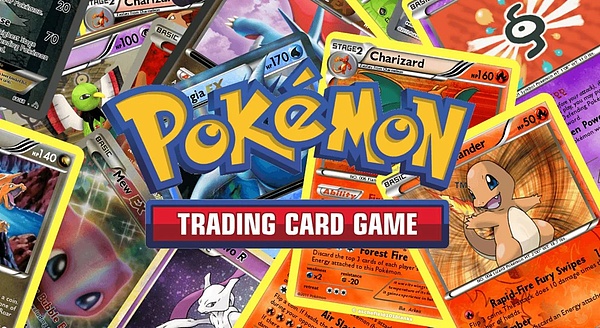
Pokémon TCG – 1996

Yu-Gi-Oh TCG – 1996

“Magic Gathered” – 1993
Looking at the size of the TCG market, TCG’s market size is comparable to major categories compared to other popular collectibles on the market.
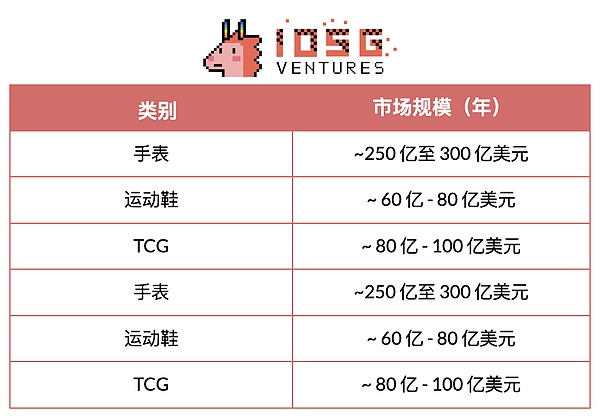
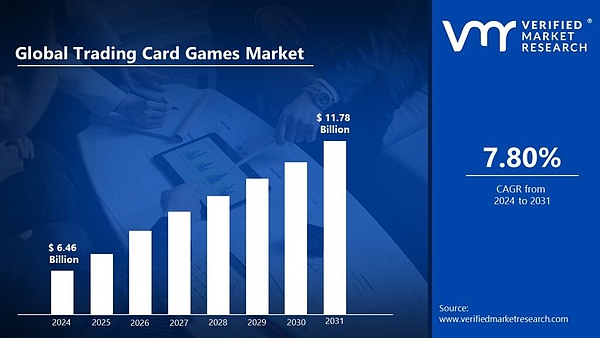
Currently, most reports place the TCG market at between $8 billion and $10 billion in annual sales, with an expected compound annual growth rate of 7.8%.
2. TCG market structure and pattern
Currently, the TCG market can be divided into off-chain TCG experience and on-chain + digital TCG experience, both of which have different players.Obviously, the off-chain market is more mature, but on-chain digital TCG environments are also rapidly gaining popularity.No matter which way you look at it, every segment of the overall TCG market is hitting all-time highs.
Off-chain
Bottom-up perspective:
-
TCG Publisher/Factory
-
Distributor
-
shop
-
TCG Official Retailer
-
Secondary market store
-
Distributors/Gray Market
-
retail
-
Grading company
The current process is roughly the same.TCG publishers/factories produce officially packaged and sealed products, which are then handed over to distributors.Distributors then distribute to stores/TCG official retailers like Walmart, Target etc or small vendors.However, due to the huge demand and popularity of these products, these products are purchased in large quantities by scalpers who then sell them to genuine collectors/retailers at high prices.
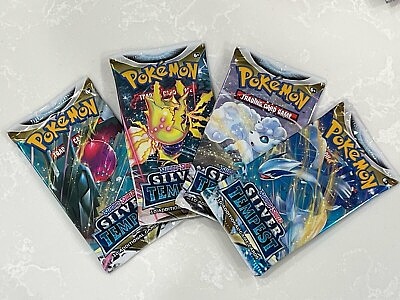
Pokémon TCG Packet
Store <> Reseller Relations
Regarding the relationship between stores and distributors, it is difficult for new individual stores to get any meaningful allocation from distributors because the demand is incredibly high.Most of the product goes to large corporations like Target/Walmart, or stores with a long history and good relationships, and very little goes to smaller stores.Therefore, many small stores source from larger stores that have better distribution from distributors, e.g.
-
Store A receives a monthly allocation of 5000 packs from a distributor
-
Store B has 100 packs
-
Store A purchases 5,000 packs from the dealer at MSRP
-
Store B buys 2500 packs from Store A at 15%+ MSRP
-
Store B sells to scalpers/retailers at 50% of the suggested retail price
Additionally, it is important to differentiate between store types.Big box stores like Walmart/Target sell to the market at MSRP.But there are also examples like Store A and Store B above, which are personal brands with distributor quotas and sell to the market at a markup of 10%-50%.Generally speaking, it’s nearly impossible for true retail collectors to get sealed products directly from Target/Walmart, and they often have to go to these smaller stores, or get their products entirely through gray channels.
gray market
The gray market itself accounts for 50% of the TCG market, and some even consider it to be a larger volume than the main market.This part of the market mainly consists of scalpers, eBay sellers, Whatnot/Livestream crackers, Facebook/Discord sellers and informal Telegram/Instagram networks that sit somewhere between official stores and real terminal collectors.
Gray market participants typically do not obtain their products from distributors, but source from:
-
Hypermarket retail(Target/Walmart’s replenishment activities, store-hopping activities, etc.)
-
Like store AAssign store, sell some allocated products at a markup
-
Need quick cash and are willing to accept discountsLiquidating collectors/stores
Gray market participants then repackage and resell the products in a variety of ways:
-
Selling sealed box/ETB/boosted box at high price
-
Carry out splits on sites like Whatnot (buying part of a card pack instead of the entire box, often with a hefty markup implied)
-
Grade and flip individual games on eBay/TCGplayer or via consignment to larger sellers
-
Gacha S Class Collector
Since genuine retailers cannot reliably obtain MSRP products, the gray market has effectively become a central venue for price discovery.Distributors and big box stores nominally sell at market price, but much of the economic surplus is captured by middlemen in the secondary market premiums they extract from retail collectors.This also means that, among popular products, the effective price is determined by the gray market clearing price, rather than the Pokémon’s official suggested retail price.As a result, this puts significant upward price pressure on the entire TCG industry.
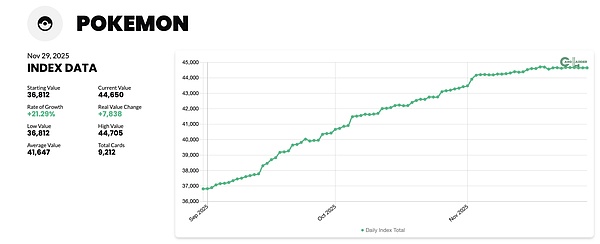
▲Pokémon Market Index
Up 21.3% in 3 months, ~250% in one and a half years
Rating
Ratings companies are at the top of the entire non-chain TCG industry.They rarely have direct contact with sealed products or dealer-distributed products; instead, they receive raw pieces from stores, card breakers, and collectors and convert them into plates with standardized condition grades.
The main rating companies are:
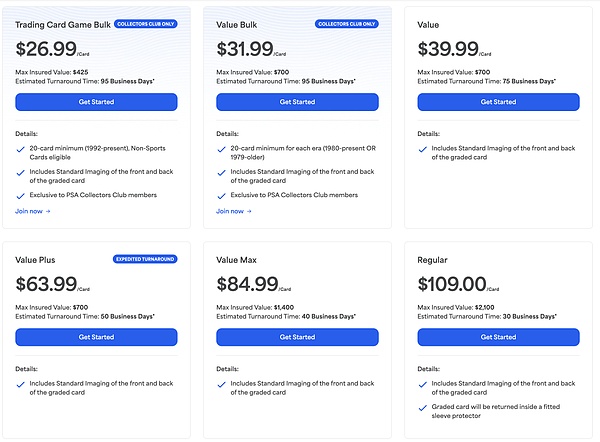
The average pricing range for rated projects is:
Cards are graded on a scale of 1-10, with grade 10 being in mint condition, which has a big impact on the card’s value.For example, an original ungraded card worth $100 would be worth $2000 if sent for grading and received a PSA 10 grade.Therefore, the vast majority of collectors and live pack openers choose to send high-value cards for grading.
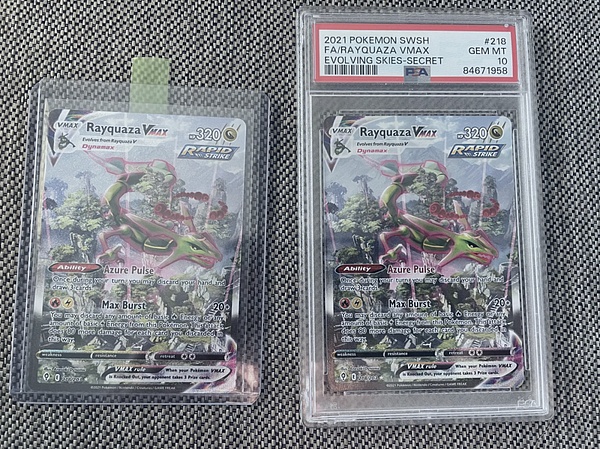
▲ Ungraded cards and graded cards (boards)
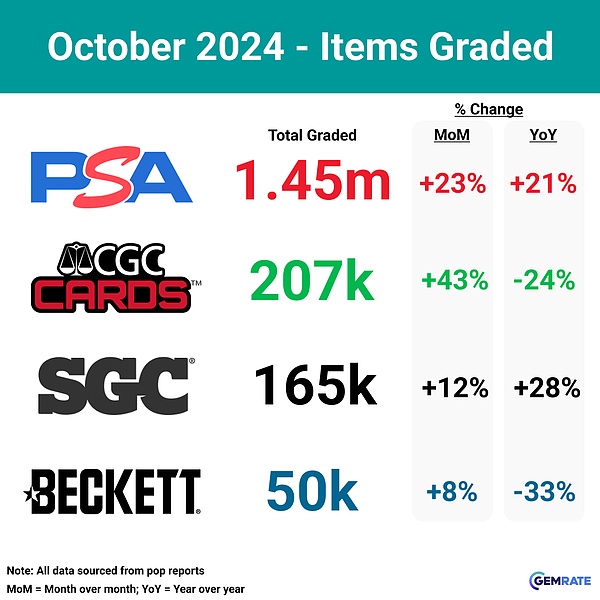
Here we can see the number of cards graded each month by the five major grading companies.Since 2021, the average monthly rated items have grown steadily year by year, with the number more than doubling when comparing head to tail.
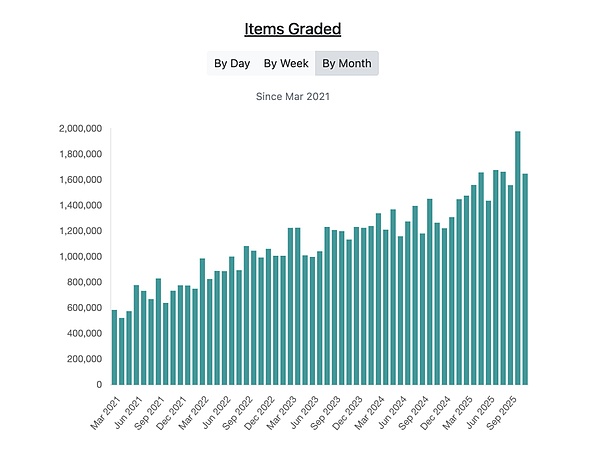
▲
Approximately 1.5 million pieces per month
Approximately 18 million units per year, not accounting for growth
About $40 each
$720 million per year industry dominated by 4 companies, with more than 65% of the graded volume coming from a single company, TCG.
As for market share breakdown, PSA is clearly the leader:
-
PSA: ~77.5%
-
CGC: ~11.1%
-
SGC: ~8.8%
-
Beckett: About 2.7%
3. On-chain + digital TCG
Now let’s take a look at the market structure of on-chain + digital TCG, which can be divided into the following types:
-
Gacha Platform
-
Sealed card pack/live broadcast pack opening and card management platform
-
Money market (lending market)
-
Perpetual contract market
Gacha Platform
Clearly, the Gacha platform has been a focus for CT given its inherent ties to cryptocurrencies.So, what is a Gacha console?
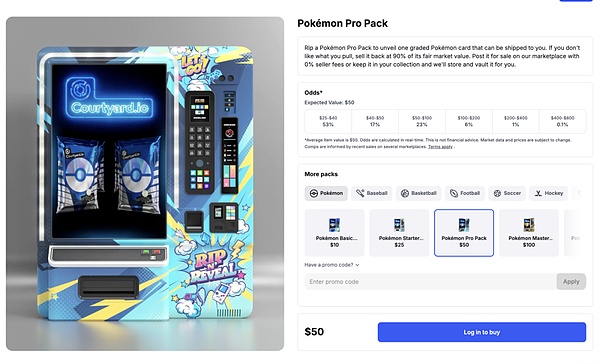
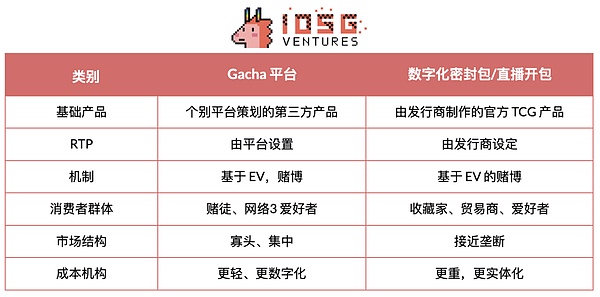
Generally speaking, Gacha machines are unofficial products curated by third parties (Courtyard, Beezie, etc.).The Gacha platform selects cards from the secondhand/gray market, purchases inventory, and curates unofficial card packs from them.
However, the core of Gacha is the random distribution of items at a fixed price.The term comes from the Japanese claw machine: you insert a coin, twist the knob, and you get a random toy from a known pool.In the case of the TCG, you grab a doll from a Gacha platform, which randomly returns rating cards.
-
You pay a fixed amount (e.g. $3 each time)
-
Draw one or more cards from a predetermined card pool
-
Card pools have different rarity levels and probabilities (common/rare/super rare)
-
Entire economies revolve around chasing specific rare cards or multiple draws
Therefore, the Gacha platform’s pricing for each draw is based on the EV mechanism:
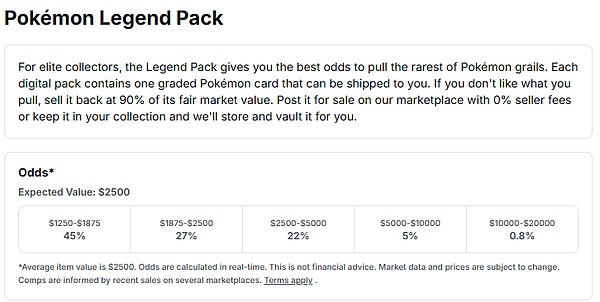
Item i = 1 … n
Drop probability $Pi (sums to 1)
Secondary market fair value $Vi (actual selling price after deducting expenses)
Price/platform fee per pull $P
Then, the expected value of a user pull is

Therefore, the overall goal of the platform is

And house edge (platform profit margin)

In fact, it is the profit of each Gacha draw on the platform.
-
Users chasing a certain card/trying to hit the best card contribute most of the EV.
-
Common/rare cards have almost zero EV.
-
The retail price of each pack will be set at a price higher than the probability-weighted resale value of the cards it contains.
Some Inspirations We Take From Beezie / Collector Crypt
“The net profit margin for most Gacha platforms is around 10% of the total spend on Gacha machines. The reason for this is that we typically buy cards in bulk from gray market stores at 90% of market value and then use that inventory for our Gacha machines”.
About traffic
#consumer
-
Players deposit USD/Cryptocurrency
-
Select and purchase the Gacha card pack you want to open
-
Sell the received cards back to the platform at 90% of the market value or exchange them in kind
-
If redeemed, receive physical card
#platform
-
Buy cards from gray market dealers or marketplaces at discounted prices
-
Curate Gacha card packs and calculate pack prices based on EV
-
Purchase the card back from the consumer, or send the card to the consumer (in the case of physical redemption)
-
Repeat
So what is most important for the Gacha platform?
-
Ability to obtain a stable supply of graded cards at prices lower than the market price
-
Able to create a + EV Gacha game console that makes players willing to continue gambling
Overall, the major players in this field can be divided into:

Courtyard.io
Users~250k
Total Platform Spend (YTD): ~~$536.5M
Gross Profit: ~$53.6 million ~~$53.6 million
Collector Crypt ($CARDS)
Users: About 10,000
Total platform spending (annual): ~$150 million
Gross profit: approximately $21 million

Phygitals
Users: about 20,000
Total platform spend (annual): ~$61 million
Gross profit: approximately $6.1 million
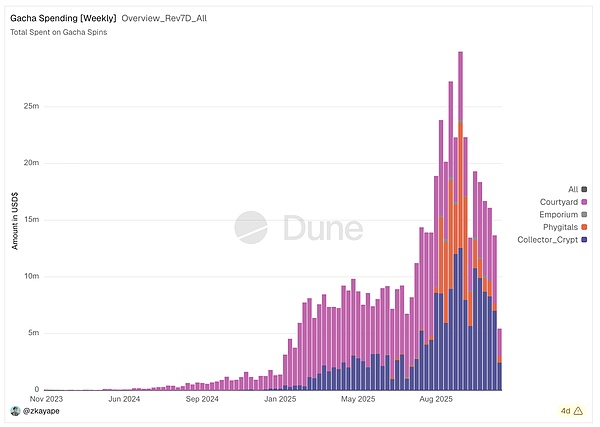
Therefore, the total Gacha industry spending by the Big Three is$747.5 million, has been an integral part of the industry’s graded card market for over 10 years.
Overall, the transaction volume distribution and growth of the entire Gacha industry over the past year is as follows.
4. Sealed card package/opening and card management platform
Recently, another new vertical has emerged in the on-chain TCG space, which is sealed card packaging/opening and card management platforms.So what’s the difference between a sealed card pack/open pack platform and Gacha?
Generally speaking, Gacha consoles are unofficial products curated by third parties, while sealed products are products officially printed by the publisher (Pokémon, MTG, etc.).They are usually available in limited quantities, and in Pokémon there are usually these standardized offerings:
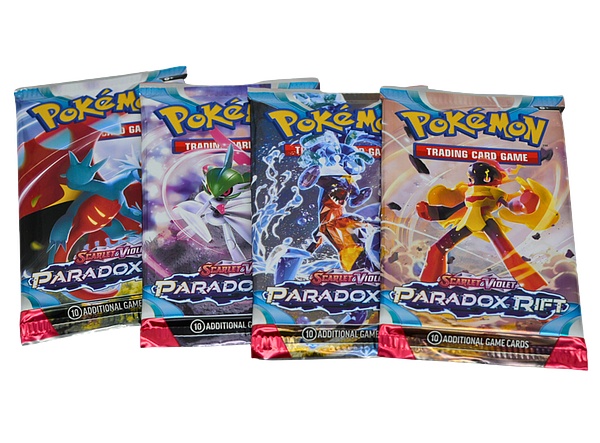
Single card packs (10 cards per pack)
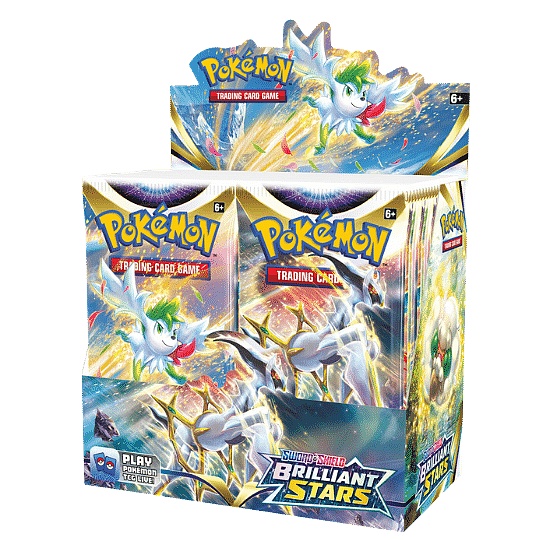
Booster Boxes (Pack of 36) – Booster Boxes

Elite Trainer Boxes – Elite Trainer Boxes
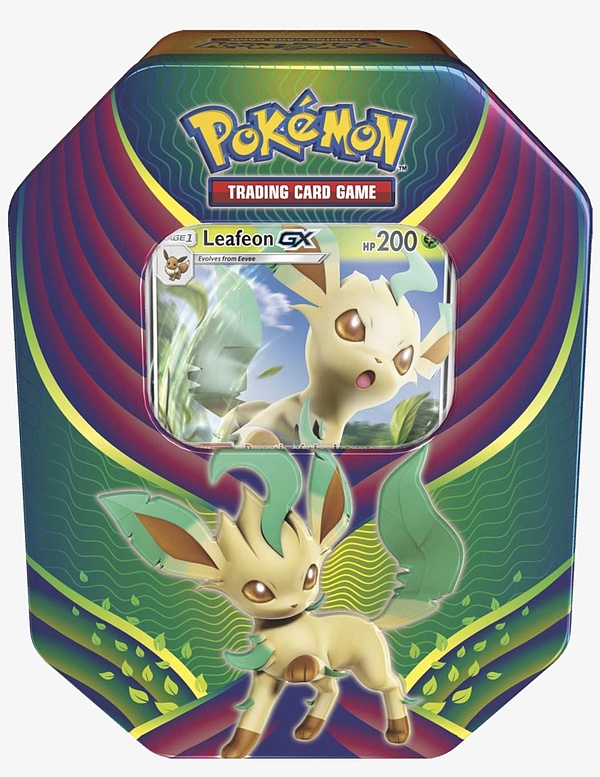
Canned – Tins
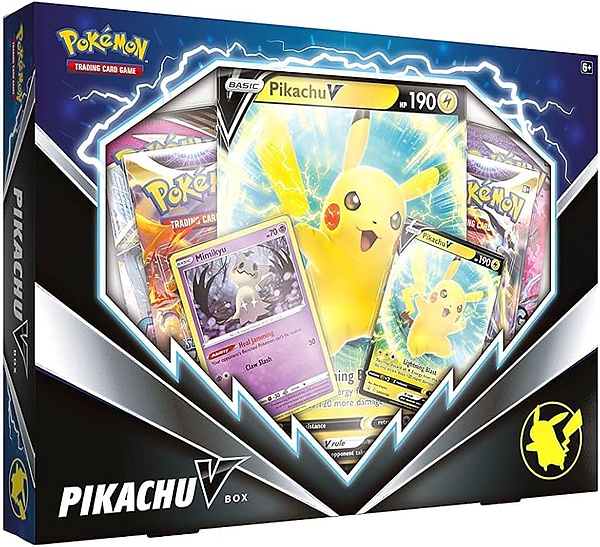
Boxes – Boxes
Therefore, the sealed card pack/live broadcast card pack unpacking platform sells official TCG products, not a synthetic prize pool like Gacha.In principle, when you purchase a sealed card pack or booster box, you are purchasing an original Pokémon or MTG designed card with hit rate exposure.The role of the platform is to source and secure these sealed products, match them with buyers, and unseal them on demand, rather than remixing the underlying cards into a custom “designed in-house” Gacha pool.
In addition, why are sealed products/live card opening products more catered to the needs of super fans?
-
Sealed products are usually limited edition, belong to a specific series, and have a specific production date
-
Collectors and fans chase a specific set of cards and therefore only want to open packaged products
-
Collectors/Fans want to get the original card grade for themselves, in order to get the original card they need to open the sealed product
About the process
#consumer
-
Players deposit USDC/Cryptocurrency
-
Select the official package you want to open
-
Wait for the platform to open the package and watch the live broadcast of the package opening
-
Sell the received cards back to the platform at a price of 90% MP, exchange them for physical items or ask the platform to send grading
-
If redeemed, receive physical card/wait for rating to return
#platform
-
Buy official packaging in bulk directly from distributors or other stores with distributor distribution
-
List packages with a set margin (10%-50%)
-
Physically unpacking, storing cards and managing them
-
Purchase the original card back from the consumer and, if redeemed, mail it to the consumer, or mail it for grading
-
Repeat
So, what is really important when it comes to sealed products/live broadcast unpacking platforms?
-
Have a stable reseller relationship with access to sealed products at official list price (MSRP), or a network of stores that will provide distribution to them
-
Set up the warehouse/infrastructure to actually manage the unpacking process and prove that these packages are authentic
-
Provide packaged products at reasonable prices to attract consumers and fans to buy
Generally speaking, the administrative fees for these sealed card pack/live card opening platforms are much higher than Gacha.While Gacha platforms also need to manage and store cards, they don’t have to deal with procuring official card packs (which is a huge capacity limitation), actually opening the packs, scanning the cards, and helping customers send them in for grading.This requires huge operating expenses from execution costs + warehouse costs.
To quote Beezie and Collector Crypt:
Neither end is interested in entering the package/live broadcast market.
Asked them very specifically and they said no
Reason
Don’t know much about this area;
Think the operational burden is too heavy and don’t know how to build the infrastructure;
No dealer relationship
They are making a big push to grow more of their Gacha product line, moving towards non-Pokémon TCG products rather than the sealed card pack/live pack opening route.However, this also means that players who can effectively enter this field have a huge moat and can easily dominate the market.
To summarize, the main differentiating factors:
Insights from John @ Cardmint
He is one of the largest buyers and suppliers of graded slate to companies such as Courtyard, Beezie and others, with a monthly transaction volume in the millions (Former Chainlink Engineer)
The on-chain TCG has a gambler/real fan distribution of 80/20
However, although the number of fans is smaller, they are more retaining and sticky than gamblers, and have huge spending power
Consumer preferences and sealing product needs
Consumer preference for Gacha and sealed card packs/live card openings is also important.Gacha products cater more to gamblers/Web3 users who only care about the value of the graded cards they get, not the cards themselves, while consumers who buy sealed card packs/live unpacks are more likely to be die-hard fans of a specific TCG series.Objectively speaking, there is a demand for Gacha, so the main question here is, is there a demand for sealed packs/live broadcast pack openings, and does the TCG core fan base have the spending power/willingness to be Gacha buyers?
Some key data:
Pokemon Pocketis an official Pokémon app and a casual digital version of the Pokémon TCG.Players spend money to open digital packs, but the cards have no monetary value and cannot be physically redeemed.It’s just a souvenir.
-
First-year revenue of $1.3 billion
-
18 million card packs were opened
Additionally, Whatnot has generated billions of dollars in GMV.On Whatnot, Pokemon fans pay streamers to live stream pack openings and have cards sent to them.
-
GMV in 2024 of $3 billion
-
6 billion GMV in 2025 (estimated)
Additionally, Whatnot has massive trust issues.Sellers on Whatnot often steal cards, weigh card packs, or swap cards before sending them to viewers.However, TCG fans are still willing to spend so much money on their platform to get sealed card packs.
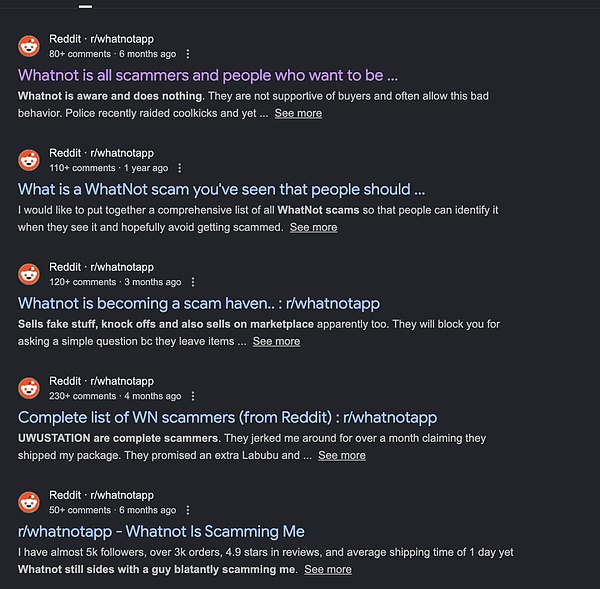
The real core TCG players are not only willing to give up the physical experience of unpacking by hand and turn to digitalization, but also demonstrate the strong spending power and high investment in games of this consumer group.In the case of Pokemon Pocket, those card packs have absolutely no monetary value, yet core fans continue to open them with gusto.
Therefore, in terms of live broadcasting of cards on the chain, this is certainly more catering to die-hard fans, but these die-hard fans have stronger spending power and are more willing to adapt to digital experiences.It’s clear that there’s a huge demand among TCG’s die-hard fans for sealed card pack products in general, whether they’re digital or physical.
On the market side, we’re also seeing huge demand drivers.
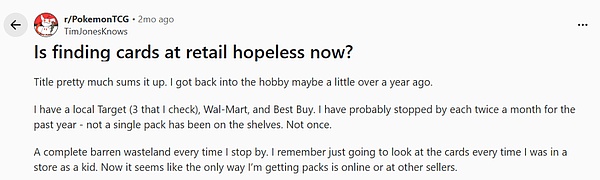
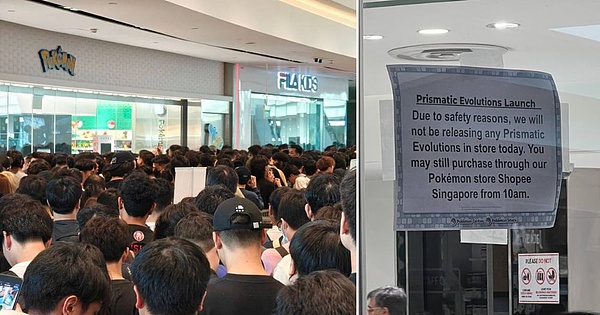
Pokémon TCG cards sell out at retail stores, and retailers (Walmart, Target, etc.) often have to limit the amount purchased per person.
5. Market Size of Gacha and Sealed Card Pack Products
The TCG market is not limited to Pokémon, but on most Gacha platforms, Pokémon has become almost the only category available.
Sealing products
-
Pokemon TCG to print 10 billion cards in 2024
-
An estimated 50 million players/buyers
-
10 cards per pack → 1.02 billion packs per year
-
About $15 per pack (MSRP + gray market mixed pricing)
Annual sales of sealed card holders are approximately $15 billion
Gacha
The Big Three dominate the industry, accounting for 90% of the market share.
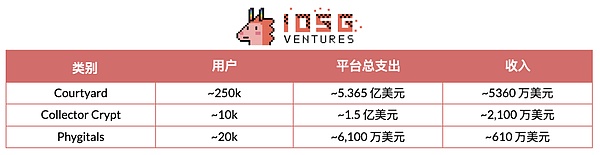
Annual Gacha sales are $747.5 million.If adjusted for ~+10% of other players, Gacha would be an $822.5 million industry.
The sealed card package product industry is much larger than the on-chain Gacha industry.
money market
Currency markets are also an area that on-chain TCGs are just beginning to explore, but logically become the next layer once cards are properly digitized and vaulted.The core idea is simple: convert plates and sealed products into collateral, so that collectors and stores can lend stablecoins as collateral when they need liquidity without having to sell collections to obtain cash every time.
In an on-chain TCG money market, tokenized TCG assets (vault NFTs/ERC-1155s representing sectors or seals) can be deposited into lending protocols, and users can use them to borrow USDC or other liquid assets.This requires:
(i) Robust floor/index pricing
(ii) Conservative LTV taking into account reprint risk and pop-report impact
and (iii) sufficient secondary liquidity to enable the liquidator to actually liquidate the collateral.
This is where PocketDex fits naturally in the entire ecological stack: products like PocketDex have already assumed the role of card database + portfolio management tool, integrating card information, price data and user collections into one interface.If this view is connected to on-chain custody and lending protocols, PocketDex can essentially become a discovery portal + risk management front-end interface for the lending market:
-
Users can view their tokenized collections, real-time valuations, and the loan amount recommended by the system;
-
Jump to the lending agreement with one click and open a credit limit with a specific sealed card/series;
-
Repayment, health and liquidation alerts can all be displayed in the Collector App they use every day.
For collectors, this is like a deposit on their collection.For stores and brokers, it’s like a warehouse line backed by inventory, allowing them to smooth cash flow and expand operations.
derivatives market
The Perp Market extends this functionality even further, allowing people to trade purely synthetic TCG prices long and short with leverage without touching a physical card.Instead of buying and keeping a box of “Evolving Skies”, traders can go long “EVSK Box Index Perp”; instead of building a large “Charizard” portfolio, traders can trade “Charizard PSA-10 Index Perp”.
Troveis the most obvious living example here: it is a decentralized perpetual futures exchange dedicated to collectibles, starting with Pokémon Card Index and CS2 skins, offering up to ~5x leverage.Trove aggregates pricing data from major markets, builds on-chain indices (e.g. Pokémon Card Index, Charizard PSA-10 benchmark), and lets users go long or short on these indices via perps.Actually, this
-
Provides collectors and shops with a way to hedge against the risk of physical/vault stock declines (when they are long cards, short Trove);
-
Allow traders to express their opinions on sets, eras, or the Pokémon market as a whole without having to deal with grading, shipping, or storage issues;
-
Create an arbitrage loop between physical spot, tokenized spot (yard/collector’s basement/Phygitals) and derivatives.
What really matters here is index construction and data quality: if Trove (and similar platforms) can become the prototypical pricing and hedging venue for TCGs, then perps can turn cards from illiquid collectibles into tradable macro surfaces.Combined with the currency market, a full set of transactions can be achieved: Hold → Borrow → Hedge → Speculate on TCG risk entirely on-chain, while Trove is the derivatives layer that sits on top of the treasury, Gacha platform and package/live-opening track.
6.Arguments and perspectives
Overall, it is clear that there is a huge demand driver for off-chain TCG, and we have seen that the atmosphere for on-chain TCG has begun to take shape.In the opinion of most, the value of cryptocurrencies to society lies in abstracting away the difficulties we see in traditional finance and providing new opportunities to expand the frontiers of financial technology.In many ways, this is the same relationship between off-chain TCG <> on-chain TCG, the latter of which exists to reduce the friction that consumers and TCG fans see to a large extent, while also providing more use cases, opportunities, and avenues for their hobby.
We can also infer that this market will continue to exist; the value of this market lies in capturing it, and the opportunities in this market are ripe.This isn’t just a new hobby/market, TCG has gained popularity in the 25 years since its inception and cards/collectibles have become valuable assets, just like art or NFTs.
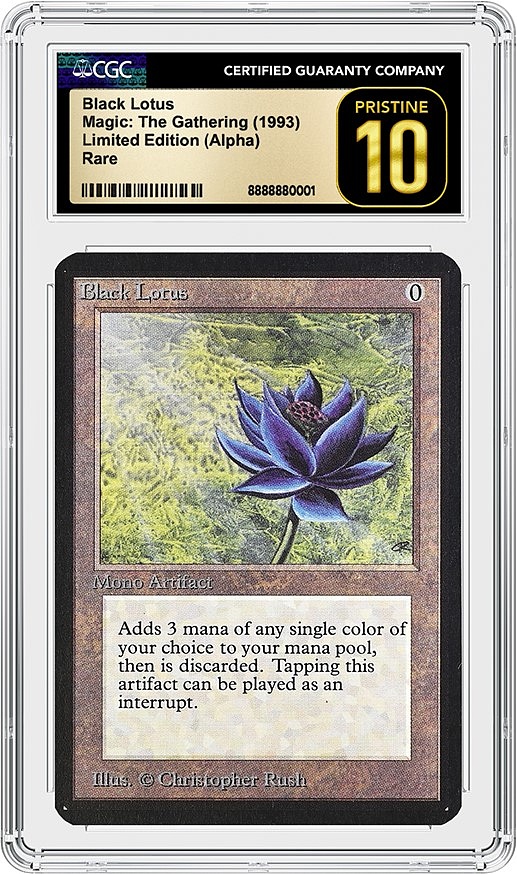
Priced at $3 million
Magic the Gathering, Black Lotus- PSA 10

Price: $5.25 million
Pokémon, Pikachu Illustrator – PSA 10
To sum up, it seems that there are several interesting angles worth paying attention to:
Products that bridge retail supply <> demand issues
Currently, there is a woeful lack of demand at retail: distributors allocate most of the supply to whales and well-connected stores, while genuine collectors are pushed into the gray market and forced to pay hefty premiums.On-chain + digital TCG infrastructure can directly solve this problem.Here, access means: providing retailers with a trusted, fair way to obtain packaged products or individual cards at close to maximum retail prices.
Product direction examples:
-
On-chain real-time card opening platform, collectors/fans can purchase and open card packs directly online for a small fee, while also redeeming physical cards if they wish.
-
Alleviates retailers’ demand for card holders;
-
Or pay 2-3x markup to scalpers
-
Fragmentation of card pack ownership, retail users can purchase a portion of a sealed stock (such as 1/36 of a box) at a reasonable price without having to pay exorbitant prices for a full box of cards they cannot afford.
-
Buying in bulk from distributors/big box stores and then repackaging into smaller, fairer fragmented products for global retail rather than product under a network of relationships.
-
Each wallet has an allocation cap and transparent odds for on-chain queuing/drawing/whitelisting of encapsulated card products.
These products don’t necessarily change the overall supply of Pokémon, but they can fundamentally change who actually has access to Pokémon cards, and the effective price.
Improve the overall TCG marketInstantLiquid platform
The value of most off-chain TCGs remains in slow, high-friction forms: physical collections or encapsulated card packs in warehouses.Selling usually means an eBay listing, fees and weeks of delay.An on-chain card management and custody platform turns this into instant, programmable liquidity.
Its core gameplay is: physical vault → tokenization → insert into a track similar to DeFi.
-
The platform enables sector vaulting and tokenization, allowing it to be traded and transferred around the clock without actually moving items.
-
The real-time unpacking solution instantly pushes clicks into the user’s digital inventory, ready for listing, auction, and staking.
-
The Yield Vault platform can act as a MM between different markets and can stand on both sides of popular SKUs (Chasing Cards, Key Slices, Flagship Packs), narrowing the price gap with eBay and enabling instant sales instead of “waiting for the 10-day auction to end.”
this can
-
Speed up store and collector turnover.
-
Global price discovery instead of fragmented local pricing.
-
The ability to incorporate TCG assets into other protocols (lending, AMMs, indices, etc.) would not be possible if everything existed as a paper card.
Auxiliary products built on the basis of the on-chain TCG market, allowing the emergence of derivative products
Related to the last point above; once TCG assets are properly digitized (NFTs, vault tokens, price feedback), derivatives and structured products can begin to be built on top of them, turning the collection into appropriate financial primitive products.
Examples are as follows
-
Perpetual Coin/Futures
-
Index of top rated cards (e.g. Top 50 Pokémon slabs index)
-
Specific sealing products (e.g. evolving skies booster box perp)
-
options or treasury strategies, allowing users to compare a set of cards without holding specific cards.VolatilityorBet on upside
-
Money market using card packs/pieces as collateral,Risk management by oracles and liquidators
-
around issuance, reprint risk, or growth in PSA volumeprediction market, allowing traders to hedge or speculate on the meta-factors driving TCG prices
These ancillary products do not directly compete with Gacha or live demos, but sit on top of them.Gacha and sealed card/live card splitting platforms handle buying and selling and inventory management, while derivatives and currency markets handle risk transfer, leverage and hedging.Together, they transform TCG from a niche collectibles ecosystem into an increasingly formal, multi-layered on-chain financial market.