 jakiro
Author: Long Yue, Wall Street News
Since the Federal Reserve launched this round of interest rate cuts in September 2024, it has lowered the benchmark interest rate by a cumulative 1.5 percentage points to a range of 3.75%-4%.However, the market’s reaction was unexpected.During the same period, the 10-year U.S. Treasury bond yield climbed nearly 0.5 percentage points to 4.1%, while the 30-year Treasury bond yield increased by more than 0.8 percentage points.
This move directly challenges traditional market logic, which is that interest rate cuts by the Federal Reserve usually lead to a downward trend in long-term interest rates.It also goes against the expectations of U.S. President Trump, who believes that faster interest rate cuts will effectively drive down interest rates on mortgages, credit cards and other types of loans.The abnormal performance of the market means that investors and the Fed have huge differences in their judgment on the outlook for interest rates.
At present, there are different opinions in the market regarding the interpretation of this disagreement.Optimists view this as a sign of confidence that the economy will avoid recession; neutral views view it as a sign that market interest rates have returned to normal before the 2008 financial crisis; while pessimists worry that this reflects the return of the “bond vigilantes” who have cast a vote of no confidence in the United States’ expanding national debt and potential inflation risks.
Rare divergence: yields rise during interest rate cut cycle
Typically, when the Fed adjusts its short-term policy rates, long-term bond yields move accordingly.However, the performance of this cycle has broken the rules.
Data show that traders generally expect the Fed to cut interest rates by another 25 basis points after this week’s meeting, and expect two more rate cuts of the same magnitude next year, leading the policy rate to around 3%.
But key Treasury yields, which serve as a benchmark for borrowing costs for U.S. consumers and businesses, have not followed suit.
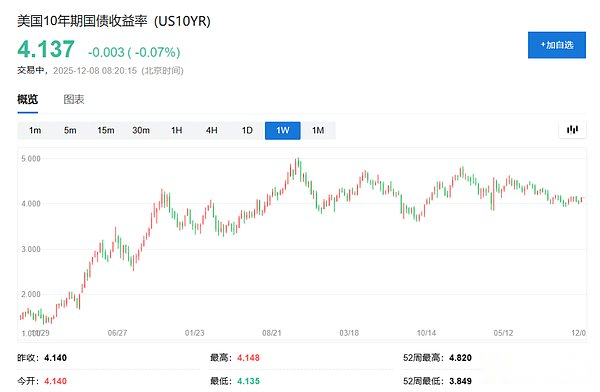
Looking back at the only two non-recession rate cutting cycles in the past four decades (1995 and 1998), when the Fed cut interest rates by just 75 basis points, the 10-year Treasury yield either fell directly or rose much less than current levels.
Soft landing expected or return to normalcy?
Regarding the reasons for the rise in yields, Jay Barry, head of global interest rate strategy at JPMorgan Chase, believes that there are two factors behind this.
First, due to the unprecedented intensity of interest rate hikes taken by the Federal Reserve to curb inflation in the post-epidemic era, the market had already digested expectations of a policy shift before the Federal Reserve actually started to cut interest rates, causing the 10-year yield to peak at the end of 2023.
Second, he noted that by cutting interest rates while inflation remains high, the Fed aims to “sustain this economic expansion, not end it,” which reduces the risk of a recession and thus limits the downside for yields.
Robert Tipp, chief investment strategist at PGIM fixed income, also expressed a similar view. He believes that this is more like a “return to normality”, that is, interest rates are returning to pre-global financial crisis levels in 2008.That crisis ushered in an era of unusually low interest rates that has ended abruptly in the wake of the pandemic.
Inflation concerns and the return of “bond vigilantes”
However, other market participants see more troubling signals in the so-called term premium.Term premium is the additional income compensation investors require for holding long-term bonds to hedge against potential risks such as future inflation or debt defaults.That premium has risen by nearly a percentage point since the start of this rate-cutting cycle, according to New York Fed estimates.
Jim Bianco, president of Bianco Research, believes that,It’s a clear sign that bond traders are worried the Fed is cutting rates too quickly while inflation remains stubbornly above its 2% target and the economy continues to show resilience.He warned: “The real concern in the market is the policy itself” and that if the Fed continues to cut interest rates, mortgage rates could “spike vertically.”
In addition, political factors have also exacerbated market concerns.There are concerns that President Trump may succeed in pressuring the Federal Reserve to cut interest rates more aggressively.According to Bloomberg, Hassett, director of the White House National Economic Council and a loyal supporter of Trump, is regarded in the betting market as a favorite to succeed Chairman Powell.Steven Barrow, head of G10 strategy at Standard Bank in London, said bluntly: “Putting a politician in charge of the Federal Reserve will not make bond yields fall.”
From ‘Greenspan’s puzzle’ to oversupply: Is a structural shift taking place?
Deeper analysis points to structural shifts in global macroeconomics.Standard Bank’s Barrow likened the current situation to a mirror image of the “Greenspan conundrum” of the mid-2000s.
At the time, then-Federal Reserve Chairman Alan Greenspan was puzzled by how he continued to raise interest rates while long-term yields remained low.
His successor, Ben Bernanke, later attributed this to excess overseas savings pouring into U.S. Treasuries.Now, Barrow believes the opposite is true: Government borrowing in the world’s major economies is too large, and what was once a “savings glut” has turned into a “bond oversupply,” which has put continued upward pressure on yields.
Barrow concluded: “The lack of a fall in bond yields may be a structural change. Ultimately, it is not central banks that determine long-term interest rates.”