 jakiro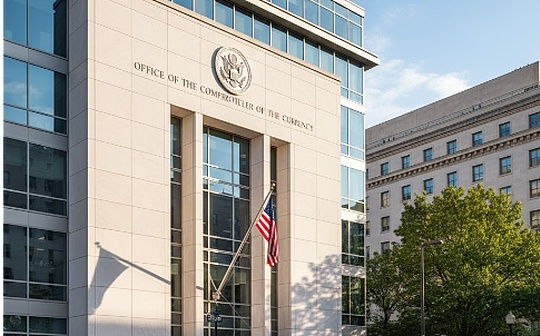
Source: Galaxy; Compiled by: Bitchain Vision
The U.S. Office of the Comptroller of the Currency (OCC) issued a significant update for the cryptocurrency space last week, confirming that U.S. banks can serve as “risk-free” primary intermediaries in cryptocurrency transactions.
Actually,Banks can now buy a crypto asset from one customer and sell it to another within the same trading day without recording the asset on their balance sheet.
In traditional markets, matching transactions is a routine task for any brokerage firm on Tuesday, but the bank’s clear approval for digital asset brokerage business marks another important step for the OCC in continuing to promote the integration of digital assets and traditional markets.
combineWhen the OCC approved last month that banks can hold native tokens to pay gas fees and operate directly on public blockchains, the direction is clear: regulators are building a coherent framework for banks to do business on the chain.
Galaxy’s take:
The newly released Interpretation Letter No. 1188 is almost as boring as any regulatory letter.The U.S. Office of the Comptroller of the Currency (OCC) essentially said that if banks are allowed to engage in risk-free proprietary trading of securities, then they can apply the same model to cryptocurrencies as long as they do not assume significant market risk exposure and properly manage settlement, operational and compliance risks.However, treating cryptocurrencies as boring infrastructure rather than magical Internet money has a deregulatory effect, and it is clear that the OCC is applying its usual interpretive lens: technology neutrality.
At the same time, Interpretation Letter No. 1186 issued in November also allows banks to hold a small amount of native tokens to pay gas fees and operate their own on-chain systems.Combining the two documents, we can see the regulator authorizing banks to interact directly with blockchain networks and allowing them to conduct customer transactions on these networks.
Notably, a U.S. regulator is moving faster on cryptocurrency regulation than global bank capital regimes.The 2024 update to bank cryptocurrency capital requirements issued by the Basel Committee still treats most crypto assets as “radioactive hazards”: high-risk exposures are subject to strict capital regulations, hedge confirmations are limited, and exposure caps are extremely conservative. Even if banks try to go bankrupt by holding cryptocurrencies, it will be difficult to succeed.Even tokenized assets and stablecoins that qualify for looser regulations face regulatory discretion and are subject to “infrastructure surcharges” that penalize these assets simply for being on-chain.Now there’s this weird divide: the U.S. Office of the Comptroller of the Currency (OCC) is expanding banks’ authority to use cryptocurrencies, while the Basel Committee is making many of these activities economically unviable.
But from a market structure perspective, last week’s guidance was certainly encouraging.Banks (at least in the United States) are finally allowed to handle cryptocurrency transactions like any other, without having to pretend that blockchain settlement requires a PhD in cryptography and a Satoshi possession.Allowing banks to execute cryptocurrency transactions on a risk-free principal basis gives customers access to regulated intermediaries rather than being forced to use unregulated venues.
If the U.S. Office of the Comptroller of the Currency (OCC) is doing anything, it’s politely telling banks: “Listen, if you want to continue serving cryptocurrency customers in 2026, you need wallets, node infrastructure, on-chain settlement controls, and actual operational capabilities.”
Accepting payment for gas fees is the first step; being able to match customers’ cryptocurrency transactions is the second step; and the third step is to “stop outsourcing all operations to fintech companies and operate some of the infrastructure yourself.”
The bigger question now is whether Basel will soften its stance.The Basel Accord last updated cryptocurrency regulations in 2024, and since then large global systemically important institutions (GSIBs) have widely adopted cryptocurrency rails for settlement, liquidity management and tokenized staking.Equity is fully tokenized on-chain and enjoys the same ownership protections that investors are entitled to demand.If banks can prove they can safely run on-chain operations, Basel regulation will feel like a throwback to 2017: imposing a set of capital rules for a technology in its growing pains on an industry that has made giant leaps in maturity and institutional adoption.
The Basel Accord is revising its guidance for 2024, hoping to recognize by then that certain cryptoassets will no longer function like speculative chips and more like payment or settlement infrastructure.Regardless, the world is moving on-chain; the real suspense is which decentralized finance (DeFi) technologies banks will adopt, transform, and package as a natural evolution of the banking industry.