
 jakiro
Author: Lin Wanwan
MSTR (Strategy) holders may not be able to sleep well recently.
The stock price of this “Bitcoin central bank” that was once held on the altar has experienced a bloodbath.With Bitcoin’s rapid correction from its historical high of $120,000, MSTR’s stock price and market value have shrunk significantly in the short term, plummeting more than 60%, and Strategy may even be removed from the MSCI stock index.
The correction in currency prices and the halving of stock prices are just symptoms.What really makes Wall Street nervous are the growing signs that MSTR is embroiled in a battle for monetary power.
This is not an exaggeration.
In the past few months, many seemingly unrelated events have begun to be connected: JPMorgan was accused of abnormally increasing its short selling of MSTR; users experienced delivery delays when transferring MSTR stocks from JPM; the derivatives market frequently suppressed Bitcoin; discussions on the “Treasury Stablecoin” and “Bitcoin Reserve Model” on the policy side were rapidly heated up;
And these are not isolated incidents.
The MSTR stands on the fault line between the two U.S. monetary systems.
On one side of the palace battle is the old system: the Federal Reserve + Wall Street + commercial banks (with JPMorgan Chase as the core); on the other side is the new system that is taking shape: the Ministry of Finance + stable currency system + a financial system with Bitcoin as a long-term mortgage.
In this structural conflict, Bitcoin is not the target, but the battlefield.MSTR is a key bridge in the conflict: it converts the US dollar and debt structure of traditional institutions into Bitcoin exposure.
If the new system is established, MSTR is the core adapter; if the old system is stable, MSTR is the node that must be suppressed.
Therefore, MSTR’s recent plunge is not a simple asset fluctuation. Behind it is the superposition of three forces:The natural adjustment of Bitcoin price; the fragility of MSTR’s own risk structure; the spillover of conflicts caused by power migration within the US dollar system.
Bitcoin strengthens the Treasury’s future monetary architecture and weakens that of the Federal Reserve.The government faces a tough choice and needs to keep JPM suppressing Bitcoin if it wants to maintain the chance of low price accumulation.
Therefore, the method of hunting MSTR is systematic.JPMorgan Chase knows the rules of this game very well, because they set the rules.They put MSTR on the dissecting table and clearly separated its veins (money flow), bones (debt structure) and soul (market beliefs).
Here we break down the four “death postures” that MSTR may face, which are also the four death talismans carefully prepared by the old order for MSTR.
Position 1: Take advantage of the situation
This is the most intuitive and the most discussed model in the market:If BTC keeps plummeting, MSTR leverage increases, and stock prices keep falling, leading to a loss of refinancing capabilities, and ultimately a chain collapse.
This logic is simple, but it is not the core issue.
Because everyone knows that “if BTC falls too much, something will happen to MSTR”, but few people know: to what extent MSTR will fall from “stable as a dog” to “unstable.”

MSTR’s asset and liability structure has three key figures:
-
The total BTC position exceeds 650k (about 3% of the total Bitcoin supply)
-
Average position cost is approximately $74,400
-
Some debts have implicit price risks (although it is not forced liquidation, it affects net assets)
Many “MSTR will return to zero” stories think of it as the liquidation style of exchange contracts, but in fact MSTR does not have a liquidation price, but there is a “narrative liquidation price”.
What does it mean?
Even if the creditors won’t liquidate his position, the market will liquidate his stock price.When the stock price drops to a certain level, he will no longer be able to issue bonds or convertible bonds to continue covering his position.
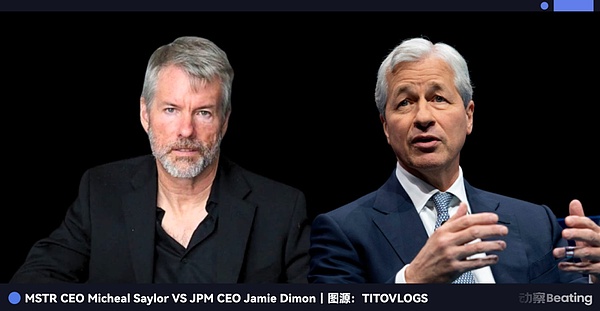
The old forces like JP Morgan are joining forces to short MSTR through the U.S. stock options market.Their tactics are simple: take advantage of the Bitcoin correction to crazily smash MSTR and create panic.They have only one goal to achieve, to break the myth of Michael Saylor.
This was MSTR’s first thunderstorm. The price of Bitcoin dropped to such a level that the outside world was no longer willing to give him money.
Position 2: Pressing debts to come to your door
Before talking about convertible bonds, we must first understand how MSTR CEO Micheal Saylor’s “magic” works.
Many novices think that MSTR only uses the money earned to buy coins, but they are wrong.MSTR plays an extremely bold “leverage arbitrage game.”
Saylor’s core approach is to issue convertible notes (Convertible Notes), borrow U.S. dollars, and buy Bitcoin.
MSTR has raised a whopping $20.8 billion this year, a scale that is extremely rare among annual fundraisings for U.S. public companies.Funding sources include common stock MSTR of US$11.9 billion, preferred stock of US$6.9 billion, and convertible bonds of US$2 billion.
It sounds mundane, but the devil is in the details.
The interest rates offered to investors by such bonds are extremely low (some are even less than 1%). Why are investors willing to buy them?Because these bonds contain a “call option.”If the stock price of MSTR rises, the creditor can convert the debt into stocks and make a huge profit; if the stock price does not rise, MSTR will repay the principal and interest at maturity.
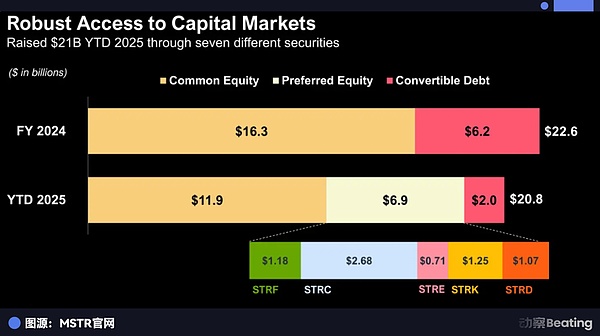
This is the famous “flywheel”, issuing bonds to buy coins, currency prices rise, MSTR stock prices skyrocket, creditors are happy, stock premiums are high, bonds are issued again, and more coins are bought.
This is the so-called “spiral”.But wherever there is an upward spiral, there is also a death spiral.
This thunderous posture is called “forced deleveraging under liquidity exhaustion.”
Imagine if one year in the future, Bitcoin enters a long sideways period (no need to plummet, just sideways).At this time, the old bond expires.Creditors saw MSTR’s share price fall below the conversion price.
Creditors are not philanthropists, they are Wall Street vampires.They would never choose to convert the bonds into stocks at this time. They said coldly: “Pay back the money. In cash.”
Does MSTR have cash?No.Its cash was converted into Bitcoin.
At this point, MSTR faced a desperate choice: borrow new debt to pay off old debt.However, due to low currency prices and poor market sentiment, the interest rates on newly issued bonds will be exorbitantly high, directly swallowing up the poor cash flow of the software business.
Or, sell coins to pay off debts.
Once MSTR was forced to announce that it was “selling Bitcoin to pay off debt,” it was a nuclear bomb launched into the market.
The market will panic, and “the dead bulls have surrendered!” Panic causes currency prices to fall, which causes MSTR stock prices to plummet. The stock price plummets to the point where more bonds cannot be converted into shares, and more creditors demand repayment.
This is the “Soros-style” sniping moment.
This kind of thunderstorm gesture is the most dangerous, because it does not require the collapse of Bitcoin to trigger, it only requires “time”. When the debt maturity date meets the market quiet period, the sound of the capital chain breaking will be crisper than the breaking of glass.
Posture Three: Killing and Punishing the Heart
If the second posture is “no money left”, then the third posture is “no one believes it anymore”.
This is currently the biggest hidden danger of MSTR, and it is also the blind spot most ignored by retail investors: premium rate (Premium).
Let me calculate an account for you.You buy one share of MSTR now, assuming you spent 100 yuan.But the 100 yuan actually only contains 50 yuan worth of Bitcoin. What is the remaining 50 yuan?
It’s air.Or to put it nicely, it’s a “belief premium.”
Why are people willing to pay double the price to buy Bitcoin?
Before spot ETFs, such as BlackRock’s IBIT, came out, compliance agencies could only buy stocks because they had no choice.After the spot ETF came out, everyone still bought it because they believed that Saylor could “raise the currency” by issuing bonds and outperform simply hoarding the currency.
However, this logic has a fatal weakness.
MSTR’s stock price is built on the narrative of “I can borrow cheap money to buy coins.”Once this narrative is broken, premium rates return.
Just imagine, but if Wall Street continues to suppress it, the White House will also force MSTR to hand over its chips?What if the US Securities Regulatory Commission suddenly issued a document saying that “listed companies’ currency holdings are illegal”?At that moment, everyone’s faith collapsed.
This thunderous posture is called “Davis Double Kill”.
At that moment, the market will ask itself a soul question: “Why should I spend 2 yuan to buy something that costs 1 yuan? Isn’t it good for me to buy BlackRock’s ETF? They still pay 1:1.”
Once this idea becomes a consensus, MSTR’s premium rate will quickly return to 1x from the current 2.5x or 3x, or even fall to 0.9x (discount) because it is a corporate entity with operating risks.
This means that even if the price of Bitcoin does not fall by a penny, MSTR’s share price may be cut in half.
This is the collapse of narrative.It’s not as bloody as a debt default, but it’s more murderous.You see that the Bitcoin in your hand has not fallen, but the MSTR in your account has shrunk by 60%, and you will doubt your life.This is called “killing valuation.”
Position 4: Close the door and beat the dog
The fourth posture is the most hidden, the least known, but also the most ironic.
What is MSTR trying desperately to do now?It is desperately trying to increase its market capitalization and try to squeeze in more indexes, such as the MSCI stock index and the Nasdaq, such as the S&P 500 index that it has already squeezed into.
Many people cheered: “If you get into the S&P 500, there will be tens of trillions of passive funds to buy it, and the stock price will be in perpetual motion!”
As the old saying goes, good fortune comes with misfortune.
Because it entered the U.S. stock index, MSTR has long ceased to be a simple market maker. It has become a screw in the structure of the U.S. stock financial system.Wall Street is shorting MSTR through the left hand, and the right hand releases the news that MSTR has been kicked out of the index, causing panic selling among retail investors.
MSTR is no longer able to help itself.It wanted to use Wall Street’s money, but ended up being locked in by Wall Street’s rules.
It wants to use the rules of Wall Street to rise to power, but it may eventually die by the rules of Wall Street.
Epilogue: Palace battle with fate
Michael Saylor is a genius and a madman.He saw through the nature of the depreciation of legal currency and seized the dividends of the times.He turned a mediocre software company into a Noah’s Ark carrying the dreams of billions of gamblers.
But the amount of Bitcoin he holds far exceeds what the company itself can bear.
Many people in the market are already speculating that the U.S. government may directly invest in MSTR in the future.
The method is either to directly replace MSTR’s equity with U.S. Treasury bonds, or to support MSTR in issuing state-backed preferred shares, or even direct administrative intervention to forcibly upgrade its credit rating.
The climax of this drama is not completely over. The battle between the old and new financial order in the United States is still ongoing.The structure of MSTR is fragile, long volatility, short time.
As long as Wall Street unscrews one of the MSTR screws, then the four postures we mentioned above:Price collapse, debt default, premium disappearance, and index strangulation will all cause the structure of MSTR to become unbalanced in a short period of time.
But on the other hand, when the chain operates simultaneously, it may become one of the most explosive targets in the global capital market.
This is the beauty of MSTR, but also its danger.