 jakiro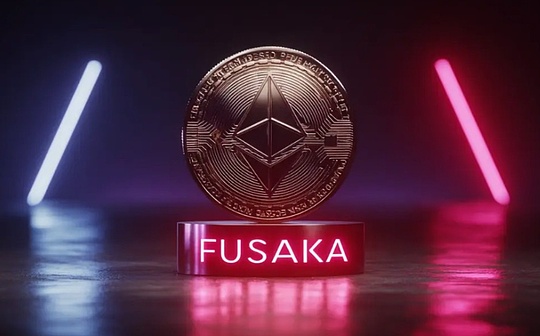
Author:K threeKai; Source: X,@kaikaibtc
It has been 8 days since the Ethereum Fusaka (Fulu + Osaka) upgrade was officially activated.
There were no price spikes and no network outages.It’s as smooth as upgrading the Windows system.Many people think, “Is this the end?”, or even feel bored.
But this kind of “boring” is the scariest thing.Fusaka is designed to allow Ethereum to not only survive but also fight back in 2026 when it is attacked by high-performance chains such as Solana and Monad.
Let’s break it down today:What exactly did Fusaka upgrade?Why do I think this is the beginning of Ethereum’s “data hegemony”?
What is Fusaka?
According to Ethereum’s old naming convention of “city + star”:
Osaka (Osaka):Execution Layer upgrade.
Fulu (belly star):Consensus Layer upgrade.
Combination=Fusaka.
If the previous Pectra upgrade (early 2025) was about making wallets usable (account abstraction), then Fusaka has only one core mission: to drive the price of “data” to the floor.
Fusaka’s core weapon: PeerDAS (Pinduoduo of data)
This is the absolute protagonist of this upgrade-EIP-7594 (PeerDAS).
Before Fusaka, although we had Blobs (which were expanded during Pectra), nodes still had to download a large amount of data.It’s like buying a book and having to read it from cover to cover to make sure it’s complete.This results in an upper limit on the number of Blobs. Although the cost of L2 has dropped, it has not dropped to the level of “negligible”.
What does PeerDAS (Peer Data Availability Sampling) do?It turns “full download” into “spot check”.
The current verification node does not need to download the complete Blob data, but only needs to randomly select a few samples (Sample).If everyone’s random checks are OK, then in terms of mathematical probability, this data is OK.
This means:
-
pair node: The burden has become smaller, and you can run it without buying a T-class hard drive.
-
For L2 (Arbitrum, Base, Optimism): You can add 8 times or more data to Ethereum with almost no increase in cost.
PeerDAS completely transforms Ethereum from an “expensive calculator” into an “infinite capacity hard drive”.
Who is affected by this upgrade?
Many people are criticizing Ethereum for being slow and expensive.But after Fusaka is upgraded, if you look at the gas fees of Base and Arbitrum, you will find that they are approaching the edge of “free” (0.001 cent level).
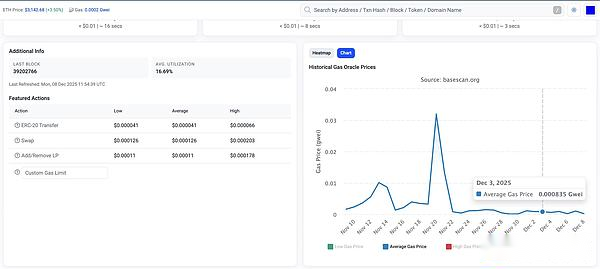
this isVitalikThe conspiracy: L1 (mainnet) no longer serves “human beings”, only L2.
-
Blob capacity skyrocketed: After Fusaka, the target number and maximum number of Blobs have been increased.This is directly beneficial to L2.In the past, L2 had to compete for Blob space, but now it has enough space.
-
Gas Limit adjustment: Although the community has been arguing for a long time about whether to increase the Gas Limit to 150 million, this time Fusaka finally implemented a relatively conservative but steady increase (to a dynamic adjustment space of about 60 million). In order to ensure decentralization, it did not radically increase the node burden.
The future: Where are Verkle Trees?
The “Statelessness” and Verkle Trees (upgraded versions of Merkle trees) that everyone was talking about last year are not fully included in Fusaka.
Fusaka just set the stage.The true “stateless completeness” – that is, you can verify the Ethereum network in seconds with your mobile phone – has been postponed to the next upgrade: Glamsterdam (2026, Glamor + Amsterdam).
This means that although Fusaka solves the congestion of data storage, it does not completely solve the historical problem of Ethereum’s “State Bloat”.This is also one of the reasons why the price of ETH did not skyrocket after the upgrade – the “ultimate form” that the market is looking forward to is still next year.
finally
After the Fusaka upgrade was implemented, several of my judgments:
-
L2’s involution battle begins: Now that it has become cheaper to pay “protection fees” to Ethereum, the profits in the hands of L2 project parties will increase.The next step is to see who is willing to subsidize users and whose ecosystem can produce popular applications.Pay attention to OP Stack and ZK series leading tokens.
-
Position transfer of ETH: Don’t expect the $ETH mainnet to be as silky as Solana.ETH’s current positioning is the “settlement layer of the global digital economy.”It is becoming more and more like the SWIFT system in the United States, or the TCP/IP protocol underlying the Internet.You don’t usually use TCP/IP to chat directly, but you can’t do without it.
-
Bullish in the long term, bottom out in the short term: Technological upgrading is not the end of all benefits, but the completion of infrastructure.Cars (applications) will come only after the roads are repaired.
In 2026, we look forward to the arrival of Glamsterdam, which will be the moment when Ethereum will truly compete with high-performance single chains.