 jakiro
Author:Poopman, crypto analyst; compiled by: Bitchain Vision
Ansem declared a peak and High CT called the cycle a “crime.”
High FDV (fully diluted valuation), products with no practical application are sucking every penny out of the crypto space.Memecoin bundlers destroyed crypto’s reputation in the public eye.What’s worse is that little of the money earned is reinvested into the ecosystem.
On the other hand, almost all airdrops turn into “pump and dump” schemes.The only purpose of TGE’s existence is to provide exit liquidity for early participants and teams.
“Diamond hands” and long-term investors were being slaughtered, and most altcoins never recovered.Bubbles are bursting, tokens are plummeting, and people are angry.
Is it all over?

Hard times make strong people.
To be fair, 2025 isn’t bad at all.We have a long list of outstanding projects: Hyperliquid, MetaDAO, Pump.fun, Pendle, FomoApp, each of them proving that there are still real builders in this industry doing things the right way.
This is a needed purge in the industry to weed out the bad apples.We are reflecting and will improve.
Now, in order to attract more funds and users, we need to show more real applications, real businesses, and token revenue with real value capture capabilities.I believe this is exactly where the industry should be heading in 2026.
2025 in Review: The Year of Stablecoins, PerpDex and DAT
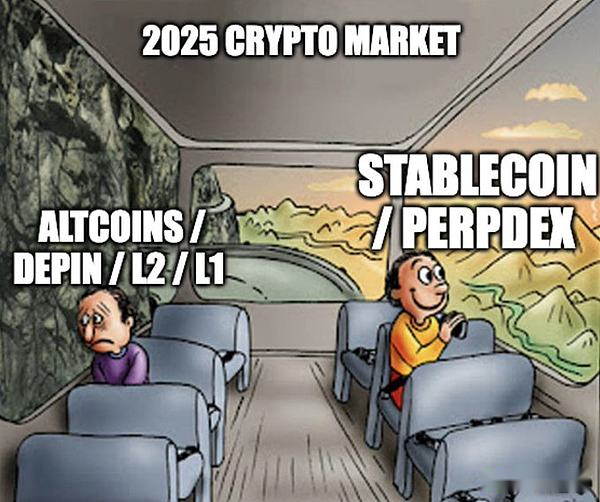
1. Stablecoins mature
In July 2025, the Genius Act was signed, marking the introduction of the first regulatory framework for payment stablecoins.The framework requires stablecoins to be 100% backed by cash or short-term Treasury bills.
Since then, traditional finance (TradFi) has seen a surge in interest in the stablecoin track, with net inflows of stablecoins exceeding US$100 billion this year, the highest in history.
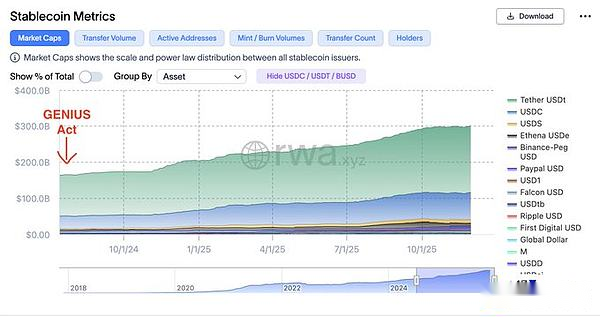
Institutions love stablecoins and believe they have the potential to replace traditional payment systems because:
-
Cheaper and efficient cross-border transactions
-
Instant settlement
-
Extremely low handling fees
-
Available 24/7
-
Hedging against local currency fluctuations
-
On-chain transparency
We’ve seen major acquisitions by tech giants (like Stripe acquiring Bridge and Privy), Circle’s oversubscribed IPO, and top banks collectively expressing interest in issuing their own stablecoins.
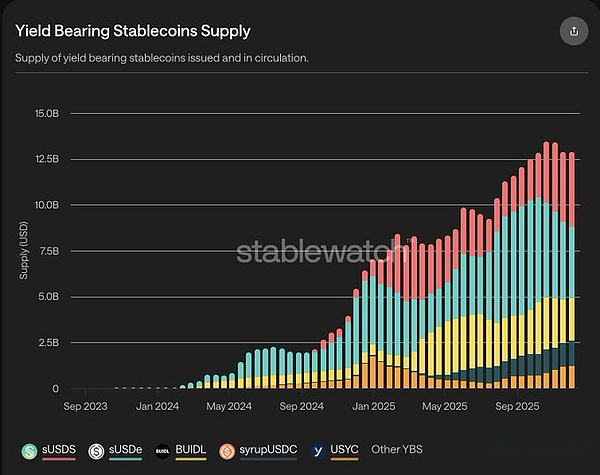
In addition to payments, another great use of stablecoins is to earn permissionless revenue, known as “Yield Stablecoins (YBS)”.
The total supply of YBS has doubled this year to $12.5 billion, driven by BlackRock BUIDL, Ethena and sUSDs, among others.While some recent security incidents, such as Stream Finance, have dampened market sentiment, stablecoins remain one of the few sustainable growth businesses in the crypto industry.
2. Perpetual Contract Exchange (PerpDex)
PerpDex is this year’s star.DeFiLlama data shows that its open interest (OI) has increased by an average of 3-4 times, climbing from US$3 billion to a peak of US$23 billion.Weekly trading volume surged from $80 billion to more than $300 billion.
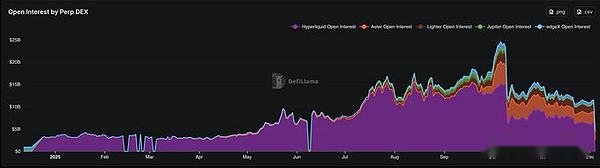
The rise of PerpDex is threatening the hegemony of centralized exchanges (CEX).Taking Hyperliquid as an example, its trading volume has reached 10% of Binance and continues to grow.Reasons why traders choose them include:
-
No real-name verification (KYC) required
-
Liquidity comparable to CEX
-
Airdrop expectations
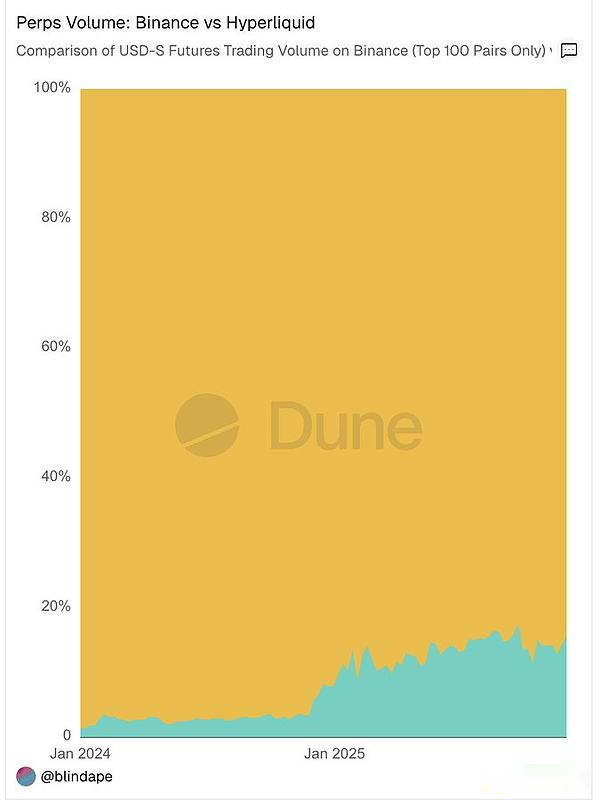
Valuation logic is also changing.Hyperliquid proved that PerpDex could have an extremely high valuation ceiling, triggering a “points war.”Through token buyback mechanisms (such as $HYPE’s buyback), such tokens provide real value support, rather than just being overvalued, useless governance tokens.
3. DAT
Wall Street interest has surged thanks to Trump’s stance on crypto.DAT follows MicroStrategy’s model and becomes a key conduit for traditional finance to gain crypto exposure.
About 76 new DATs were established this year, with total holdings reaching US$137 billion (82% BTC).Over 82% of the assets are in BTC, about 13% are in ETH, and the remainder is spread across different altcoins.
Please look at the picture below:
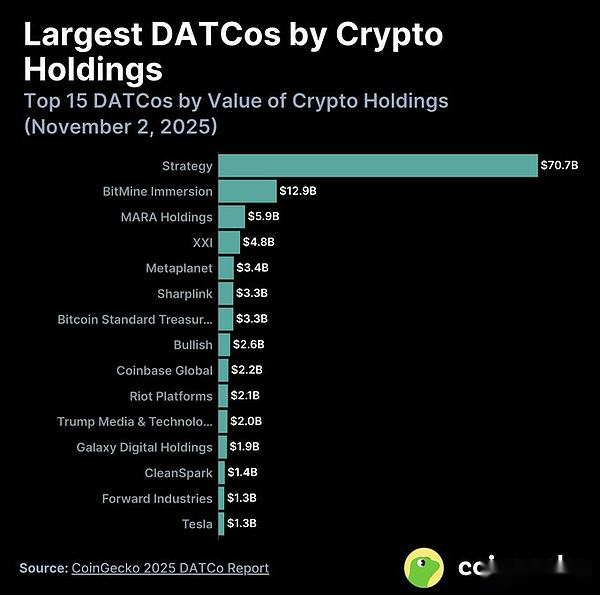
One of the most iconic highlights of this DAT wave was Bitmine (BMNR), founded by Tom Lee, becoming the largest ETH buyer of all DAT participants.But despite the early hype, most DAT stocks experienced a “pump and dump” within their first 10 days.Following October 11, inflows into DATs plummeted 90% from their July highs, and the price of most DATs has fallen below net assets per share (mNAV).This signals that the premium has disappeared and the DAT hype cycle is essentially over.
During this cycle we learned:
-
Blockchain needs more real-world applications.
-
The core usage scenarios of cryptocurrency are still focused on: transactions, financial management (income) and payments.
-
At present, people’s preferences have changed: “fee creation potential” of the protocol > “degree of decentralization” (refer to @EbisuEthan’s view).
-
Most tokens require stronger “value anchors” tied to protocol fundamentals to protect and reward long-term holders.
-
A more mature regulatory and legislative environment will provide greater confidence for builders and top talent to join the industry.
-
Information has become a tradable asset on the Internet (such as prediction market PM, Kaito and other projects).
-
New public chains (L1/L2) that lack clear positioning or competitive advantages will gradually die out.
So, what’s the next step?
Looking forward to 2026: prediction markets, stablecoin payments, mobile terminals and real income
I believe cryptocurrencies will evolve in the following four directions in 2026:
-
Prediction Market
-
More stablecoin payment services
-
More mobile DApp applications
-
more real income

1. Prediction market continues to be popular
There is no doubt that prediction markets have always been one of the hottest tracks in the cryptocurrency space.
-
“The ability to bet on anything”
-
“Predictions of real-world outcomes with up to 90% accuracy”
-
“Skin in the game”
These slogans have brought huge attention to the field, and so have its fundamentals.As of this writing, the prediction market’s total weekly trading volume has surpassed the peak during the US 2024 election (even accounting for wash trading at the time).
Currently, giants like Polymarket and Kalshi have completely dominated distribution channels and liquidity, leaving little room for meaningful market share gains from competitors that lack substantial differentiation (other than Opinion lab).
Institutions are also “fooling” (fomoing): Polymarket received investment from ICE at a valuation of $8 billion, with secondary valuations reaching $12 billion to $15 billion.Meanwhile, Kalshi completed a Series E round at a valuation of $11 billion.
This momentum is unstoppable.
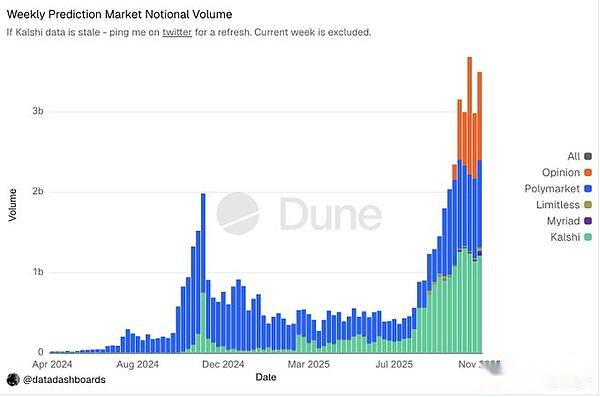
What’s more, with the impending launch of the POLY token, upcoming IPOs, and mainstream distribution channels through platforms like Robinhood and Google Search, prediction markets will easily become one of the dominant narratives of 2026.
Nonetheless, there is still a lot of room for improvement in this area, such as improving adjudication and dispute resolution mechanisms, developing methods to deal with “toxic flow”, and maintaining user participation during lengthy feedback cycles.
In addition to these dominant players, we can also expect new, more personalized prediction markets to emerge, such as @BentoDotFun and others.
2. Stable currency payment field
Institutional interest and participation in stablecoin payments surged in the wake of the Genius Act, becoming one of the key drivers of increased adoption.
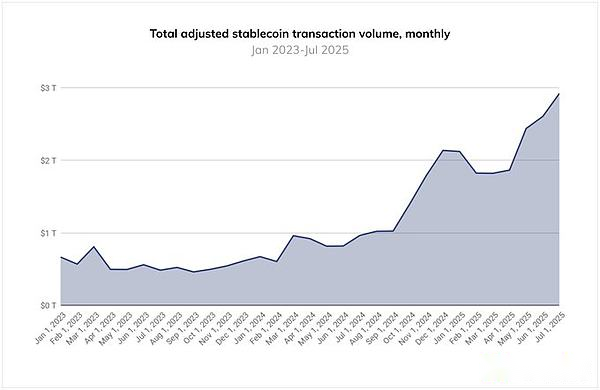
Monthly stablecoin trading volumes have climbed to nearly $3 trillion over the past year, and adoption is accelerating rapidly.While this may not be a perfect metric, it already shows the growth in stablecoin usage after the Genius Act and Europe’s MiCA framework came into effect.
On the other hand, Visa, Mastercard and Stripe are all embracing stablecoin payments, whether by enabling stablecoin consumption through traditional payment channels or by partnering with centralized exchanges (CEXs) (e.g. Mastercard x OKX Pay).Merchants can now choose to accept stablecoins regardless of how customers pay, showing that the Web2 giant is willing to show confidence and flexibility in this type of asset.
Meanwhile, crypto neobank services like Etherfi and Argent (now called Ready) are also offering card products that allow users to spend their stablecoins directly.
Take Etherfi, for example: daily consumption has steadily grown to over $1 million, with no signs of slowing down.

But we can’t ignore the fact that crypto neobanks still face high CAC (Customer Acquisition Cost) and struggle to monetize deposited funds as users self-custody their assets.
Some potential solutions include offering in-app swaps, or repackaging yield products and selling them to users as financial services.
As @tempo and @Plasma prepare to launch as dedicated payments chains, I expect significant growth in the payments space, especially given the distribution and branding power Stripe and Paradigm bring.
3. Popularization of mobile applications
Smartphones are becoming increasingly popular around the world, and younger generations are driving the shift towards electronic payments.
As of now, nearly 10% of daily transactions globally are conducted via mobile devices.Southeast Asia is leading this trend, thanks to its mobile-first culture.
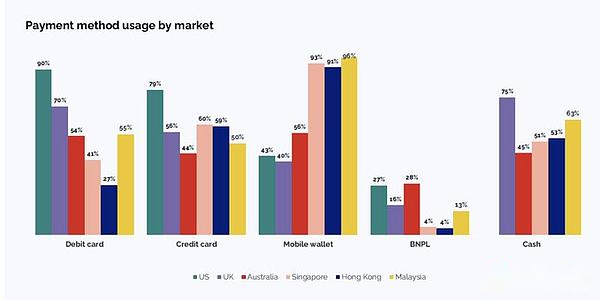
This represents a fundamental behavioral shift in the traditional payments rail, and I believe this shift will naturally extend to the crypto space, as mobile transaction infrastructure has improved significantly compared to just a few years ago.
Remember account abstraction, unified interfaces, and mobile SDKs from tools like Privy?
The mobile onboarding process is much smoother now than it was two years ago.
According to research from a16z Crypto, crypto mobile wallet users grew by 23% year-over-year, and this trend shows no signs of slowing down.

In addition to the changing consumption habits of Gen Z, we also see more mobile-native DApps emerging in 2025.
For example, fomo app, a social trading app, has seen explosive growth in new users thanks to its intuitive, unified experience that allows anyone to buy tokens with no prior knowledge.
In just 6 months of construction, they achieved an average daily trading volume of $3 million, peaking at $13 million in October.
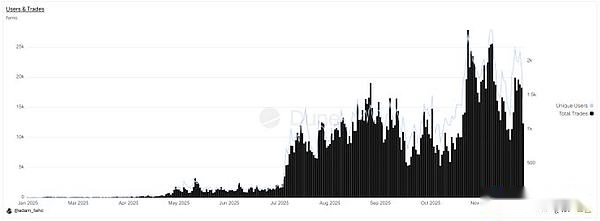
Along with Fomo, major players such as Aave and Polymarket are also prioritizing mobile-first savings and betting experiences.Newcomers like @sproutfi_xyz are experimenting with mobile-first revenue models.
As mobile behavior continues to grow, I expect mobile DApps to be one of the fastest-expanding areas in 2026.
4. Need more revenue (More Revenue PLS)
The main reason people have difficulty believing this cycle is simple:
Most tokens listed on major exchanges either generate little meaningful revenue or, if they do, lack an anchor of value back into the token or “stake.”Rationally speaking, once the narrative fades, these tokens will be unable to attract sustainable buyers and the charts will then just plummet all the way down.
It’s clear that cryptocurrencies favor speculation too much and not enough emphasis on real business fundamentals.
Most DeFi projects fall into the trap of designing a “Ponzi scheme” in order to kick-start initial adoption, and every time, they end up figuring out how to sell after TGE instead of building a lasting product.
As of today, only 60 protocols generate more than $1 million in 30-day revenue.By comparison, Web2 has about 5,000 to 7,000 IT companies generating at least this amount of revenue every month.
Thankfully, things started to change in 2025 under Trump’s pro-crypto policies, which made profit sharing possible and helped solve the long-term problem of weak token value anchors.
Projects such as Hyperliquid, Pump, Uniswap, Aave, and many others have taken the initiative to focus on growing their products and revenue.
They recognize that cryptocurrency is a “bearer-asset” ecosystem, which naturally requires active value accumulation.
This is why buybacks are such a strong anchor of value in 2025, as it’s the clearest signal that team and investor interests are aligned.
So which businesses generate the most solid revenue?
The main usage scenarios of cryptocurrencies are still transactions, financial management and payments.
However, fee compression on blockchain infrastructure means chain-level revenue is expected to fall by around 40% this year.In contrast, DEXs (decentralized exchanges), exchanges, wallets, trading terminals and applications were the big winners, growing by 113%.
Please bet on more apps and DEXs.
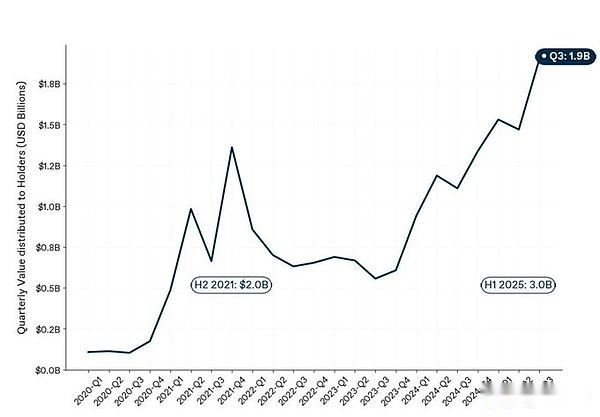
If that doesn’t convince you, we’re actually experiencing the highest flow of value to token holders in cryptocurrency history, according to research from 1kx.Please see the picture below.
Summary
Cryptocurrency is not over, it is evolving.We are going through a cleansing that the market needs that will make cryptocurrencies 10x better than before.
Those projects that can survive, implement real-world applications, generate real revenue, and build tokens with meaningful utility or value accrual will ultimately be the big winners.
2026 will be the year of this transformation.