 jakiro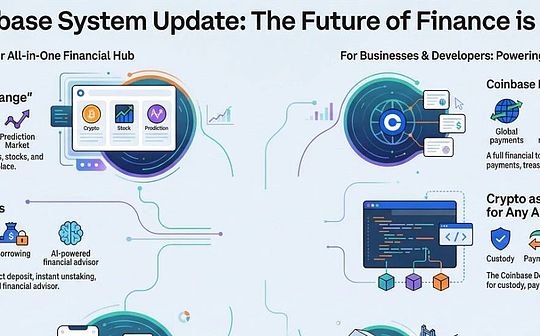
Author: Charlie Liu
I originally didn’t plan to write another article before the end of the year, but there were so many highlights in Coinbase’s “System Update” conference yesterday. After some hesitation, I decided to write again.
This year I wroteRobinhood vs Coinbase, also discussed in depth on a friend’s podcast.Both are Gen-Z’s favorite financial apps, but the battle is getting more complicated.
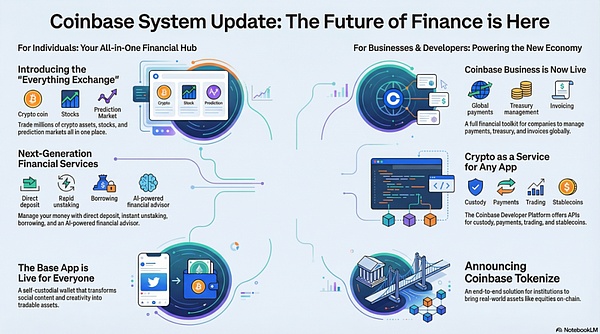
The press conference announced a series of new product features: stocks, prediction markets, perpetual contracts, the DEX entrance of the long-tail assets of Base and Solana on the chain directly into the Coinbase main App, payment and collection for enterprises, AI investment advisors, plus the Base App – which is packaged into a global “everything app” on the chain. The content can be tokenized and tradable, becoming a new platform for creators.
Underneath the superficial “family bucket” approach, there is actually a deeper feeling: Coinbase’s update is not only stacking functions, but also strengthening them.“Distribution layer”anglecolor——Use more distribution portals to turn itself into something more like a one-stop compliant financial product, allowing tokenized finance to occur within its interface, even if the underlying chains, assets, and even exchanges are not native to Coinbase.
Finance looks like a technology war, but it is actually a distribution war.Technology and products are of course key, but profits usually belong toUser mentality and stickiness brought by card slots——When you decide to buy, sell, borrow, or pay, you don’t want to switch apps.
Retail side: It is deliberately blurring the boundaries between itself and Robinhood
Coinbase’s slogan is straightforward: “Everything Exchange.”The most obvious action is to integrate US stock trading into the main app, put crypto and stocks into the same account view, use USD or USDC to buy stocks directly, and add the typical retail-friendly narrative (brought by Robinhood) of “zero commission, 24/5”.
Functionally, this is moving closer to Robinhood.As the largest financial asset class in the retail market, stocks are a must-have and must become the most popular product among C-end customers.
Moreover, Coinbase is not only listed on stocks, it is also listed on another type of thing that is closer to “attention assets” – the popular ones this year.prediction market.During the prediction market launch phase, all market traffic will come from Kalshi.Rather than building everything in-house (for now), start by embedding a compliant, proven backend and keep the front door firmly in your hands.
This is a typical European and American fintech approachStripe/Adyen also started with the payment gateway, which is also a path that Robinhood has verified.
Prediction market: Kalshi is not a function, but a “compliance distribution weapon”
The prediction market has exploded this year, and the comparison that everyone often mentions is Polymarket vs Kalshi.On the surface, it seems to be a battle between products and liquidity pools, but from a distribution perspective, Kalshi’s differentiated competition is that it is easier to be embedded in large platforms.
Kalshi emphasizes that it is a contract market regulated by the CFTC.On the other hand, Polymarket’s dilemma in the United States is stuck in compliance. The closer it is to the best customer base (existing KYC users of large platforms), the more difficult it is to distribute.
That’s why Kalshi’s distribution advantage really comes to fruition: Coinbase doesn’t need to rely on prediction markets to win the “liquidity” indicator on the first day. What it needs is to turn the prediction market into a habitual channel and embed it in an App that already holds user balances and has completed KYC.
To put it more bluntly, like Robinhood, Coinbase wants to capture users’ top moments.Sports, elections, data, policy, climate, cultural hot topics – these are the events that are spread through social media and the ones that most easily turn attention into trading actions.
It is as dangerous as addiction, but it is precisely because it is dangerous that it is forced to appear.
In addition, there is actually a second-order effect that is easily overlooked: prediction markets not only bring transactions, but also data.It is closer to “quantifiable emotions” than social media, captures the turning point of narratives faster than news, and is easier to be transformed into users’ next actions by AI products.
So,When you also put an AI Advisor in the App, the data is not just traffic, but actionable intention input.
Chains and Assets: Beyond Base, win more trust
Coinbase has tasted the sweetness of betting on Base in the past two years, and it will continue on this path.But in this update, a very key gesture is to bring Solana into the same platform for discovering and trading long-tail assets.distribution stream.
On the surface, this is an experience upgrade: no need to switch wallets, no need to deal with complex cross-chain paths.On a deeper level, it is responding to two pressures at the same time.
The first is “perception”.“Will Coinbase always favor its own chain?” This is a trust constraint.If you want to do Everything Exchange, you cannot let users feel that you are promoting your own products, even if they are just suspicious.Multi-chain polymerization is a way to suppress this doubt.
The second is “capture”.Let the cycle be ecological at the other endFlow to Coinbase’s own ecosystem, complete transactions and cross-sell within its own fee, risk control, and distribution systems.It’s not “Coinbase turns DeFi”, but “Coinbase turns DeFi into its own underlying supply”, which is the logic of a distribution entrance.
The third one is “enterprising”,ifEthereum and Solana continue to compete for narrative space as “Wall Street’s preferred chain”, Coinbase brings both sides into the distribution plane at the same time, which is essentially improving its strategic position as a “neutral entrance”——No matter which chain wins in the end, it hopes to be invincible.
B2B: Stripe + Brex’s ambition, one year of transformation
Looking further away from retail, Coinbase Business is positioned more and more like a “one-stop enterprise financial service”: for start-ups and small and medium-sized enterprises, it provides a complete set of accounts, payments, collections, USDC income, compliance infrastructure, etc., and enters from key markets such as the United States and Singapore where enterprise financial services are mature.
Over the past year, the transformation and evolution from Coinbase Commerce to Coinbase Business has been impressive.
It’s helpful to use the “Stripe + Brex” analogy—not that Coinbase will replace them, but that it is benchmarking against more full-stack and more complete B2B fintech services.
Stripe’s strength is “acquisition and orchestration”.Brex’s forte is “Spend and Money Management.”What Coinbase is building is a set of crypto-native enterprise services: stablecoin settlement, global payments, USDC fund management, and the ability to place assets, send and receive payments in the same account, and may add more tools in the future.
What makes it more powerful is not only the surface-level SaaS service of Coinbase Business, but also the underlying modular CDP (Coinbase Developer Platform) – and its hint that Coinbase wants to expand its customers to “all apps.”
Coinbase summarizes the capabilities of CDP into four pillars: custody, payment, transaction, and stable currency.Translated: Any App can grow wallets, payments, and transactions based on Coinbase’s underlying capabilities.
And x402 is more like its continued bet on the new narrative of agentic commerce:It wants to sit under one layer of the application economy and not just be part of the crypto economy.
Stripe made money in an era when e-commerce moved to APIs.And Coinbase is betting on a new era:When payments, wallets, and transactions migrate to stablecoin tracks and chains, money will also flow to infrastructure providers along similar paths.
Identity and attention: Base App is the answer to the “post-SocialFi” era
Coinbase says the Base App is already available in 140+ countries, describing it as an onchain everything app: social, trading, payments, distribution, making money all mixed together, and the content is tokenizable and tradable.
Web2’s monetization stack has centralized value. Creators often receive salaries, and platform fees and inflation eat away at purchasing power.
The narrative of Base App is web3 that a16z has been preaching: if your works, influence, and community relationships exist in the wallet in the form of native assets on the chain, it is possible for creators to directly obtain the income from future appreciation, instead of only receiving the little salary-type income allocated by the platform to offset inflation and currency over-issuance.
But the difficulty is also very real: the performance of SocialFi implemented by a16z based on the web3 concept is not ideal, and iconic projects like Farcaster are converging in the “wallet first” direction – because pure social networking is not likely to compound interest, wallets and asset loops are.
Put in this context, the intention of Base App is clear: Coinbase is not trying to make a better Instagram/TikTok, but is saying: the wallet is the new account, and the information flow is the new asset discovery mechanism.The social layer is subordinate to the financial layer and the distribution logic is dominated by assets..
AI Advisor: It’s the glue and the risk amplifier
Coinbase Advisor turns natural language intentions into portfolios and execution paths, and emphasizes that it is non-autonomous – no orders are automatically placed without user confirmation.
This is almost an inevitable development direction: when you put stocks, encryption, sustainability, prediction markets, and lending all into one App, you must reduce decision fatigue and enhance discovery mechanisms, and use AI to assist information collection, analysis, and decision-making.You cannot ask ordinary users to be their own CIO, macro researcher and risk control officer every day.From a strategic perspective, it is grabbing the “intent layer”.
But this may also be the place where the most backlash will come in the future: when an App is equipped with stocks, sustainability, prediction markets, social trading, and AI advice at the same time,It will be judged by regulators and the public with the “worst result” instead of the “smoothest experience”..”AI makes me…” This sentence pattern is naturally suitable for future news to use to smear them.
Coinbase can use a compliance structure to suppress risks as much as possible, but goodwill risks still exist and will be amplified as the distribution area expands.
So, what is Coinbase becoming?
Putting these together, Coinbase is more like building three interlocking moats.
The first is the consumer home screen: Multi-asset trading + high-frequency attention loop (prediction market) + long-tail asset discovery (DEX aggregation, seamless cross-chain).
The second channel is the enterprise/developer base: Wallet, stablecoin payment, transaction API, allowing other apps to develop financial capabilities on top of it, x402 is trying to write itself into the next generation payment default standard.
The third way is identity: Base App combines wallet, information flow, and ownership into a distribution surface, allowing “content-transaction-income” to form a closed loop.
In this framework, comparing only Robinhood is correct, but it is not enough.Robinhood is just a retail distribution machine, while Coinbase wants to be:Retail distribution + commercial distribution + wallet/identity distribution.
The ambition is great, but the constraints are also clear:Regulation and trust.
This battle ultimately does not depend on whether Coinbase can implement the function, but on whether it can maintain the coherence of the experience under regulatory pressure – and not be forced to fragment into a bunch of tabs that do not compound each other.As long as it can maintain the consistency of the “home screen”, this distribution surface will begin to strengthen itself.