 jakiro
Decentralized Finance (DeFi) builds a point-to-point financial system through blockchain and smart contract technology, and strives to eliminate centralized intermediaries such as banks, thereby reducing costs and process time.Among the numerous DeFi protocols, Aave stands out as the leading lending platform.
Aave’s team led by Stani Kulechov was launched in November 2017 under the name “ETHLend” and was renamed Aave (Finnish meaning “ghost”).As the non-custodial lending agreement of the Ethereum ecosystem, Aave allows users to lend another asset with one crypto asset, while lenders can earn interest by providing liquidity.This article will systematically sort out Aave’s development history and current situation and compare its advantages over traditional finance in detail.
1. Aave’s development history
-
2017: StaniKulechov launched ETHLend, a peer-to-peer lending platform, and raised $16 million through ICO.In 2018, ETHLend was renamed Aave (meaning “ghost”) and replaced the original LEND token with AAVE at a ratio of 1:100.
-
January 2020: AaveV1 main network has been officially launched, introducing a liquidity pool model, allowing users to deposit crypto assets into the pool for other users to over-mortgage loans, thereby significantly improving the efficiency of capital use.
-
December 2020: AaveV2 was released, further reducing transaction costs and adding new features such as batch lightning loans.Among them, Lightning Loan is the first innovative feature launched by Aave in 2020. Users can borrow funds without collateral in advance, and they can only repay the principal and interest in the same transaction.
-
March 2022: AaveV3 is released, focusing on improving cross-chain capabilities and risk control.V3 supports multi-chain deployment and is compatible with Ethereum Layer2 network (such as Arbitrum, Optimism) and other Layer1 chains (such as Polygon, Fantom, etc.).At the same time, V3 introduced a cross-chain “portals” function, allowing users to “deposit on the Ethereum main network, borrow on Polygon, and repay on Avalanche”, which greatly improved asset liquidity and arbitrage efficiency.
-
July 2023: Aave launches native decentralized stablecoin GHO.GHO can be minted by collateralizing a variety of assets, and all interest income belongs to the Agreement DAO.In the same month, the Aave community also voted to connect to the US dollar stablecoin PYUSD issued by PayPal, taking the pace of cooperation with traditional financial institutions.
-
Future (expected in 2025): Aave will release the V4 version and introduce a new “Hub-and-Spoke” architecture.In V4, each network (such as Ethereum and each Layer2) will have a unified liquidity hub (Hub), and different “radiometric” market connection hubs can support configurations for special assets or strategies, thus breaking the situation of liquidity silos in each market under V3.This architecture will further improve capital utilization, simplify governance processes, and facilitate innovative products such as dedicated markets for stablecoins, derivatives or real assets.
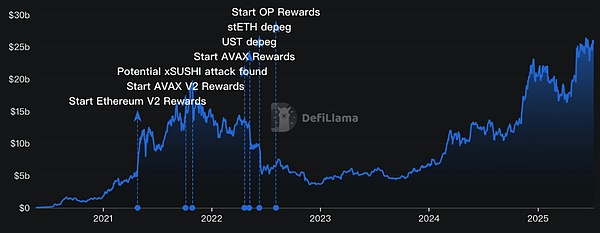
As of May 2025, Aave’s total lock-in value (TVL) has hit a new high, exceeding US$26 billion, becoming one of the most important lending agreements in the DeFi field.
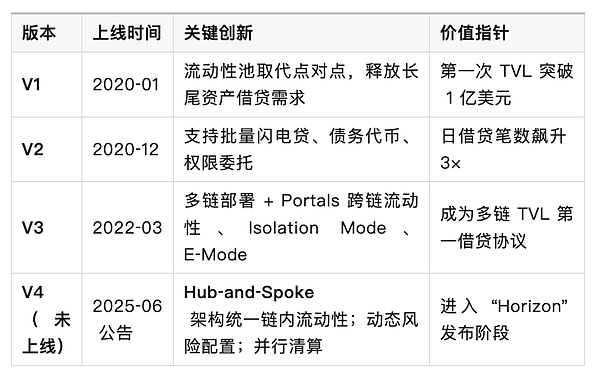
V4 highlights: A “liquidity hub (Hub)” is installed in a single chain, called by a diversified “Spoke” to ensure capital efficiency, but also support customized scenarios such as RWA, E‑Mode, and Vault.
2. The current situation of Aave
Aave has now become a decentralized, non-custodial integrated liquidity protocol, where users around the world can play the role of liquidity providers (depositors) or borrowers in multiple networks, and its core functions include:
-
Liquidity pool: The user deposits crypto assets into the agreement’s asset pool to earn floating interest; the borrower provides excess mortgage to obtain loans.Aave’s algorithm dynamically adjusts deposit interest rates and loan interest rates based on market supply and demand to achieve a decentralized interest rate discovery mechanism.
-
Lightning loan: Aave’s first Flash Loan allows users to borrow without collateral and return it in the same transaction.This mechanism supports second-level arbitrage, clearing and rescue, and complex combination transactions, becoming a unique tool in DeFi.
-
GHO stablecoin: GHO is a native decentralized stablecoin in the Aave ecosystem. Users can mint GHO by collateralizing crypto assets that have been deposited into the V3 market, while retaining the interest generated by the collateralized assets.GHO is governed by the community and its repurchase interest is used to supplement the agreement vault, thereby providing financial support for Aave’s long-term development.
-
Governance mechanism: AAVE token is the governance token of the Aave protocol. Holders can vote in the decentralized autonomous organization (DAO) to decide the direction of the agreement, such as introducing new assets, modifying parameters and enabling new functions.This community-driven governance ensures transparency and autonomous evolution of protocols.
-
Cross-chain extension: Aave has been deployed on the Ethereum main network and multiple chains such as Avalanche, Polygon, Arbitrum, Optimism, Fantom, etc.The bridge and interoperability design between each chain allows users to freely transfer funds and obtain benefits between different networks, showing Aave’s high degree of adaptability and flexibility.
-
Safety measures: The Aave protocol has been audited by several top security companies and has a vulnerability bounty program to inspire white hat hackers around the world to discover risks.In addition, Aave’s “Safety Module” allows users to pledge AAVE tokens, providing additional guarantees for the agreement; if there is a fund shortage, the staking pool of the security module can be used to make up for losses, and the staked person will receive generous rewards.
3. Comparison with other lending agreements
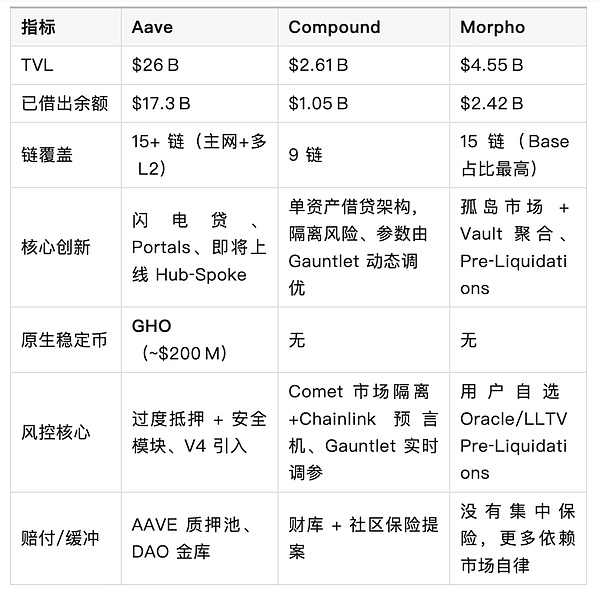
in conclusion: Aave TVL is still far ahead, but Morpho is achieving “starting up and overtaking” through Vaults aggregation and CEX scenario cooperation.Compound attracts institutional users with a single benchmark asset model.
4. Advantages of Aave (DeFi) compared to traditional finance
Compared with the traditional financial system that relies on centralized institutions, DeFi protocols such as Aave have significant advantages:
-
Decentralization and non-mediation: Traditional lending requires intermediaries such as banks and securities firms, and the process is cumbersome and there are high handling fees.Aave enables peer-to-peer transactions through smart contracts without third-party approval and custody.Borrowing and repayment are performed automatically on the chain, and users only need to connect to a crypto wallet to participate in global financial activities without credit review or lengthy KYC processes.
-
Openness and inclusion: Traditional finance usually sets the threshold high, making it difficult for people without bank accounts or credit history to obtain services.In contrast, DeFi platforms such as Aave are open to any user with an Internet connection without geographical restrictions.For example, users around the world can deposit and borrow crypto assets at any time through Aave, and are not subject to bank branches and working hours.
-
Transparency and auditability: Traditional financial institutions often lack transparency in operations, and ordinary customers find it difficult to understand internal processes and capital flows.Each transaction and capital flow of the Aave protocol is recorded on the public blockchain, and the protocol code can be checked open source.Anyone can audit smart contract logic and all transaction records to ensure that the protocol runs transparently and can eliminate black box operations.
-
Efficiency and immediacy: Traditional loan approval and cross-border payments may take several days or even weeks, accompanied by high handling fees.Aave achieves instant matching and loan loans through smart contracts, and Lightning Loan can complete the lending process in one block.This near-real-time capital turnover greatly improves the efficiency of capital use, and users can obtain liquidity without a long wait.
-
Innovative financial tools: Aave continues to launch innovative products, such as Lightning Loan, which enables unsecured arbitrage, and the high-efficiency model (E-Mode) increases the borrowing rate of similar assets to 98%.Its modular design also enables the protocol to be seamlessly connected with other DeFi ecosystems (such as Uniswap, Curve, etc.), derives a variety of strategies such as cross-protocol arbitrage and income aggregation, creating a product iteration speed far exceeding the traditional financial cycle.
-
User control and asset autonomy: In the traditional banking system, customer assets are custodianized by banks and other institutions. Once a dispute or policy changes occur, personal assets may be frozen or misappropriated.As a non-custodial agreement, Aave always has the private keys and only operates according to the preset rules of the smart contract after the funds are deposited into the agreement.This means that the user has full control over the assets and does not rely on trusting any intermediaries.
V. Challenges and risks
Despite many advantages, Aave also faces the following challenges:
-
Smart contract risk: DeFi protocol code vulnerabilities may cause funds to be stolen or lost.Although Aave significantly reduces risks through multiple security audits and vulnerability bounty programs, any software is inevitably potentially flawed and users still need to be cautious.
-
Market volatility: The price of crypto assets fluctuates violently, and the value of collateral may suddenly drop, triggering automatic liquidation.Aave requires over-collateral to ensure loan security, but when the market falls sharply, borrowing positions may still be forced to close.Although this liquidation mechanism maintains the stability of the protocol, it may also bring additional risks to ordinary users.
-
Regulatory uncertainty: The decentralized characteristics of DeFi conflict with the current regulatory framework.Current financial regulations are mostly based on jurisdiction restrictions, and it is still difficult to cover cross-chain anonymous transactions.In the future, agreements such as Aave may face compliance pressures, such as anti-money laundering (AML) and securities laws, which need to find a balance between decentralization and compliance.
-
Complexity of use: For users who lack blockchain experience, Aave’s concept and operation process are relatively complicated.For example, Lightning loans and high-efficiency models require understanding of smart contracts and transaction principles, and the learning cost is high.The high flexibility of the protocol also means a steep learning curve, which is especially challenging for new users.
6. Future prospects
Looking ahead, Aave will continue to maintain its leadership through innovation.
Technical levelThe launch of Aave V4 will bring a new design: cross-chain hubs (Hubs) unified liquidity, and various special markets (Spokes) provide services to specific asset groups.This structure is expected to be gradually implemented in 2025, and is expected to further improve funding efficiency and flexibility.
Application level, Aave is actively working with traditional financial institutions and emerging projects.For example, in early 2024, the Aave community voted to connect to the US dollar stablecoin PYUSD issued by PayPal, exploring the interconnection of stablecoins and mainstream payment ecosystems; at the same time, Aave has supported a bridging mechanism to introduce stablecoins and real-world assets into the protocol.
Regulation and competitionOn the one hand, Aave needs to cope with the tightening global regulatory environment, strengthen compliance construction, and continue to innovate under the challenges of competitors such as Compound and Morpho.Overall, with the improvement of blockchain technology and DeFi maturity, Aave is expected to become a bridge connecting traditional finance and decentralized finance, providing global users with more democratic, efficient and transparent financial services.