 jakiro
1. Introduction
Chatting with a friend today, he raised an interesting question: “If Crypto × Fintech really creates gains in the next 10 years, who will be the biggest winners? In other words, who will be the ‘Mag7’ companies in this field?”
Revolut, Robinhood, Coinbase, Stripe… these are obviously the first names that will be mentioned.Over the past decade, they have proven their ability to reinvent certain parts of traditional finance.
But while chatting, I suddenly realized: There was actually a misunderstanding in my previous thinking framework.I’m always asking—“What aspects of traditional finance have not been redone?” This logic is still essentially looking for gaps in the old map.
But what you should really ask is:Which companies are not digitizing old finance but creating a whole new financial market?
Under this framework, there is one name that is almost the default –Polymarket.Not because it’s rising fast, or because it’s been cited frequently by the media recently, but because it does something completely different:It does not transform banks, nor does it transform payments. What it transforms is the “event” itself.It turns events into assets and probabilities into prices.
And coincidentally, prediction markets have exploded again in the past year.So we naturally asked another more important question:Why will prediction markets suddenly become “one of the most worthy of research tracks” in 2024–2025?In this round of renaissance, what paths do Polymarket, Kalshi, and Opinion represent?
2. Why will the prediction market heat up again in 2024–2025?
If you only use “US elections” and “celebrity incidents” to explain this wave of popularity, it actually doesn’t hold water.There have been numerous hot spots in the past few years, but the prediction market has not risen so high.This time is different.There are several deeper structural changes behind it.
1) AI makes “probability” important again
In the past, the answers given by large models were judgment sentences; now, more and more scenarios are beginning to outputProbability.Forecasting CP, predicting interest rate cuts, predicting company events, and predicting policy trends, after the probability appears, a demand will naturally arise:Probability requires price, and price requires the market.So, for the first time, prediction markets becamePart of the AI workflow.rather than a “speculative instrument”“.The impact of this point will far exceed the discussion we are seeing now.
2) It is regarded by the media as a “real-time sentiment indicator”
Over the past year, one change has been evident: Polymarket has been cited in more and more mainstream media outlets.Why?Because it is faster than polling and more transparent than expert judgment.Media Citations → User Growth → Increased Market Depth This is a simple but effective flywheel.In the past, the prediction market was not big enough because it did not enter the mainstream narrative; now it has.
3) The density of events is high, but the market lacks “corresponding tools”
In the world of 2024–2025, the information density is higher than at any time in the past decade: elections, geography, macro policy, technology regulation, corporate events (especially AI) The question is:These events have a huge impact, but there are no corresponding financial instruments that can be traded.
You can buy gold, U.S. stocks, and Treasury bonds, but you can’t buy: “Changes in the probability of the Federal Reserve cutting interest rates in December.””Whether a certain CEO will resign this quarter” and “whether a certain regulation will be implemented”, the prediction market has just filled this gap.Essentially, it creates a new asset type:event assets.
4) Small but important changes in regulatory attitudes
The CFTC once fined Polymarket, but at the same time, Kalshi obtained a CFTC license.This is a very realistic signal: part of the prediction market can be allowed to follow the compliance route, and the gray area begins to be divided. For institutional investors, “uncertainty is reduced” is a signal of growth.
5) The user structure has changed
In the past: Mainly entertainment users, liquidity was dispersed, and products were more like “information applications”.This wave is obviously different: there are more institutional accounts, professional players who make indicator predictions have entered, funds using it as a hedge have begun to increase, and AI companies have used it as a reference. When the user structure upgrades from “eating melons” to “trading”, the quality of the market will undergo a qualitative change.
Summary
Prediction markets didn’t suddenly become popular.It is a structural rise formed by the demand for AI, media citations, macro-environmental promotion, changes in user structure, and the gradual clarification of regulatory boundaries.This wave is not driven by short-term events.It’s more like the first time prediction markets have gained “use scenarios of the era.”
3. Three completely different paths: Polymarket, Kalshi, Opinion
They are also doing prediction markets, but these three companies are taking completely different routes.They do not solve the same problem, nor do they face the same type of users.Looking at them together, we can see the possible future layered structure of this track..
1) Polymarket: Turn the event itself into an asset
Polymarket’s route is very straightforward: turn events into assets and probabilities into prices.It is not a “prediction tool” in the traditional sense, but more like a real-time event price screen.The higher the social attention, the greater the event density, and the more frequently cited by the media, the faster its market reaction will be.The low threshold for user understanding and strong emotional push are the reasons for its fastest growth.The advantage is speed; the challenge is regulation.In one sentence:Entrance to event capitalization
2) Kalshi: a regulated event derivatives exchange
Kalshi is the most financial route.What it does is an event contract that can be defined by regulation and captured by models: CPI, unemployment rate, yield, FOMC, etc.It attracts a different kind of user: macro traders, hedge funds, quant teams.This determines that its trading structure is more stable and scalable than Polymarket.
The political market you see on Kalshi does not mean that it is the same type of product as Polymarket – politics is just one of the regulated event categories and does not bear the logic of growth.In one sentence:event derivatives exchange,Financial infrastructure for prediction markets.
3) Opinion Labs: Model consensus layer in the AI era
Opinion takes the third route, not trading for the public, nor serving institutional traders.It attempts to build a “probabilistic consensus layer” for AI models: so that the probabilities output by different models can be aggregated, quoted, and ultimately priced by the market.Its target users are not people, but models.Not “let users place bets”, but “let the model have a readable, tradable probabilistic interface”.
This path has a longer time scale and is more forward-looking.Compared with the first two companies, Opinion is obviously in the earliest stage of development.
It already has a trading interface (opinion.trade), but it will restrict access to the United States, China and other regions, so the access experience is inconsistent in different network environments.There is not much public information, and the main external contact point is still Twitter.The bottom layer is still undergoing rapid iteration, and the brand and official website are not priorities.
This is not an “immature website experience”, but a typical state of early infrastructure projects: first run through the underlying mechanism, and then gradually move towards external stabilization.
In one sentence: Opinion already has products, but they are still in a very early stage. They are more like a bottom-level building block of the future AI ecosystem rather than a member of the current competition for user scale.
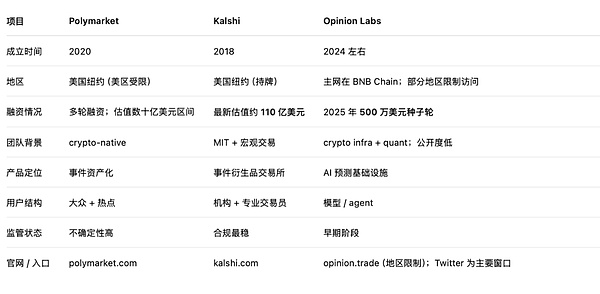
Polymarket, Kalshi and Opinion all seem to be doing prediction markets, but their directions, product structures, compliance paths and future positioning are completely different:PolymarketWhat is captured is “attention and emotion.”KalshiWhat is captured is the “risk and pricing model”.OpinionCaptures “how AI understands the future.”
They correspond to the three-layer structure of the prediction market:Public layer, financial layer, model layer.It is precisely because these three paths appeared at the same time that this round of prediction market is not like the past – it is not that a product suddenly became popular, but that a market is taking shape.
4. My observation on this track: AI is making noise, and Web3 is distinguishing noise
I don’t want to draw a conclusion about “what will happen in the future” to the prediction market, because I have not done in-depth research on this track.But in the past year, in different projects and different product forms, I have seen one thing repeatedly:The combination of AI and Web3 is happening faster than we thought, and the direction is very clear.
The ability of AI lies in “generation” – generating text, generating judgments, and generating predictions.But as it generates more and more content, a new problem becomes more and more obvious:AI is making noise.Judgment, explanation, probability, inference, each is growing exponentially.The amount of information becomes more → the noise becomes louder → the cost becomes higher.
The role of Web3 is just behind the noise:Web3 is distinguishing noise.What it provides is not “content”, but: it cannot be tampered with, can be settled, can be verified, incentives can be aligned, and prices can be formed
The combination of the two will gradually become natural in the financial market:
-
AI is responsible for generating views of the future;
-
Web3 is responsible for putting these opinions into the market and subjecting them to the test of price, time, and incentives.
Prediction markets are just a very intuitive example.It turns “AI-generated probabilities” into “prices that finance can use.”From this perspective, it is more like an interface than an application.I’m not sure what this track will ultimately look like, but what I can see is:AI is making the future more ambiguous, and Web3 is making the future more verifiable.In financial markets, the two naturally need each other.