 jakiro
Author: AJC, Drexel Bakker, Youssef Haidar; Source:Messari 2026 Crypto Theses;Compiled by: Bitchain Vision
core ideas
1. BTC has clearly distinguished itself from all other crypto-assets and is undoubtedly the dominant form of cryptocurrency.
2. BTC will perform poorly in the second half of 2025, partly due to increased selling pressure from early large holders.We do not believe this underperformance will become a long-term structural issue and expect Bitcoin’s monetary narrative to remain intact for the foreseeable future.
3. L1 valuation is increasingly divorced from its fundamentals.The sharp year-on-year decline in public chain revenue means that its valuation is increasingly dependent on expectations of currency premiums.With few exceptions, we expect public chains to underperform Bitcoin.
4. ETH is still the most controversial asset.Concerns about value capture have not yet fully eased, but the performance of the second half of 2025 proves that the market is willing to treat it as a cryptocurrency along with Bitcoin.If the cryptocurrency bull market returns in 2026, Ethereum digital asset treasury (DATs) may usher in a “second spring.”
5. ZEC is gradually being priced as a privacy cryptocurrency rather than a niche privacy coin, making it a complementary hedging tool for Bitcoin in an era of intensified surveillance, institutional dominance, and financial repression.
6. Applications may start to adopt proprietary currency systems instead of relying on the native assets of the network where they are located.Applications with social attributes and strong network effects are the most likely candidates to make this shift.
Introduction
It is no accident that the 2026 Messari Crypto Thesis opens with the most fundamental and important part of the cryptocurrency revolution—currency.When we first planned this report this summer, we never imagined that market sentiment would turn so sharply negative.
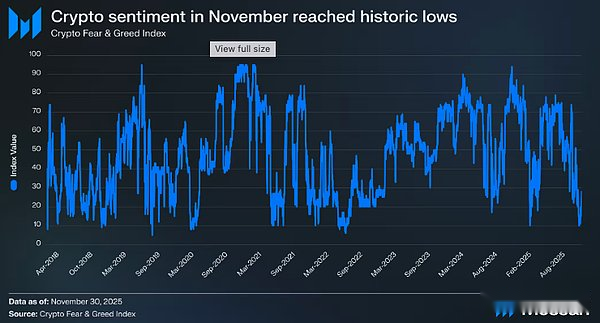
In November 2025, the Cryptocurrency Fear and Greed Index dropped to 10 (“Extreme Fear”).Prior to this, the index had fallen to 10 or lower only in the following periods:
– From May to June 2022, the chain reaction caused by the collapse of Luna and the crisis of Three Arrows Capital (3AC);
– A massive wave of liquidations in May 2021;
– COVID-19 crash in March 2020;
– Multiple points during the 2018-2019 bear market.
There have only been a handful of times in the history of the cryptocurrency industry when sentiment has been more subdued than it is now, and only when the industry truly went into meltdown and the future was uncertain.But this is obviously not the case today: there are no large exchanges running away with user funds, there are no blatant Ponzi schemes with valuations reaching tens of billions of dollars, and the total market capitalization has not fallen below the previous cycle high.
On the contrary, cryptocurrencies are gaining recognition and integration at the highest levels of global institutions.The U.S. Securities and Exchange Commission (SEC) has publicly stated that it expects all U.S. markets to be on-chain within two years; stablecoin circulation has hit an all-time high; and the “someday in the future” application implementation narrative that we have repeatedly mentioned for ten years has finally become a reality – however, industry sentiment has almost never been so bad.Almost every other week, a trending post appears on social platform
Amidst this disconnect between the collapse of market sentiment and the rise of institutional applications, it is an excellent time to re-examine cryptocurrencies from first principles.The original rationale that gave rise to the chaotic but beautiful industry we love today is actually very simple: build an alternative currency system that is superior to the current fiat currency system.This ideal has been deeply embedded in the industry’s DNA since Bitcoin’s genesis block – which famously contained the message: “The Times January 3, 2009 Chancellor on edge of second bank bailout”.
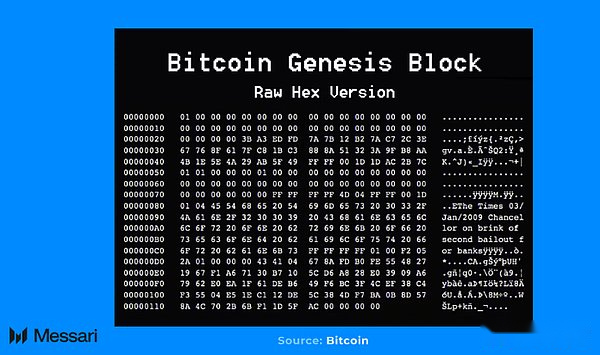
This origin is crucial because during its development, many people have forgotten the original purpose of cryptocurrencies.Bitcoin was not created to provide banks with better clearing channels, to reduce the cost of foreign exchange transactions by a few basis points, or to drive endless speculative token “slot machines.”The birth of BTC is a response to a failed monetary system.
Therefore, to understand where cryptocurrencies are today, we need to return to the core question of the entire industry: Why is cryptomoney so important?
1. What is Cryptomoney?
For much of modern history, people had few substantive choices about the currency they used.Under the current global monetary order based on fiat currency, people are actually subject to the decisions of their national currencies and their central banks.The state determines the currency in which you earn, save and pay taxes – whether that currency is inflated, devalued or mismanaged, you have to live with it.And in almost every political and economic system—whether free market, authoritarian, or developing country—the same pattern holds true: Government debt is a one-way street.

Over the past 25 years, the debt scale of the world’s major economies has increased significantly relative to GDP.As the world’s top two economies, the government debt-to-GDP ratios of the United States and China have increased by 127% and 289% respectively.Regardless of political regime or growth model, rising government debt has become a structural feature of the global financial system.And when debt grows faster than economic output, the costs will be borne primarily by savers—inflation and low real interest rates erode the value of fiat currency savings and transfer wealth from individual savers to the state.
Cryptomoney provides an alternative to this system by separating the state from the currency.Throughout history, governments have changed monetary rules through inflation, capital controls, or restrictive regulations when it suited their interests.Cryptocurrency hands over monetary governance to a decentralized network rather than a central authority – a move that re-empowers people with monetary choices.Rather than being trapped in a monetary system that is often at odds with their long-term financial well-being, savers can choose monetary assets that align with their priorities, needs and desires.
But choice only makes sense if the chosen object offers real advantages.Cryptocurrency is just like this. Its value comes from a number of core attributes that distinguish it from all previous forms of currency:
First, the core value cornerstone of a cryptocurrency is its predictable, rules-based monetary policy.These rules do not come from institutional commitments, but are properties of software run by thousands of independent actors.Changing the rules requires broad consensus rather than the subjective decision-making of a few people, which makes it extremely difficult to change currency rules arbitrarily.Unlike a fiat currency system—where the supply of fiat currency expands in response to political and economic pressure—the rules by which cryptocurrencies operate are public, predictable, and enforced by consensus and cannot be quietly modified behind the scenes.
Second, cryptocurrencies reshape the way personal wealth is kept.In a fiat currency system, true self-custody has become impractical: most people rely on banks or other financial intermediaries to store their savings.Even traditional non-sovereign asset alternatives such as gold often end up in centralized vaults, reintroducing trust-based risks.In practice, this means that your assets could be delayed, restricted in use, or even frozen entirely if the custodian or the state decides to take action.

Cryptocurrencies enable direct ownership, allowing individuals to hold and secure their assets without relying on a custodian.The importance of this capability has become increasingly important as financial restrictions such as bank withdrawal limits and capital controls become increasingly common around the world.
Finally, cryptocurrencies are tailor-made for a globalized digital world.It can be transferred across borders instantly, with no limit on the amount, and without the need for institutional permission.This gives it a significant advantage over gold – which is difficult to divide, verify or transport, especially across borders.Cryptocurrencies can be transferred globally in minutes, on any scale, without relying on centralized intermediaries.This ensures that individuals can freely transfer or allocate their wealth regardless of geographical location or political environment.
All in all, the value proposition of cryptocurrency is clear and unambiguous: it provides individuals with currency choice, establishes predictable rules, eliminates single points of failure, and enables unlimited global movement of value.In a system where government debt continues to climb and savers bear the consequences, the value of cryptocurrencies will continue to grow.
2. BTC: The Dominant Cryptocurrency
Bitcoin created the cryptocurrency category, so it’s natural for us to start with it.Nearly 17 years later, Bitcoin is still the largest and most widely recognized asset in the entire industry.And since money is essentially the product of social consensus rather than the result of technical design choices, the real criterion for measuring the status of a currency is whether the market assigns a long-term premium to an asset. From this perspective, Bitcoin’s status as the dominant cryptocurrency is unquestionable.
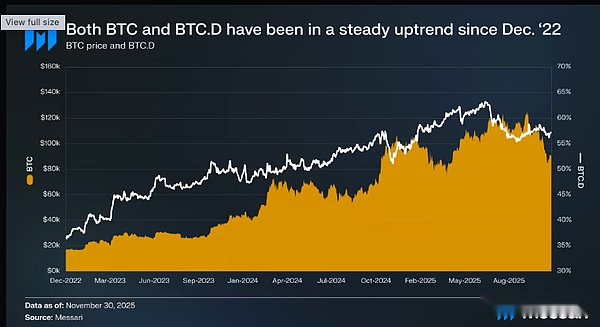
This is most evident in the performance of Bitcoin over the past three years: from December 1, 2022 to December 2025, Bitcoin rose from US$17,200 to US$90,400, an increase of 429%, setting record highs many times during this period (the most recent one was US$126,200 on October 6, 2025).At the beginning of this period, Bitcoin’s market value of approximately $318 billion was not enough to rank among the world’s largest assets; today, its market value has reached $1.81 trillion, making it the ninth most valuable asset in the world.The market not only recognizes Bitcoin’s monetary attributes and gives it a higher valuation, but also elevates it to the first echelon of global asset rankings.
But even more telling is Bitcoin’s performance relative to other cryptocurrencies.Historically, during cryptocurrency bull markets, Bitcoin’s market capitalization share (BTC.D, the ratio of Bitcoin’s market capitalization to the total cryptocurrency market capitalization) has shrunk as funds move toward the end of the risk curve; however, in this current Bitcoin bull market, this trend has completely reversed.In the past three years, Bitcoin’s market capitalization share has increased from 36.6% to 57.3%—Bitcoin is diverging from the entire cryptocurrency market.
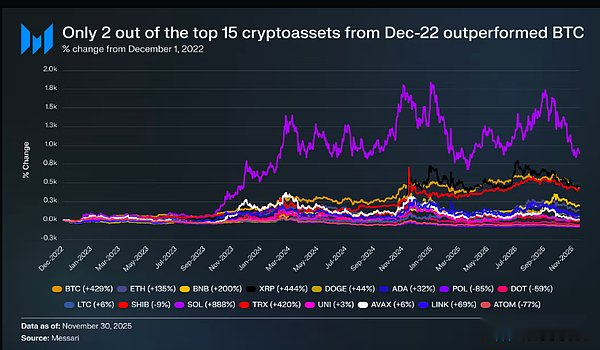
Of the top 15 cryptoassets on December 1, 2022, only two (XRP and SOL) outperformed Bitcoin, and only SOL performed with a significant advantage (up 888% compared to Bitcoin’s 429%).Other assets in the market lagged behind significantly, with many large-cap assets barely rising or even falling during the same period: Ethereum rose 135%, BNB rose 200%, Dogecoin (DOGE) rose 44%, while assets such as POL (-85%), DOT (-59%), ATOM (-77%) are still stuck in the quagmire.What’s more noteworthy is Bitcoin’s size – as a trillion-dollar asset, it would have required the most capital to drive its price, yet it still outperformed almost every major coin.This suggests there is real, sustained buying pressure on Bitcoin, while most other assets are behaving more like beta assets, only rising when Bitcoin drives the overall market higher.

One of the main drivers of Bitcoin’s continued buying pressure is growing institutional adoption.The landmark event for this institutional adoption was the launch of the spot Bitcoin ETF.Market demand for such products is extremely strong. BlackRock’s iShares Bitcoin Trust (IBIT) broke multiple ETF records and was hailed as “the most successful debut in ETF history” – IBIT achieved $700 billion in assets under management (AUM) in just 341 days, 1,350 days faster than the previous record of the SPDR Gold Shares (GLD) ETF.
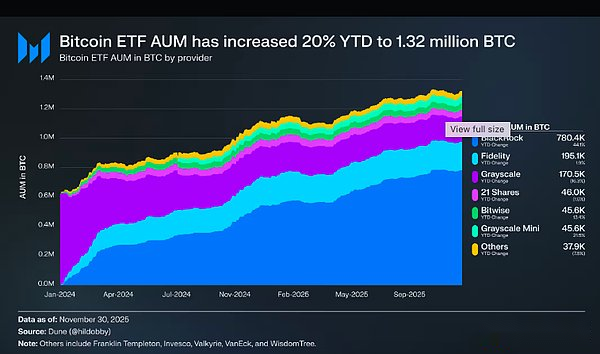
The momentum of ETF launches in 2024 has continued directly into 2025, with total ETF assets under management increasing by 20% year-on-year, from approximately 1.1 million Bitcoins to 1.32 million.These products hold more than $120 billion worth of Bitcoin at current prices, accounting for more than 6% of Bitcoin’s maximum supply.Rather than subside after the initial initial rush, ETF demand has become an ongoing source of buying pressure, continuing to accumulate Bitcoin regardless of market conditions.
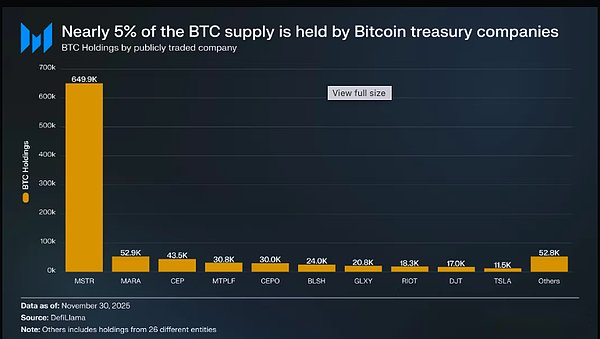
Additionally, institutional involvement extends far beyond ETFs.In 2025, digital asset treasuries (DATs) became major buyers, further strengthening Bitcoin’s status as a treasury reserve asset.While Michael Saylor’s MicroStrategy has long been the most prominent example of a company accumulating Bitcoin, nearly 200 companies around the world now have Bitcoin on their balance sheets.Listed companies alone hold approximately 1.06 million Bitcoins (5% of the total supply), of which MicroStrategy holds 650,000 Bitcoins, occupying an absolute dominant position.
The most important event in 2025 that will further differentiate BTC from other cryptocurrencies is the establishment of the “Strategic Bitcoin Reserve” (SBR).The SBR formally recognized the distinction that the market had already made between Bitcoin and other cryptocurrencies – treating Bitcoin as a strategic monetary commodity and placing all other digital assets into a separate reserve category for routine management.In a statement, the White House described Bitcoin as a “unique store of value in the global financial system” and likened it to “digital gold.”Finally, and most importantly, the directive requires the Treasury Department to develop a strategy for increasing its holdings of Bitcoin in the future.While no such purchases have occurred yet, this option alone suggests that U.S. federal policy is now viewing Bitcoin through a forward-looking reserve asset lens.If implemented, such accumulation plans would further solidify Bitcoin’s status as a currency, not just among cryptoassets, but across all assets.
3. Is BTC a high-quality currency?
While Bitcoin has solidified its position as the leading cryptocurrency, 2025 raises a new set of questions about its monetary properties.As the largest non-sovereign monetary asset, gold remains Bitcoin’s most important benchmark.Gold is having one of its strongest annual performances in decades as geopolitical tensions rise and expectations of future monetary easing rise — but Bitcoin is not following the trend.

Although the Bitcoin-to-gold (BTC/XAU) ratio briefly hit an all-time high in December 2024, it has since fallen back by about 50%.This pullback is noteworthy because it comes against the backdrop of gold surging to record highs against the U.S. dollar – up more than 60% since 2025 to $4,150 an ounce.With gold’s total market capitalization approaching $30 trillion, and Bitcoin accounting for only a fraction of that, this divergence raises a legitimate question:
If Bitcoin fails to keep pace with gold during one of its strongest cycles, how solid is its status as “digital gold”?
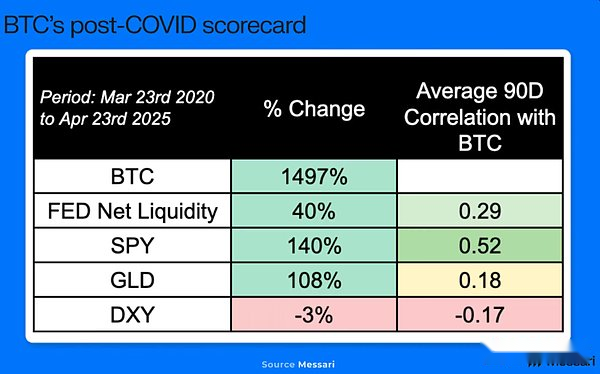
If Bitcoin moves inconsistently with gold, then the next thing to look at is how it performs relative to traditional risk assets.Historically, Bitcoin has experienced correlation phases with stock benchmark indexes such as the S&P 500 ETF (SPY) and the Nasdaq 100 ETF (QQQ).For example, from April 2020 to April 2025, Bitcoin’s 90-day rolling correlation with SPY averaged 0.52, while its correlation with gold was relatively weak (0.18).Therefore, if the stock market weakens, Bitcoin’s lag relative to gold may be understandable.

But that’s not the case.Since 2025, gold (XAU) is up 60%, SPY is up 17.6%, QQQ is up 21.6%, while Bitcoin is down 2.9%.Considering Bitcoin’s smaller size and higher volatility compared to gold and major stock indexes, its underperformance relative to these benchmarks in 2025 raises legitimate questions about its monetary narrative.With both gold and stocks hitting all-time highs, one would have expected Bitcoin to show similar moves, especially given its historical correlations – but this has not been the case.Why?
The first thing to point out is that this underperformance is recent and not a year-round trend.As of August 14, 2025, Bitcoin’s absolute return during the year is still higher than that of gold, SPY and QQQ; its relative weakness did not begin to appear until October.What is noteworthy is not how long this weakness lasts, but its severity.
While there may be multiple factors contributing to this severe relative weakness, we believe thatThe biggest driver of Bitcoin’s lackluster performance is the behavior of early large holders.Over the past two years, as Bitcoin has become increasingly institutionalized, its liquidity characteristics have changed significantly.Now, through deep, regulated markets such as ETFs, large holders can sell assets without causing the market shocks that were inevitable in earlier cycles – creating for many such holders the first real opportunity to take profits.
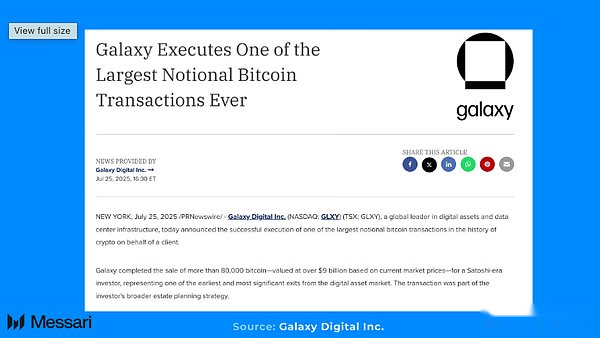
There is ample anecdotal and on-chain evidence that some long-dormant holders have taken the opportunity to reduce their holdings.Earlier this year, Galaxy Digital facilitated the sale of 80,000 Bitcoins by a “Satoshi era investor” – a single transaction representing 0.38% of the total Bitcoin supply and from a single entity.
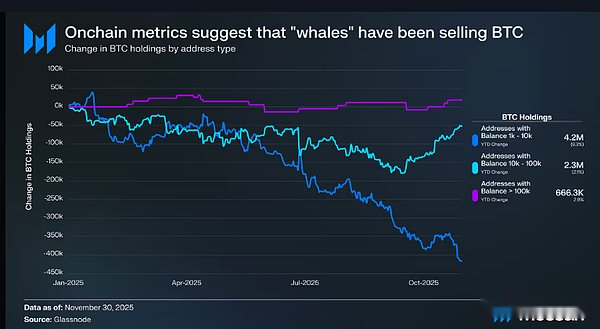
Bitcoin on-chain indicators reflect a similar situation.Some of the largest and longest-standing holders (addresses holding 1,000-100,000 Bitcoins) have been net sellers throughout 2025.These addresses held 6.9 million Bitcoins (nearly one-third of the total supply) at the beginning of the year and continued to sell throughout the year: the group holding 1,000-100,000 Bitcoins had a net outflow of 417,300 Bitcoins (-9% year-on-year), and the group holding 100,000-1 million Bitcoins had an additional net outflow of 51,700 Bitcoins (-2% year-on-year).
As Bitcoin becomes increasingly institutionalized and more money moves off-chain, the informational value of on-chain metrics will naturally decline.Even so, combined with anecdotal evidence such as investors selling Bitcoin during the Satoshi era, these data still provide a reasonable basis for the following conclusions:In 2025, especially in the second half of the year, early large holders will be net sellers.
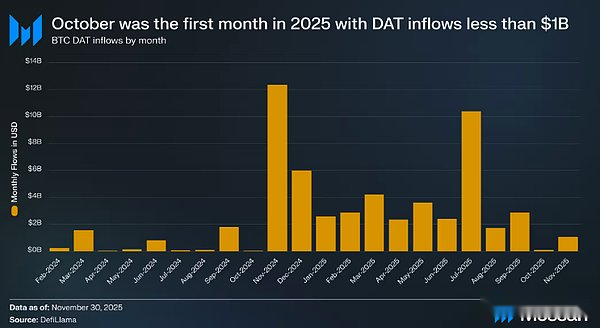
This wave of supply also coincides with a significant slowdown in the main buying flows that have driven up Bitcoin prices over the past two years: inflows into digital asset treasuries (DATs) dropped sharply in October, marking the first time in 2025 that monthly net inflows into DATs were less than $1 billion; on the other hand, spot ETFs, which have continued to be net buyers throughout the year, have turned to net sellers since October.With DATs and ETFs, the two major sources of stable demand for Bitcoin, temporarily weakened, the market had to absorb the dual pressures of declining inflows and reductions in holdings by early holders at the same time.
Still, is there reason to worry?Does the recent poor performance mean that BTC’s monetary properties have expired?In our opinion, the answer is no.As the old saying goes: “When in doubt, take the long view.”It would be difficult to dismiss Bitcoin based on just three months of weakness — especially given that Bitcoin has endured longer periods of underperformance in the past, only to still rebound and hit new all-time highs against the U.S. dollar and gold.While this underperformance is currently a setback, we do not believe it is a structural issue.
Looking to 2026 is another challenge.As Bitcoin is increasingly viewed as a macro asset, traditional frameworks such as four-year cycles are less important than they once were.Bitcoin’s performance will be influenced by broader macro factors, which means the relevant question becomes: Will central banks continue to increase their gold holdings?Will AI-driven stock trading continue to accelerate?Will Trump fire Powell?If so, will Trump force the new Fed chairman to start buying Bitcoin?These variables are difficult to predict, and we do not claim to know their results.
But what we are confident about is Bitcoin’s long-term monetary trajectory.Over time spans of years and decades, we expect Bitcoin to continue to appreciate in monetary value relative to the U.S. dollar and gold.Holding this view ultimately boils down to a simple question: “Are cryptocurrencies a superior form of money?” If the answer is yes, then the long-term direction of Bitcoin is clear.
4. In addition to Bitcoin: What is the situation of the L1 public chain?
Bitcoin has clearly established itself as the dominant cryptocurrency, but it is not the only crypto asset with a monetary premium.The valuations of multiple L1 public chain tokens also reflect a certain degree of currency premium, or market expectations that they may form a currency premium in the future.
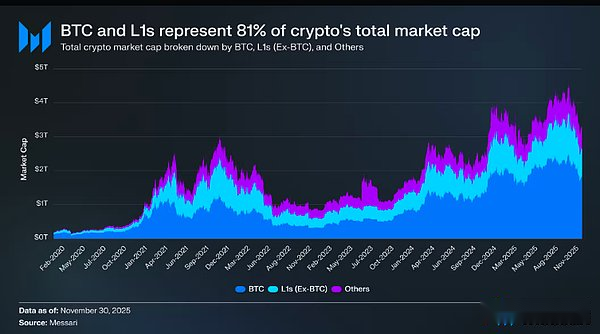
The total market value of cryptocurrencies is US$3.26 trillion, of which Bitcoin accounts for US$1.8 trillion, and approximately US$830 billion of the remaining US$1.45 trillion is concentrated in the L1 public chain (non-Bitcoin public chain).In total, $2.63 trillion in market capitalization (approximately 81% of the total market capitalization) comes from cryptoassets that have been regarded as currencies by the market, or are considered to be expected to form a currency premium.
So whether you’re a trader, investor, capital allocator or industry builder, it’s critical to understand how markets confer and recoup monetary premiums.In the world of cryptocurrencies, few factors influence the valuation of an asset more than the market’s willingness to treat it as a currency.From this perspective, predicting the flow of currency premiums in the future is undoubtedly the most core consideration in the construction of cryptocurrency portfolios.
As mentioned above, we expect Bitcoin to continue to take market share from gold and other non-sovereign stores of value in the coming years.But what does this mean for other public chains?Is “a rising tide lifting all boats” and all crypto assets benefit together?Or will Bitcoin fill the valuation gap between itself and gold by plundering the currency premium of other public chains?
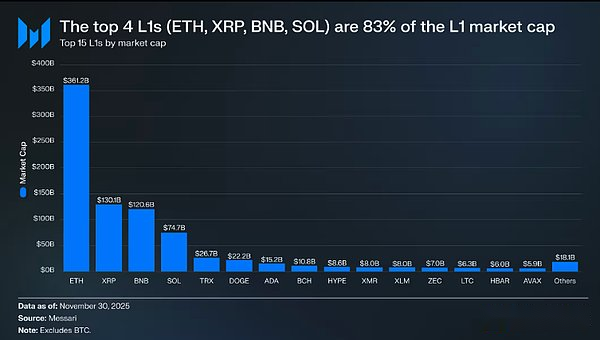
To answer this question, we first need to clarify the current valuation status of public chains.The top four public chains by market value are Ethereum (US$361.15 billion), XRP (US$130.11 billion), BNB (US$120.64 billion) and Solana (US$74.68 billion), with a total market value of US$686.58 billion, accounting for 83% of the L1 public chain market.After the top four, the market value of public chains has declined rapidly (Tron Coin has a market value of US$26.67 billion), but it still has a certain scale – Avalanche Coin, which ranks fifteenth in market value, has a valuation of more than US$5 billion.
It should be emphasized that L1 market capitalization is not solely determined by the implicit currency premium.There are three main frameworks for public chain valuation: (1) currency premium, (2) real economic value (REV), and (3) economic security needs.In other words, the market value of a project is not simply derived from the market’s expectation that it will be treated as currency.

Although there are games of multiple valuation frameworks, the market is increasingly inclined to price L1 from a currency premium perspective rather than a revenue-driven perspective.In the past few years, the overall price-to-sales ratio (P/S) of all L1 public chains with a market value of over US$1 billion has slowly climbed from 200 times to 400 times.However, this surface number is misleading – because it includes two special projects, Tron and Hyperliquid.In the past 30 days, Tron and Hyperliquid contributed 51% of the group’s revenue, but their market capitalization accounted for only 4%.
Once these two outliers are eliminated, the true valuation logic emerges clearly: the valuation of the L1 public chain rose instead of falling despite the continued decline in revenue.The adjusted price-to-sales ratio shows a continued upward trend:
– November 30, 2021: 40 times
– November 30, 2022: 212 times
– November 30, 2023: 137 times
– November 30, 2024: 205 times
– November 30, 2025: 536 times
If interpreted from the perspective of actual economic value, the market seems to be pricing future revenue growth in advance.But this explanation cannot withstand scrutiny – the revenue of the same public chain portfolio after excluding outliers has been in decline except for one year:
– 2021: US$12.33 billion
– 2022: US$4.89 billion (down 60% year-on-year)
– 2023: US$2.72 billion (down 44% year-on-year)
– 2024: US$3.55 billion (31% year-on-year growth)
– 2025 (annualized): US$1.70 billion (down 52% year-on-year)
In our opinion,The most straightforward and reasonable explanation is that the current valuation of the L1 public chain is dominated by currency premiums, not its current or future revenue levels.
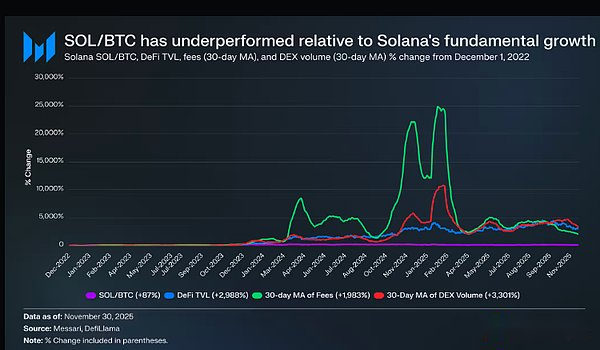
An in-depth analysis of Solana’s excess performance reveals that its growth rate does not actually match the growth rate of the ecosystem.During the same period when SOL achieved 87% excess returns relative to Bitcoin, its ecological fundamentals showed explosive growth: decentralized finance (DeFi) lock-up value increased by 2988%, fee income increased by 1983%, and decentralized exchange (DEX) transaction volume increased by 3301%.By any reasonable measure, Solana and the ecosystem have expanded 20 to 30 times in size since December 1, 2022.However, SOL, which is supposed to carry the value of ecological growth, has an excess return of only 87% relative to Bitcoin.
Please read the above data carefully again.
For an L1 public chain to outperform Bitcoin, its ecological growth rate does not need to reach 200% to 300%, but it needs to achieve explosive growth of 2000% to 3000% in order to obtain less than double excess returns.
Based on all the above analysis, we believe that although the market is still pricing other public chains based on the expectation that “currency premium will form in the future”, the confidence in this expectation is quietly losing.At the same time, the market’s confidence in Bitcoin’s currency premium has not only not weakened, but its lead has continued to expand.
From a technical perspective, the valuation of cryptocurrency does not necessarily require handling fees or revenue support, but these indicators are crucial to public chains.Different from Bitcoin, the narrative logic of other L1 public chains is based on building an ecosystem that can support the value of the token (including applications, users, throughput, economic activities, etc.).However, if the ecological usage of an L1 public chain declines year-on-year (directly reflected in the decline in handling fees and revenue), then the public chain will lose its only competitive advantage over Bitcoin.Without the support of actual economic growth, the “cryptocurrency” narrative of these public chains will become increasingly difficult to be accepted by the market.
Looking forward, we do not expect this trend to reverse in 2026 and beyond.With a few exceptions, other L1 public chains will continue to transfer market share to Bitcoin.Their valuations mainly rely on the expectation that “currency premium will occur in the future”, and as the market gradually realizes that Bitcoin is the most competitive cryptocurrency, the valuations of these L1 public chains will continue to shrink under pressure.
Although Bitcoin will also face many challenges in the future, these challenges are either too far away or depend on many unknown variables to provide substantial support for the currency premium of other public chains.For other public chains, the burden of “proving themselves” has shifted – under the aura of Bitcoin, their narratives are no longer convincing, and they cannot always rely on the overall enthusiasm of the market to support valuations.
5. Opponent’s point of view: Can other L1 public chains challenge Bitcoin?
Although we believe that it will be difficult for other L1 public chains to outperform Bitcoin in the short term, it would be a mistake to conclude that their currency premium will eventually return to zero.The market rarely gives a certain type of asset a valuation of hundreds of billions of dollars for no reason, and the persistence of such valuations just shows that investors believe that some L1 public chains can occupy a long-term and unique place in the cryptocurrency landscape.In other words, although Bitcoin has stood out and become the dominant monetary asset in the cryptocurrency field, if Bitcoin fails to properly solve several structural challenges it faces in the future, some L1 public chains may still take the opportunity to seize their own currency track.
1. Quantum computing threats
Currently, the most urgent threat to Bitcoin’s currency status is the “quantum computing threat.”Once the computing power of a quantum computer breaks through the critical point, it will be possible to crack the Elliptic Curve Digital Signature Algorithm (ECDSA) used by Bitcoin, and then derive the private key from the public key.In theory, this would compromise all on-chain addresses whose public keys have been exposed, including those that are reused, as well as old unspent transaction outputs (UTXOs) created before best security practices became common.
According to calculations by Nic Carter, approximately 4.8 million Bitcoins (23% of the total supply) are stored in exposed addresses that are vulnerable to quantum attacks.Among them, 1.7 million Bitcoins (8% of the total supply) are stored in early p2pk addresses. These coins can almost be regarded as “dead coins” – their holders have either passed away, are no longer active, or have long lost their private keys.These dead coins constitute the biggest unsolved problem facing Bitcoin.
Once the threat of quantum computing becomes a reality, the Bitcoin network must be upgraded to support quantum-resistant signature schemes.If this transformation cannot be completed, the monetary value of Bitcoin will collapse instantly, and the widely circulated slogan will be reversed to “your private key may not be your currency.”Therefore, we believe that the Bitcoin network is highly likely to be upgraded to deal with quantum threats.But the real problem is not “whether to upgrade”, but how to deal with those dead coins that cannot be migrated.Even if new quantum-resistant address formats are introduced, these dead coins will always be vulnerable.
Currently, there are two main solutions to this problem in the industry:
– Option 1: Maintain the status quo.Eventually, any subject with quantum computing power could steal these dead coins and put 8% of the total Bitcoin supply back into circulation—with a high probability that these coins would go to people who never held them.This will almost certainly depress the price of Bitcoin and undermine market confidence in its currency properties.
– Option 2: Destroy dead coins.Setting a specific block height and then marking all dead coins in vulnerable addresses as unspendable essentially removes them from the circulating supply.But this approach also has drawbacks: it violates Bitcoin’s core principle of “resistance to censorship” and may even set a dangerous precedent of “destroying tokens through voting.”
Thankfully, quantum computing is unlikely to pose a material threat anytime soon.Although the predictions of various parties vary greatly, even the most radical estimates believe that the earliest time window in which the threat may appear is around 2030.Based on this timeline, we do not expect substantial progress on quantum computing in 2026 – it will remain a long-term governance challenge rather than an imminent technical problem.
But beyond this timeline, things become unpredictable.The biggest suspense is how the Bitcoin community will deal with dead coins that cannot be migrated to quantum-resistant addresses.We cannot predict the final choice, but what is certain is that the community will make decisions that are most conducive to maintaining and maximizing the value of Bitcoin at all costs.
The above two solutions actually have their own rationality.The first option maintains the censorship resistance of Bitcoin, but at the cost of the market needing to absorb a sudden increase in supply; the second option, although it triggers controversy about censorship resistance, can prevent these Bitcoins from falling into the hands of criminals.
Regardless of which path Bitcoin ultimately chooses, quantum computing issues are a real and long-term governance challenge it faces.Once the quantum threat comes true and the Bitcoin network fails to complete the upgrade in time, its currency status will completely collapse.By then, those alternative cryptocurrencies that have deployed anti-quantum technology in advance will have an excellent opportunity to absorb the currency premium lost by Bitcoin.
2. Lack of programmability
Another major shortcoming of the Bitcoin network is that it does not have universal programmability.Bitcoin was not originally designed to be Turing complete – its scripting language was limited in scope from the beginning, which resulted in strict limitations on the complexity of on-chain transaction logic.Unlike other public chains that support native smart contracts and can automatically verify and execute signature conditions, Bitcoin can neither verify external information nor achieve trustless cross-chain bridging without the support of off-chain infrastructure.Because of this, many types of applications (such as decentralized exchanges, on-chain derivatives, privacy tools, etc.) are almost impossible to build on the Bitcoin main chain.
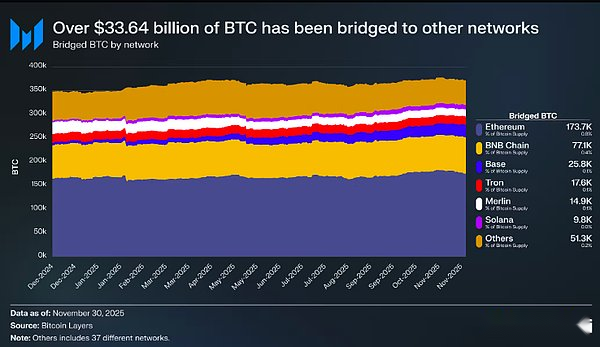
Although some supporters believe that this design reduces the attack surface of the network and maintains the simplicity of Bitcoin as a currency, it is undeniable that a considerable number of Bitcoin holders hope to use Bitcoin in a programmable environment.As of this writing, 370,300 Bitcoins (worth approximately $33.64 billion) have been cross-chain bridged to other networks.Among them, 365,000 Bitcoins (accounting for 99% of all cross-chain Bitcoins) were cross-chained through custody solutions or solutions that introduced trust assumptions.In other words, to use Bitcoin in a more feature-rich ecosystem, users have to reintroduce the trust risks that Bitcoin was originally designed to eliminate.
The Bitcoin ecosystem is also trying to solve this problem, such as alliance side chains, early second-layer networks (L2), trustless multi-signatures and other solutions, but these attempts have not fundamentally reduced the reliance on trust assumptions.Users are eager to use Bitcoin in a highly expressive ecosystem, but in the absence of a trustless cross-chain solution, they can only resort to centralized custodians.
As the scale of Bitcoin continues to expand, its macro asset attributes become more and more prominent, and the market’s demand for “efficient ways to utilize Bitcoin” will also continue to grow.Whether using Bitcoin as collateral, borrowing against Bitcoin, exchanging for other assets, or interacting with a programmable financial system with richer functions, users are naturally not satisfied with just “holding” Bitcoin.However, under the current design framework, these usage scenarios are accompanied by extremely high long-tail risks – without entrusting assets to a centralized intermediary, it is almost impossible to use Bitcoin in programmable or leveraged scenarios.
For the above reasons, we believe that the Bitcoin network may need to fork to implement these trustless, permissionless usage scenarios.We are not advocating that Bitcoin transform into a smart contract platform, but we believe that the introduction of a specific operation code (such as OP_CAT) is the most reasonable choice – it can achieve trustless Bitcoin cross-chain bridging.
The appeal of OP_CAT is that it requires only minor modifications to the consensus rules to unlock Bitcoin’s trustless cross-chain capabilities.This is not about transforming Bitcoin into a smart contract platform, but using a simple opcode, combined with Taproot and existing script primitives, to allow the Bitcoin main chain to directly enforce the spending conditions of cross-chain transfers.This solution can realize a trustless cross-chain bridge that does not require custody, alliance, or external verification nodes, and fundamentally solves the current core risk of hundreds of thousands of Bitcoins being locked in custodial cross-chain encapsulated assets.
Unlike the quantum threat, the lack of programmability is not an “existential crisis” for Bitcoin’s monetary properties.But it does limit the total addressable market size of Bitcoin as a cryptocurrency.The market demand for programmable currency already exists – more than 370,000 Bitcoins (accounting for 1.76% of the total supply) have been cross-chained to other ecosystems, and the scale of locked assets in decentralized finance (DeFi) has exceeded US$120 billion.As cryptocurrencies gain popularity and more and more financial activities move on-chain, this demand will continue to rise.Bitcoin currently cannot provide a path to “trust the use of Bitcoin in a programmable ecosystem.” If the market deems this risk unacceptable, then programmable public chain assets such as Ethereum and Solana will take on this demand.
3. Security budget issues
The third structural challenge facing Bitcoin is the security budget.This issue has been discussed for more than a decade, and despite differing opinions on its severity, it remains one of the most controversial long-term issues of Bitcoin’s monetary integrity.The core of the security budget is the total revenue that miners can obtain from maintaining network security, which currently consists of block rewards and transaction fees.With block rewards halving every four years, Bitcoin will eventually rely primarily, if not entirely, on fees to incentivize miners to maintain network security.
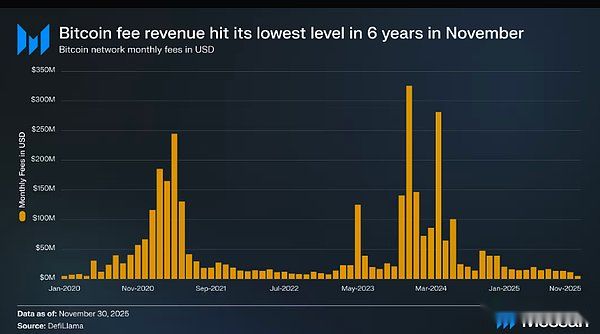
Once upon a time, with the popularity of Ordinals and Runes, the market once believed that transaction fees alone were enough to support miners’ income and ensure network security.In April 2024, the fee income on the Bitcoin chain reached US$281.4 million, setting the second-highest monthly record in history.However, today, a year and a half later, fee income has plummeted – in November 2025, the Bitcoin chain fee was only US$4.87 million, setting the lowest monthly record since December 2019.
While the plunge in fee income is alarming, there may not be too much concern in the short term.Block rewards still provide significant incentives for miners today, and will continue to do so for decades.Even in 2050, the Bitcoin network will still produce about 50 Bitcoins per week – which is still a mining profit that should not be underestimated for miners.As long as block rewards dominate miner revenue, there is no substantial threat to the security of the Bitcoin network.But it is undeniable that the possibility of transaction fees completely replacing the current block rewards is becoming smaller and smaller.
However, the discussion about security budget is far more complicated than “whether handling fees can completely replace block rewards.”The fee does not need to reach the size of the current block reward, it only needs to exceed the cost of launching a credible attack – and this cost itself is unknown and can fluctuate significantly with changes in mining technology and energy markets.In the future, if mining costs drop significantly, the minimum fee threshold required to maintain network security will also be lowered.This may be achieved through a variety of scenarios: in mild scenarios, iterative upgrades of mining machine chips and efficient use of idle renewable energy will reduce the marginal cost of miners; in extreme scenarios, breakthroughs in energy production technology (such as commercial nuclear fusion, ultra-low-cost nuclear energy) may reduce electricity prices by several orders of magnitude, completely changing the economic model of mining.
Although we admit that there are too many unknown variables to accurately calculate a “reasonable threshold” for Bitcoin’s security budget, it is still necessary to assume an extreme situation: What will happen if future miner profits are not enough to cover the economic costs of maintaining network security?In this case, the economic incentive mechanism that supports Bitcoin’s “trusted neutrality” will begin to fail, and the security of the network will increasingly rely on social consensus rather than enforceable economic constraints.
One possible result is that certain entities (such as exchanges, custodians, sovereign states, and large holders) may “mine at a loss” to protect the Bitcoin assets they rely on for survival.However, although this kind of “defensive mining” can maintain the operation of the network, it may weaken the market consensus on the currency attributes of Bitcoin. If users realize that the security of Bitcoin needs to rely on the collaborative support of large entities, its “currency neutrality” and even currency premium will face severe tests.
Another possibility is that no entity is willing to take losses to defend Bitcoin.By then, Bitcoin will face the risk of a 51% computing power attack.Although a 51% attack will not completely destroy Bitcoin (proof-of-work currencies such as Ethereum Classic and Monero have survived 51% attacks), it will undoubtedly cause the market to fundamentally question the security of Bitcoin.
With so many unknown variables affecting Bitcoin’s long-term security budget, no one can predict exactly how the system will evolve decades from now.Although this uncertainty does not currently pose a threat, it is indeed a “long-tail risk” that needs to be priced in by the market.From this perspective, the residual currency premium of some public chains can be regarded as a hedging tool – used to hedge against the extreme risk of possible problems with Bitcoin’s future economic security.
6. The debate over Ethereum: Does it count as a cryptocurrency?
Of all the major cryptoassets, none has sparked such lasting and intense controversy as Ethereum.Bitcoin’s status as the dominant cryptocurrency has been widely recognized, but Ethereum’s positioning has always been unclear.In the eyes of some people, Ethereum is the only non-sovereign currency asset with credibility besides Bitcoin; in the eyes of others, Ethereum is just a “company” with declining revenue, narrowing profit margins, and facing fierce competition from faster and cheaper public chains.

The debate seemed to reach its peak in the first half of this year.In March, Ripple’s fully diluted valuation (FDV) once surpassed Ethereum (it should be noted that Ethereum’s supply has been fully released, while Ripple only has about 60% of the supply in circulation).
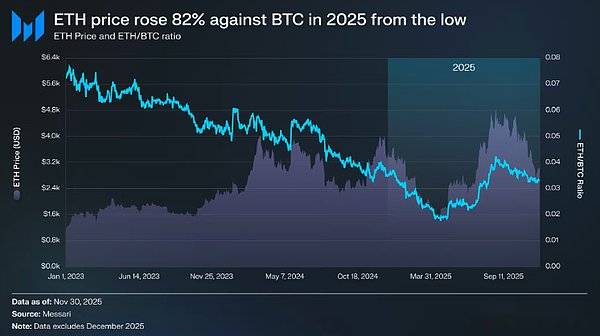
On March 16, Ethereum’s fully diluted valuation was $227.65 billion, while Ripple reached $239.23 billion—a result that almost no one could have predicted a year ago.Then, on April 8, 2025, the ETH/BTC exchange rate fell below 0.02, hitting a new low since February 2020.In other words, all the excess returns accumulated by Ethereum relative to Bitcoin in the last bull market have been given back.At that time, market sentiment towards Ethereum fell to its lowest point in several years.
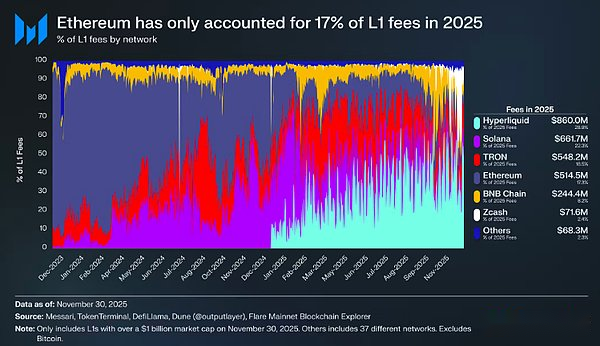
To make matters worse, the price decline is just the tip of the iceberg.With the rise of rival ecosystems, Ethereum’s share of the public chain fee market continues to shrink.In 2024, the Solana ecosystem will recover strongly; in 2025, Hyperliquid will emerge as a new force.Under the attack of the two, Ethereum’s handling fee market share fell to 17%, ranking fourth among public chains – in sharp contrast to its top position a year ago.Although handling fees cannot represent everything, they are an intuitive signal of the flow of economic activity – today, Ethereum is facing the most intense competitive environment in history.
But historical experience tells us that the most significant reversals in the cryptocurrency field often begin when market sentiment is the most pessimistic.When Ethereum was labeled a “failed asset”, most of its so-called “negative factors” had actually been priced in by the market.
In May 2025, signs of excessive market pessimism began to appear.The exchange rate of Ethereum against Bitcoin and the price of the US dollar both bottomed out and rebounded during this period.The ETH/BTC exchange rate soared from a low of 0.017 in April to 0.042 in August, an increase of 139%; during the same period, the USD price of Ethereum rose from US$1,646 to US$4,793, an increase of 191%.The rally eventually peaked on August 24 when Ethereum hit an all-time high of $4,946.
After this round of valuation repair, Ethereum’s long-term trend has clearly returned to the upward channel.Leadership changes at the Ethereum Foundation and the emergence of Ethereum-focused digital asset treasuries (DATs) have injected confidence into the market that had been lacking in the previous year.
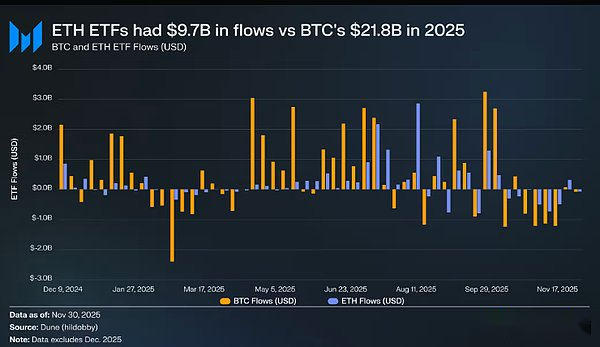
Before this round of rise, the differentiation between Bitcoin and Ethereum was vividly reflected in the ETF markets of the two.In July 2024, when the Ethereum spot ETF was launched, capital inflows were very dismal.In the first six months of listing, total inflows were just $2.41 billion—dwarfed by the Bitcoin ETF’s record-breaking performance.
However, as Ethereum rebounded strongly, market concerns about its ETF also dissipated.For the whole year, the Ethereum spot ETF’s capital inflow reached US$9.72 billion, and the Bitcoin ETF’s inflow was US$21.78 billion.Considering that Bitcoin’s market capitalization is nearly five times that of Ethereum, the difference in ETF inflows between the two is only 2.2 times, a result that far exceeds market expectations.In other words, if calculated based on market capitalization adjustment, the financial attractiveness of Ethereum ETF even exceeds that of Bitcoin – which is in sharp contrast to the mainstream narrative of “institutional lack of interest in Ethereum”.In certain time periods, Ethereum’s advantage is even more obvious: between May 26 and August 25, Ethereum ETF inflows were US$10.2 billion, exceeding the Bitcoin ETF’s inflow of US$9.79 billion during the same period. This was the first time that institutional demand was clearly tilted towards Ethereum.

From the perspective of ETF issuers, BlackRock has continued its dominance in the Ethereum ETF market.At the end of 2025, BlackRock held 3.7 million Ethereum, accounting for 60% of the Ethereum spot ETF market.This number has increased by 241% from 1.1 million at the end of 2024, and the growth rate is far faster than other issuers.As of the end of the year, the total holdings of Ethereum spot ETFs reached 6.2 million, accounting for approximately 5% of the total supply of Ethereum.
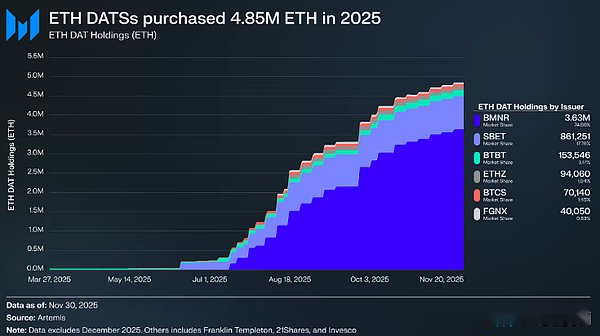
Behind Ethereum’s strong rebound, the most critical structural change is the rise of Ethereum’s digital asset treasury (DATs).These treasury creates a stable and continuous source of demand for Ethereum – something that has never been seen in the history of Ethereum. Its supporting role in Ethereum is far beyond the comparison of narrative hype or speculative funds.If the price trend is the “surface” of Ethereum’s reversal, then the continued accumulation of treasury holdings is the “deep driving force” driving this reversal.
In 2025, the cumulative holdings of the Ethereum digital asset treasury reached 4.8 million, accounting for 4% of the total supply of Ethereum, which had a significant impact on its price.Among them, the most representative one is Bitmine (stock code BMNR) owned by Tom Lee.This company, which originally focused on Bitcoin mining, began to shift its treasury funds and capital to Ethereum in July 2025.From July to November, BitMine purchased a total of 3.63 million Ethereum, accounting for 75% of its holdings, becoming the absolute leader in the field of Ethereum digital asset treasury.
Although Ethereum’s rally was strong, the gains eventually gave way.As of November 30, Ethereum prices have fallen back from the August high to $2,991, significantly lower than the previous bull market’s all-time high of $4,878.Compared with the lows in April, Ethereum’s situation has improved significantly, but the structural concerns that previously triggered the bear market narrative have not been completely eliminated.On the contrary, the debate over Ethereum’s positioning is becoming more intense than ever.
On the one hand, Ethereum is exhibiting many of the characteristics that characterized Bitcoin’s rise to currency status: ETF inflows are no longer weak, and digital asset treasury has become a sustained pillar of demand.More importantly, more and more market participants are beginning to distinguish Ethereum from other public chain tokens and regard it as an asset that belongs to the same monetary framework as Bitcoin.
But on the other hand, the core problems that dragged down Ethereum in the first half of this year have not yet been completely resolved: Ethereum’s fundamentals have not yet fully recovered, and its public chain fee share is still facing squeeze from strong opponents such as Solana and Hyperliquid; the activity of the main chain is far lower than the peak of the previous bull market; despite the sharp rebound of Ethereum, Bitcoin has firmly reached a new historical high, while Ethereum has not yet broken through the previous high.Even during Ethereum’s strongest months, a significant number of holders saw rallies as an exit opportunity rather than an endorsement of its long-term monetary narrative.
The core question in this debate is not “whether Ethereum is valuable”, but “how Ethereum tokens capture value from the Ethereum ecosystem.”
During the last bull market, the common assumption in the market was that Ethereum tokens would directly benefit from the success of the ecosystem.This is the core logic of the “Ultrasound Money” narrative: Ethereum’s utility will generate massive burning of fees, eventually making Ethereum tokens a deflationary value asset.
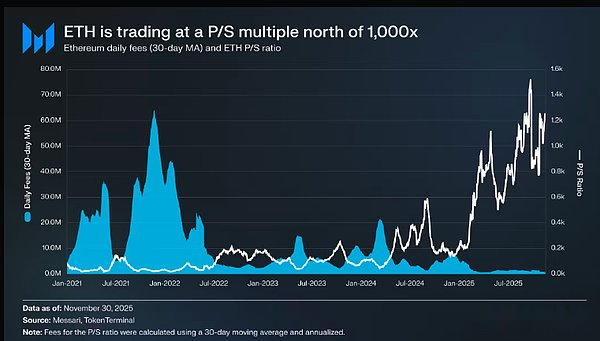
Today, we feel confident enough to assert that this straightforward logic of value capture will not come true.Ethereum’s fee income has fallen sharply, and there are no signs of recovery; at the same time, the fastest-growing areas of the Ethereum ecosystem (real-world asset tokenization, institutional business) mainly use the U.S. dollar as the base currency, not Ethereum tokens.
In the future, the value of Ethereum will depend on how it indirectly captures value from ecological success.But indirect value capture is much less certain – it relies on a premise: as Ethereum’s systemic importance continues to increase, more and more users and capital will choose to treat Ethereum tokens as cryptocurrencies and stores of value.
But unlike direct, mechanistic value capture, there are no guarantees in this indirect path.It relies entirely on social preferences and collective consensus – this is not a flaw in itself (as explained in detail above, Bitcoin’s value capture is based on this logic), but it means that the appreciation of Ethereum is no longer deterministically related to the economic activities of the Ethereum ecosystem.
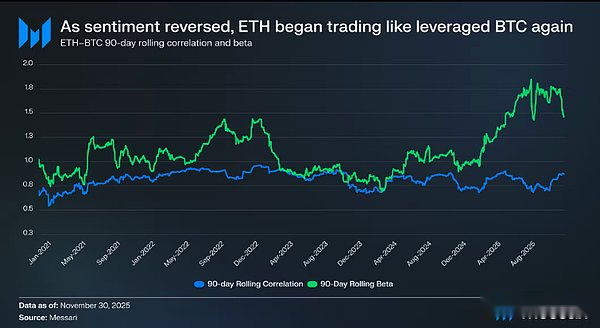
All of this has brought the Ethereum debate back to its core contradiction: Ethereum may indeed be accumulating a currency premium, but this premium has always lagged behind Bitcoin.The market once again views Ethereum as a “leveraged expression” of Bitcoin’s monetary narrative rather than an independent monetary asset.Throughout 2025, Ethereum’s 90-day rolling correlation with Bitcoin has consistently fluctuated between 0.7 and 0.9, while its rolling beta has soared to multi-year highs, even exceeding 1.8 in some periods.This means that the price fluctuations of Ethereum are greater than that of Bitcoin, but the trend is still highly dependent on Bitcoin.
This is a subtle but crucial distinction.Ethereum’s current monetary value is entirely based on the establishment of Bitcoin’s monetary narrative.As long as the market believes that Bitcoin is a non-sovereign store of value, there will be a segment of investors willing to extend that trust to Ethereum.Therefore, if Bitcoin’s bull market continues in 2026, Ethereum will also have a clear upward path.
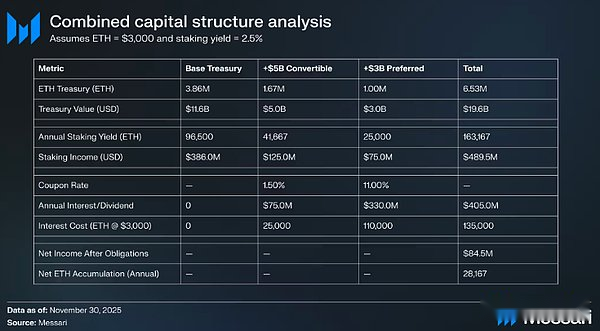
At present, the Ethereum digital asset treasury is still in the early stages of development, and the funds for its increased holdings of Ethereum mainly come from the issuance of common shares.However, in the context of the restart of the cryptocurrency bull market, these treasury banks are expected to learn from the financing strategies of companies such as MicroStrategy in accumulating Bitcoin and explore more capital operation methods, such as issuing convertible bonds, preferred stocks, etc.
For example, a digital asset treasury like BitMine can raise funds by issuing a combination of low-interest convertible bonds and high-yield preferred stocks, using the raised funds directly to purchase Ethereum, and at the same time pledge these Ethereums to obtain stable pledge income.Under reasonable assumptions, pledge income can partially cover bond interest and preferred stock dividend payments, allowing the treasury to continue to increase its holdings of Ethereum through increased leverage when the market environment is favorable.Assuming that the Bitcoin bull market returns in 2026, this “second growth curve” of Ethereum’s digital asset treasury will become an important force supporting the high beta properties of Ethereum relative to Bitcoin.
Ultimately, the market still views Ethereum’s currency premium as a derivative of Bitcoin.Ethereum has not yet become an independent currency asset with independent macro logic, but is only a “secondary beneficiary” of the Bitcoin currency consensus.Its recent strong rebound reflects that some investors are willing to regard Ethereum more as Bitcoin than as an ordinary L1 public chain token.But even in the relatively strong stage, the market’s confidence in Ethereum is inseparable from the continued strength of the Bitcoin narrative.
In short, although Ethereum’s monetary narrative is not broken, it is far from settled.Under the current market structure, given Ethereum’s high beta properties relative to Bitcoin,As long as Bitcoin’s bullish logic continues, Ethereum is poised for impressive gains——The structural demand brought by digital asset treasury and corporate treasury will provide it with real upward momentum.But for the foreseeable future, Ethereum’s monetary trajectory will remain attached to Bitcoin.Unless Ethereum can achieve low correlation and low beta coefficient with Bitcoin over a longer period of time, its currency premium will always be shrouded in Bitcoin’s halo.
6. Zcash: Bitcoin’s hedging tool?
Of all cryptoassets outside of Bitcoin and Ethereum, ZEC’s perception of its currency properties has undergone the most significant shift in 2025.For years, ZEC has been on the fringes of the cryptocurrency system, viewed as a niche privacy coin rather than a true monetary asset.However, as global surveillance intensifies and Bitcoin becomes more institutionalized, privacy has reemerged as a core attribute of cryptocurrencies—rather than a fringe ideological preference.
Bitcoin proved that a non-sovereign digital currency could circulate around the world without retaining the privacy that people enjoy when using physical cash.Every transaction in Bitcoin will be broadcast to a transparent public ledger, and anyone can track it simply through a block explorer.Ironically, this tool, which was intended to subvert centralized power, has inadvertently created a “financial panopticon.”
ZEC perfectly combines Bitcoin’s monetary policy with the privacy of physical cash through zero-knowledge proof cryptography.Currently, no digital asset can provide proven and deterministic privacy guarantees like ZEC’s latest Privacy Pool (Shielded Pool).This makes ZEC a unique private currency whose value cannot be easily replicated.In our view, the market is re-evaluating ZEC’s value relative to Bitcoin and positioning it as a “potential privacy cryptocurrency” – in the context of the rise of surveillance states and the institutionalization of Bitcoin, ZEC has become an ideal tool to hedge against these two trends.

Since 2025, ZEC has increased by 666% relative to Bitcoin, and its market value has climbed to US$7 billion, once surpassing Monero (XMR) and becoming the privacy coin with the highest market value.This relative strength suggests that ZEC, along with Monero, is viewed by the market as a viable privacy cryptocurrency.
Privacy for Bitcoin
It is almost impossible for Bitcoin to adopt a privacy pool architecture, so the idea that Bitcoin will eventually swallow up the ZEC value proposition is untenable.The Bitcoin community has always been known for its conservatism, and the core of its culture is “solidifying the protocol” – reducing protocol changes, reducing the attack surface, and maintaining the integrity of the currency.Embedding privacy features at the protocol layer requires substantial modifications to Bitcoin’s core architecture, which may introduce the risk of inflationary vulnerabilities and thus damage its monetary foundation.ZEC is different. Privacy is its core value proposition, so it is willing to take this technical risk.
In addition, deploying zero-knowledge proofs at the main chain layer will also reduce the scalability of the blockchain.Zero-knowledge proofs require the use of “nullifiers” and “hashed notes” to prevent double spending, which will lead to the long-term hidden danger of “state inflation”: the nullifier will generate a permanent list that can only be appended. Over time, this list will expand infinitely, ultimately leading to a significant increase in the hardware resource threshold for running a full node.If nodes were forced to store massive and ever-growing collections of invalidators, Bitcoin’s decentralization would be severely compromised.
As mentioned above, without the introduction of OP_CAT and other opcodes that support zero-knowledge proof verification through soft forks, Bitcoin’s second-layer network will not be able to achieve ZEC-level privacy protection while inheriting the security of Bitcoin.Current solutions either require the introduction of a trusted intermediary (such as a consortium chain), accept a long and highly interactive withdrawal waiting period (such as the BitVM model), or can only completely transfer the execution and security layers to an independent system (such as a sovereign rolling record).Unless this status quo is changed, there is currently no path to achieve a combination of “Bitcoin-level security + ZEC-level privacy” – which precisely establishes ZEC’s unique value as a privacy cryptocurrency.
Hedging Central Bank Digital Currency (CBDC)
The urgency of privacy needs is further exacerbated by the rise of central bank digital currencies (CBDC).At present, half of the countries in the world are studying or have launched central bank digital currencies.Central bank digital currencies are programmable, meaning issuers can not only track every transaction but also control how, when and where funds are spent.For example, funds can be programmed to be spent only at designated merchants, or only available within a specific geographic area.

This may sound like the plot of a dystopian novel, but cases of the financial system being politicized and weaponized have already happened in reality:
– Nigeria (2020): During the #EndSARS protests against police brutality, Nigeria’s central bank froze the bank accounts of several protest organizers and women’s rights groups, forcing the protests to rely on cryptocurrencies to stay afloat.
– United States (2020-2025): Regulators and large banks deprive certain legal but politically disfavored industries of banking services, citing “reputational risk” and ideological concerns, rather than safety and soundness considerations.This phenomenon has become serious enough to attract the attention of the White House – a 2025 study by the U.S. Office of the Comptroller of the Currency (OCC) shows that multiple legal industries such as oil and gas, firearms, adult content, and cryptocurrency are facing systemic financial service restrictions.
– Canada (2022): During the Freedom Rides protests, the Canadian government invoked the Emergency Act to freeze the bank and cryptocurrency accounts of protesters and even small-dollar donors without court approval.The Royal Canadian Mounted Police also blacklisted 34 decentralized cryptocurrency wallet addresses, ordering all regulated exchanges to stop trading with these addresses.This incident proves that Western democracies are also willing to use the financial system as a weapon to suppress political dissent.
In an era where money can be programmed and controlled, Zcoin provides people with a clear “exit option.”But ZEC’s value goes beyond circumventing central bank digital currencies—it’s becoming increasingly important, even becoming a necessary tool to protect Bitcoin itself.
Hedging Bitcoin Capture
As influential industry advocates such as Naval Ravikant and Balaji Srinivasan have said, ZEC is insurance to maintain Bitcoin’s vision of “financial freedom.”
Currently, Bitcoin is rapidly concentrating towards centralized entities.According to statistics, centralized exchanges hold 3 million Bitcoins, ETFs hold 1.3 million, and listed companies hold 829,192 — a total of about 5.1 million Bitcoins, accounting for 24% of the total supply.

This level of concentration means that 24% of Bitcoins are at risk of regulatory seizure – a historical backdrop that echoes the 1933 U.S. government’s seizure of gold.That year, U.S. Executive Order No. 6102 forced U.S. citizens to turn over all gold worth more than $100 to the Federal Reserve, and the compensation citizens received was only legal tender converted at the official fixed exchange rate.The execution of this order does not rely on physical coercion, but is achieved through the “choke” of the banking system.
For Bitcoin, a similar mechanism can be replicated.Regulators can seize 24% of Bitcoins without obtaining users’ private keys – they can simply apply legal pressure on the custodians.In this scenario, the government could issue enforcement orders to institutions such as BlackRock and Binance.These legally bound institutions will be forced to freeze and move the Bitcoins in their custody.Overnight, the equivalent of 24% of the total Bitcoin supply could be “nationalized”—and all without having to tamper with a single line of code.Although this is an extreme case, we can never completely rule out the possibility.
The transparency of the Bitcoin blockchain also means that “self-custody” is no longer a foolproof strategy.Any Bitcoin withdrawn from a compliant exchange or brokerage may be traced – because the flow of funds will leave a clear “paper trail” that ultimately points to the final storage address of these Bitcoins.
Bitcoin holders can cut off this custody chain and “physically isolate” their wealth from the monitoring system by exchanging ZEC.Once funds enter ZEC’s privacy pool, its target address will become a cryptographic “black hole” to outside observers.Regulators may be able to track funds leaving the Bitcoin network, but they have no way of knowing where the funds ended up — making these assets completely invisible to governments.Although there are still certain regulatory bottlenecks in converting ZEC back to legal currency and transferring it to domestic bank accounts, the ZEC asset itself is censorship-resistant and difficult to be actively tracked.Of course, the strength of this anonymity depends entirely on the user’s operational security – if the user reuses the address or obtains ZEC through a compliant exchange, permanent traceable traces will have been left before the funds enter the privacy pool.
The road to product-market fit (PMF)
The market demand for privacy currency has always existed. ZEC’s previous problem was that it failed to lower the threshold for users to use it.For years, the Zcash protocol has struggled with high memory usage, long attestation times, and cumbersome desktop client operations, making private transactions slow and difficult to operate for most users.In recent years, a series of infrastructure breakthroughs have systematically solved these pain points and paved the way for ZEC user adoption.
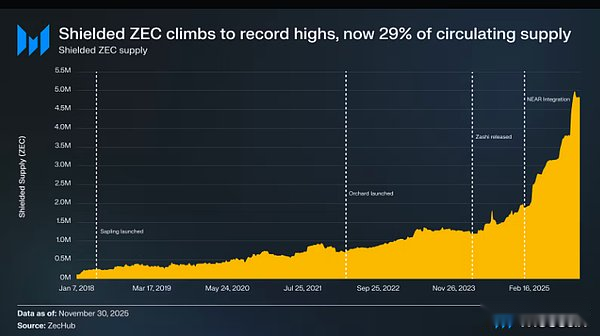
The Sapling upgrade reduced ZEC’s memory footprint by 97% (to about 40MB) and shortened the proof time by 81% (to about 7 seconds), laying the foundation for private transactions on the mobile terminal.
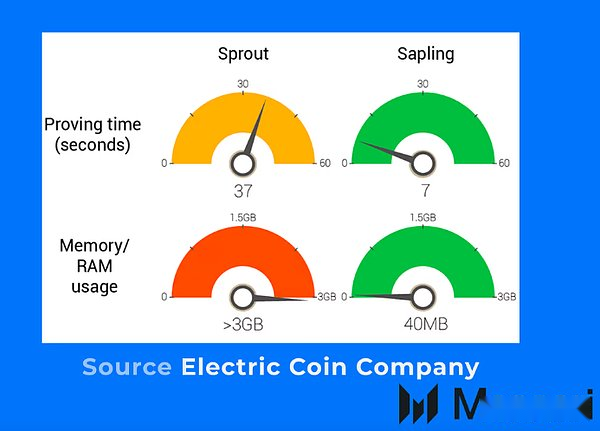
The Sapling upgrade solved the speed problem, but Trusted Setup is still considered a hidden danger by the privacy community.By integrating Halo 2 technology, ZEC completely gets rid of its dependence on trusted settings and achieves complete trustlessness.At the same time, the Orchard upgrade also introduced “Unified Addresses”, which integrates transparent addresses and private addresses into a single address, eliminating the need for users to manually select address types.
These architectural improvements ultimately led to the birth of the Zashi wallet.This mobile wallet developed by Electric Coin Company will be officially released in March 2024.Zashi takes advantage of the characteristics of a unified address to simplify the operation of private transactions to a few clicks on your phone, making privacy the default user experience.
After solving the user experience obstacles, the next problem ZEC faces is “circulation”.Previously, users still had to go through centralized exchanges to deposit or withdraw funds from the Zcoin wallet.The integration of the NEAR Intents protocol completely solves this pain point: Zashi users can directly exchange mainstream assets such as Bitcoin and Ethereum into the privacy currency ZEC without going through a centralized exchange.In addition, the NEAR Intent Protocol also allows users to use the privacy coin ZEC to pay for any asset to any address across 20 blockchains.
These measures work together to help ZEC overcome historical barriers to use, connect to the global liquidity network, and accurately meet market needs.
future outlook
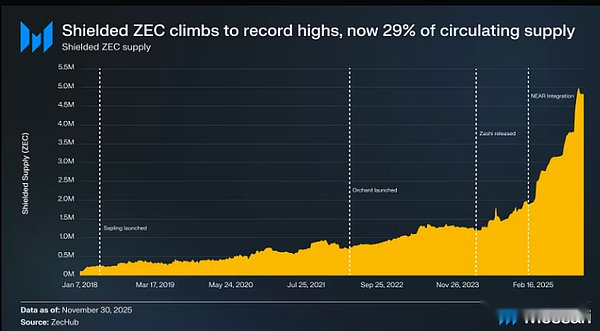
Since 2019, ZEC’s rolling correlation with Bitcoin has shown a clear downward trend – from a high of 0.90 to a recent low of 0.24.Meanwhile, ZEC’s rolling beta relative to Bitcoin rose to a new all-time high.This means that while ZEC is amplifying the price fluctuations of Bitcoin, its linkage with Bitcoin is constantly weakening.This differentiation shows that the market is beginning to assign a “unique premium” to ZEC’s privacy guarantees.Going forward, we expect ZEC’s performance to be dominated by this “privacy premium” – the value the market places on financial anonymity in an era of heightened global surveillance and weaponized financial systems.
We believe it is almost impossible for ZEC to surpass Bitcoin.Bitcoin’s transparent supply and unparalleled auditability make it the most robust cryptocurrency.In contrast, ZEC, as a privacy coin, always has to bear inherent trade-offs: while achieving privacy through encrypted ledgers, it sacrifices auditability and introduces the theoretical risk of “inflation loopholes” – that is, there may be undetected supply expansion in the privacy pool, which is exactly what Bitcoin’s transparent ledger wants to completely eliminate.
Despite this, ZEC can still carve out its own unique track outside of Bitcoin.These two assets are not competing for the same market, but in the cryptocurrency field, meeting different usage needs: Bitcoin is a robust cryptocurrency that optimizes transparency and security, while ZEC is a private cryptocurrency that optimizes confidentiality and financial privacy.In this sense, the success of ZEC does not require replacing Bitcoin, but rather complementing it by providing attributes that Bitcoin deliberately abandons.
7. Application layer currency will rise in 2026
Another trend that we expect to accelerate in 2026 is the feasibility of application money.Application layer currency is a currency asset designed for a specific application scenario. Its functions are highly focused and different from general currency assets such as Bitcoin and public chain tokens.To understand why application layer currencies can be implemented in the cryptocurrency environment, we first need to review the two core principles of currencies:
1. The value of currency comes from the goods and services it can be exchanged for;
2. When the cost of switching between different currency systems is high, market participants will gradually converge on a single mainstream currency standard.
Historically, currency was created to store the value created by economic activities.Because most goods and services are perishable or time-sensitive, money allows people to store purchasing power for future use.It needs to be emphasized that currency itself has no inherent value. Its value is a reflection of “purchasing power” in a specific economic scenario.
As economies expand and interact, multiple monetary systems follow a power-law distribution and eventually converge to a single dominant standard.The driving force for this convergence is the high switching costs between different currency systems – including slow settlement speed, insufficient liquidity, information asymmetry, intermediary agency fees, physical barriers to cross-border currency transportation, etc.In this high-friction environment, currency network effects will continue to strengthen the dominance of mainstream currencies, and independent niche currency systems will become increasingly inefficient.
Cryptocurrency fundamentally changes this landscape – it significantly reduces the friction of switching between monetary systems.In this low-friction environment, small, application-specific monetary systems become feasible: users can seamlessly enter or exit these systems without incurring excessive costs.Therefore, applications no longer need to rely on a universal currency system, but can issue exclusive application layer currencies to internalize and retain the value created by their own economic activities within the ecosystem.
In 2025, multiple feasibility cases of application layer currencies will appear on the market, the most representative of which are Virtuals and Zora.
Virtuals
Virtuals is the first cryptocurrency application (not blockchain) to successfully implement its own currency system.The platform allows users to create, deploy and monetize artificial intelligence agents (AI Agents) without any technical knowledge.Each artificial intelligence agent on the platform will issue corresponding tokens, and these tokens are paired with the platform’s core token VIRTUAL to provide liquidity.In this architecture, VIRTUAL is the basic currency asset of the Virtuals ecosystem: whenever a user purchases a token of an artificial intelligence agent, VIRTUAL needs to be deposited into the agent’s liquidity pool.This design deeply binds the value of VIRTUAL to the economic activities on the platform – the higher the value of the artificial intelligence agent and the more widely used it is, the stronger the underlying demand for VIRTUAL will be.In this sense, VIRTUAL fully possesses the properties of currency: it is a unified unit of measurement for all agent value circulation in the Virtuals economy.
Zora
Zora is another typical example of an application layer currency.This is a financialized social media platform, and users’ personal homepages and published content are all tokenized.When a user creates a personal homepage, the corresponding “creator token” will be generated; for each piece of content posted by the user, an exclusive “content token” will also be issued.Zora draws on and optimizes the token pairing model of Virtuals: all creator tokens are paired with the platform’s core token ZORA, and each creator’s content token is paired with the creator’s personal token.

In addition, Zora further optimizes the user experience of application layer currency through a built-in integrated wallet – it completely “hides” the currency layer from the user’s perspective.When users purchase creator tokens or content tokens, they can choose to pay with any asset such as Ethereum or USDC, and the underlying “ETH/USDC→ZORA→Creator Token→Content Token” exchange process is completely transparent to users.Not only that, users can also directly exchange one creator’s content tokens for another creator’s content tokens, greatly simplifying the asset transfer process.
Design Principles of Application Layer Currency
In order for the application layer currency model to operate stably, it needs to follow two core design principles:
1. Automatic market maker (AMM) liquidity pool: Automatic market makers set asset prices and transaction execution rules through smart contract algorithms, provide continuous liquidity for application layer currencies, and build stable economic relationships.In Virtuals, all agency tokens are paired with VIRTUAL; in Zora, all creator tokens are paired with ZORA, and content tokens are paired with creator tokens.This structure firmly binds the value of the application layer currency to the core activities that the platform hopes to cultivate.
2. Currency layer abstraction from the user’s perspective: A successful application layer currency system must hide the complexity of the currency layer from users.Users are unwilling to frequently switch currency systems in order to use different applications.The best practice for application layer currency is to completely eliminate this switching cost: users can use any assets they prefer, and only when they interact with the application, these assets will be automatically converted to application layer currency in the background – this process is completely invisible to the user.
Applicable scenarios for application layer currency
Cryptocurrency reduces switching friction and makes application-level currencies possible, but this does not mean that all applications are suitable for issuing proprietary currencies.The best applicable scenario for application-layer currencies is applications where network effects can amplify ecological value.In this type of application, the existence of the currency layer can ensure that the value created by ecological activities is retained within the system.
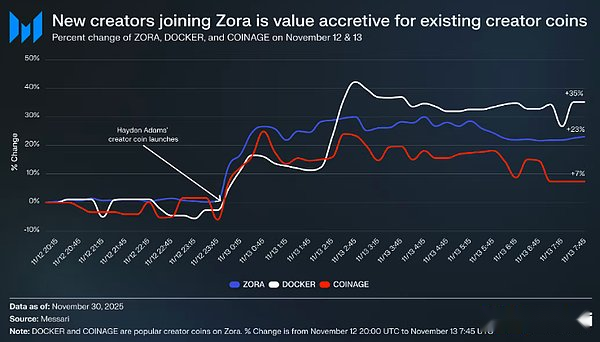
Taking Zora as an example, when high-profile users join the platform, it brings attention, liquidity, and new on-chain activity to the platform—all of which translate into demand for ZORA tokens.Since the liquidity of all creator tokens is paired with ZORA, the increase in the price of ZORA will drive the price increase of all creator tokens through the algorithm mechanism.
This effect has been verified in reality: On November 12, Hayden Adams, founder of decentralized exchange Uniswap, created a personal homepage on Zora and issued corresponding creator tokens.Before he created the homepage, the price of ZORA was $0.055; within hours after the homepage was created, the price of ZORA rose to a stage high of $0.071; within 8 hours after Hayden Adams created the homepage, the price of ZORA was still 23% higher than 12 hours ago.Meanwhile, other popular creator tokens on the Zora platform, such as DOCKER and COINAGE, also gained 35% and 7% respectively in the same 12 hours.
For a social network like Zora, this design is indispensable.All other things being equal, a social network account with millions of users is worth much more than an account with only a hundred users.As the scale of platform users expands, the overall value of the network will increase, and the value of each user account will also increase accordingly.By denominating platform activity in ZORA tokens rather than neutral assets such as USD stablecoins, Zora fully internalizes this network effect-driven price increase into the ecosystem.On the contrary, if USDC is used as the base currency, this kind of value capture is out of the question: users purchasing Hayden Adams’ creator tokens will not directly generate demand for ZORA, nor can it be effectively transmitted to DOCKER, COINAGE and other related assets.Therefore, the ZORA token is the core mechanism for Zora to capture and superimpose the value of social activities.
8. More projects will test the application layer currency in 2026
Early cases such as Virtuals and Zora prove that in a low-friction cryptocurrency environment, applications can internalize the value of economic activities by issuing exclusive currencies instead of outflowing to general currency assets.As tools continue to improve and the market understands the model, application-layer currencies will increasingly be seen as a viable design option—especially for applications with strong native network effects.
For app developers, the motivation for issuing a proprietary currency is clear: an app-layer currency allows projects to directly capture the value created by their core activities, whether that’s social interaction, content creation, or collaborative governance.In applications where user growth amplifies the value of individual participants, relying on neutrally liquidated assets dilutes this network effect, while application-layer currencies can enhance this effect.
However, it needs to be emphasized that not all applications are suitable for issuing exclusive currencies.This model works best in the scenario where “user growth can amplify individual value”, but in the scenario where “user growth only increases the overall activity volume”, it is of little significance.Outside of such applicable scenarios, blindly issuing application-layer currencies will only increase the complexity of the system but fail to bring about substantial value capture.For example, in financial protocols such as lending platforms and perpetual contract exchanges, user growth will not increase the value of individual positions in the same way.For such applications, issuing application-layer currencies will only increase complexity without creating additional economic benefits.
Even projects suitable for issuing application-layer currencies still need to weigh the pros and cons.The volatility of application layer currencies is likely to be higher than mature currency forms such as stablecoins, Bitcoin, and even L1 public chain tokens.If your app’s target users are sensitive to price fluctuations, an app-level monetary model can be counterproductive and hinder user growth.In addition, although cryptocurrencies have significantly reduced exchange costs, this cost is not zero – slippage and handling fees may still cause a considerable burden on users.If the users of the application are highly cost-sensitive, then the project team needs to reconsider whether the application layer currency is really better than a general currency asset.
Finally, the widespread adoption of application layer currencies will also have a knock-on impact on the value capture of public chains.As more and more economic activities shift to application-layer currency denomination, the share of value flowing into public chain tokens will decrease.In this scenario, the public chain can still capture value through handling fees, security services, execution layers, etc., but the application’s “monetary attribute dependence” on the underlying public chain tokens will be significantly reduced.In the long run, this trend may put pressure on the currency premium of some public chains – especially those that regard “cryptocurrency positioning” as their core value proposition.
Conclusion: Thoughts on Stablecoins
Before we end our discussion of cryptocurrencies, we also want to talk about stablecoins.In the next part, we will explore the integration trend of traditional finance (TradFi) and cryptocurrency – and stablecoins are the core hub of this integration process.
This integration is undoubtedly a positive development and arguably one of the most important achievements of the cryptocurrency industry in 2025.Stablecoins have expanded the coverage of financial services, improved transaction efficiency, and brought tangible practical benefits to millions of users.The significance of this progress cannot be underestimated, but we also need to remember that the vision of cryptocurrency is not just to make existing financial infrastructure more efficient.
The original intention of cryptocurrency is to create an alternative currency system that is completely different and superior to the existing legal currency system.Stablecoins are an important tool in this grand vision, but they are by no means the end goal.As the industry continues to mature, the risk we face is not that “stablecoins are not successful enough”, but that the success of stablecoins will obscure the core innovation of cryptocurrency – that is, cryptocurrency itself.