
 jakiro
【Editor’s Note】11The U.S.’s monthly performance fell sharply short of expectationsCPIAfter the data was released, the market was cautiously optimistic. On the one hand, it was happy to see soft inflation data, but on the other hand, it did not trust the authenticity of this inflation data because of the government shutdown.This suspicion is reasonable.due to10The federal government shutdown resulted inBLS(Bureau of Labor Statistics) suspended field data collection and used it extensively in data processing“Previous period values carried forward“(Carry Forward)method, that is, directly follow the9Monthly price data to fill10Month blank.The market is generally worried that this artificially depressed10The monthly base operation masks the real inflationary pressure.
We believe this view is valid but not entirely accurate.Carry ForwardThis technical means mainly leads to the housing sub-item (RentandOER) is underestimated, while for ordinary non-housing goods and services, its9-11The monthly cumulative inflation reading was not too popularcarry forwardinfluence.In other words,11monthCPIChina-Africa housing sector“noise“It may not be as big as the market thinks.
1.CPIThe three interpolation methods andAfter the government shutdownBLSprocessing method
USACPIThe calculation depends on the monthly approx.80000Collection of price quotes, but when data is missing,BLSThree main interpolation methods are used to fill in the gaps to ensure exponential continuity as much as possible.The methods are applied in order of priority: first is cell-relative interpolation (Cell-relative Imputation), which uses the average price change of similar items in the same geographical area and product category to estimate missing values. For example, the price of milk in a certain supermarket cannot be collected for some reason.BLSThe missing data will be calculated with reference to the average rise and fall of milk in other stores in the same area; followed by category mean interpolation (Class-mean Imputation), filled through broader similar commodity changes; and finally “previous period value carry forward” (Carry Forward), directly copying the price of the previous month, assuming no change.
in2025year10month1Solstice11month12During Japan’s government shutdown,BLSsuspended most in-person and telephone investigations, resulting in10Monthly data are completely missing and cannot be collected retrospectively.Therefore,BLSTake in bulkCarry Forward, will9Monthly data is moved directly to10month, as11Baseline for monthly calculations, which is why11Monthly inflation only has an annualized value and not a month-on-month value.This approach does artificially lower the10monthCPIexponent (since it is assumed that and9same month), but the fundamental problem is that in11After the monthly sample statistics are restored,10Whether monthly underestimation will be corrected automatically.
2. Why is it said that carry forward only affects housing CPI, but not ordinary commodities?/Little impact on services
This leads to the question of the relationship between housing sub-items and ordinary commodities.CPIImportant differences in index construction.For non-housing sub-items such as food, energy, and core commodities,CPIThe calculation follows“price level“(Price Level) logic, that is“peer to peer“Measure.No matter how the data in the middle months is filled in, the index ultimately depends only on the absolute price level collected in the current period, not on the path in the middle.Take milk as an example,Suppose the milk is9The price index in the monthly survey is10,11The price index in the monthly survey rose to12, then no matter10What is the monthly price level that is takencarry forwardI actually investigated the price and found out the price.9-11The monthly compound inflation growth rate is20%.
And the housing sub-item (Shelter) is different, it uses a unique“Panel rotation“mechanism.BLSIt does not directly compare the rent levels of the current month with the previous month, but first calculates the rental level of the current sample in the past.6Month’s “cumulative increase” in rent, and take the6The second root (geometric mean) is used to calculate the monthly rent.“average increase“, and finally multiply this ratio by last month’s index to calculate the current month’s rental price index.This algorithm leads to a mismatch:Calculating the growth rate of the current month relies on samples6The historical base number of months ago, but the calculation of the final index relies on the index of last month.This means that if the index base for the previous month was distorted due to non-counting, the new index for the current period will also be wrong.
Let me give you an example.Suppose a housing sample is in5The price in the month (base period) is8,11The price at the time of the monthly survey had increased to12.BLSFirst, the average monthly growth rate of the sample is calculated, which is approximately 7%.

Then,BLSwill7%multiplied by10Based on the monthly rent index11Monthly index.Here comes the problem.if10monthly indexCarry ForwardInherited9month value, then11The monthly index will be significantly lower than the true price index12.

As a result, the rentCPIin9-11The monthly compound growth rate has changed from what it should have been20%(from10Arrive12) is underestimated to7%(from10Arrive10.7).
P.S.:The reason why hereBLSNot used directly12 as11The monthly rent price index is because, in fact,BLSWhat we get is thousands of sample rents instead of a single rent price – it can’t be calculated directly12For this price index, we can only calculate the weighted growth rate first and then multiply it by the base period price.
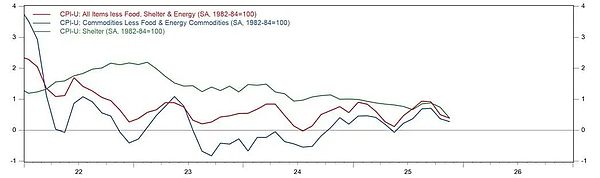
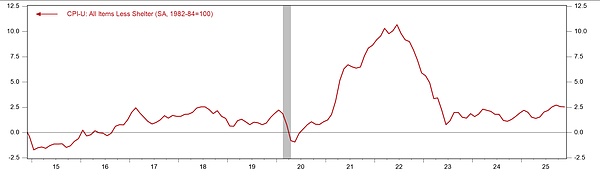
To sum up, for ordinary goods and non-household services, even if10Monthly data due tocarry forwardAnd being artificially suppressed, as long as11The monthly collection data itself is accurate, then9-11The monthly compound inflation growth rate is relatively accurate.But the housing component is unable to achieve this self-correction.10Once the monthly data iscarry forward, then11months housingCPIIt is bound to be underestimated.The extent of underestimation is exactly10Housing inflation for the month itself.This is why if we compare this month’s rent inflation, its decline compared with previous months is significantly higher than that of core goods and non-housing services (Figure1), and the year-on-year growth rate of CPI after excluding housing has actually changed little from the previous two months (Figure 2).
According to this estimate, this month’s housing breakdown0.18%The bi-monthly compound growth rate is actually10-11monthly growth rate.This is also related to6-9month-on-month housing growth rate (approximately0.26%) is a better match.
Figure1: Inflation in housing, core goods and non-housing services
Data source: Haver, GMF Research
Figure 2: Year-on-year CPI growth rate after excluding housing
Data source: Haver, GMF Research
3. Other factors that may depress other inflation components
Of course, we do not assume that other sub-items are necessarily accurate.After all11The monthly data collection period is also shorter than other months.We speculate that there are three other factors that cause the non-housing component to be underestimated, but the degree of underestimation may not be as obvious as the housing component.
The first is the lag in weight adjustment.Normally,BLSComponent weights are adjusted based on relative price changes, and generally the weights of high-inflation components are increased.BLSmake it clear that10The lack of monthly data results in non-adjusted weights, which may slightly understate overall inflation.
The second issue is the time window of data collection.due to11The monthly data collection was delayed by about two weeks than usual, and part of the collection work may have coincided with the“black friday“Waiting for the holiday promotion season, this may result in the elimination of the entire11The seasonal adjustment factor for monthly seasonal fluctuations is invalid.
Finally, it is not excluded11In the data collection of the month itself, there are still some samples that cannot be added in time, and the previous values continue to be used. However,BLSIt is not clear how much data analysis comes from9monthCarry Forward.
4. Overall review of inflation data and monetary policy
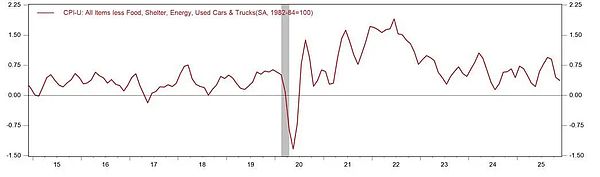
SinceCarry ForwardMainly affecting housing, then super core inflation excluding housing and used cars may still be of reference value.11Quarterly super core inflation growth fell to0.37%, in2024A relatively low level since the beginning of the year, but not the lowest point.This will undoubtedly ease the inflation concerns of the market and the Federal Reserve in the short term, further confirming the Goldilocks (Goldilocks) macro environment.
Figure 3: Super Core Inflation
Data source: Haver, GMF Research
Given that Powell is in8monthJackson HoleAfter the meeting, it was repeatedly stated that there is not much pressure on rising inflation. We believe thatbefore next year6Monthly inflation data will not be the focus of market attention, and it will be difficult to bring clear monetary policy implications.The most important indicator for determining the path of policy rates next year is likely to remain the change in the unemployment rate.Based on the historical experience of soft landing interest rate cuts, the unemployment rate will turn downward in the fourth quarter after the start of soft landing interest rate cuts. At that time, the Federal Reserve may restart its focus on inflation pressure.