 jakiro
Author: Bennett Ma
Faced with the complexity of smart contract applications, we shouldAbandon the simplistic thinking of “code is law” and instead adopt a more refined and pragmatic perspective of “scenario analysis”,OnlyThis way, can we clearly define rights while embracing technological innovationwithresponsibility, managementincome vs.risk.
Introduction
The concept of “smart contract” originally described only a digital agreement that can be executed automatically.But when the concept was put into practice, people discovered that this code could run automaticallyinact as a “contract”outside, can alsobecomeRules for organizational governance, channels for asset transfer, and even tools for illegal activities.
Although smart contracts are not used as “contracts” in many scenarios, everyone will always refer to them as “smart contracts”.It can be seen that “smart contract” is not a legal concept, but a technical concept with different application scenarios.Different scenes correspond to different social relationships, and different social relationships become legal relationships after being confirmed by law. If the scene is slightly different, the corresponding social relationships and legal relationships may be different.
Based on this, this article aims to exploredifferent applicationssceneLegal characterization of smart contractsquestion, although it is difficult to cover all situations, we still hope to help readers briefly understand the relevant legal issues.
Why should the legal characterization of smart contracts be clarified?——Quality determines destiny
There is no better way to understand the importance of clarifying the legal nature of smart contracts than to look at real judicial conflicts.
Tornado Cash is a decentralized, non-custodial currency mixing protocol deployed on Ethereum. The core is a series of non-tamperable smart contracts.Users can deposit cryptocurrencies into “fund pools” built by these contracts for mixing, thereby concealing the source and flow of transactions.
Because the protocol has been used to launder more than $7 billion since its creation in 2019, in August 2022, the U.S. Department of the Treasury’s Office of Foreign Assets Control (OFAC), pursuant to an executive order,Adding Tornado Cash to Sanctions List.A key point to note is that the Executive Order stipulates that sanctions must be imposed on “property” owned or controlled by a “legal entity.”
In addition, in August 2023, the U.S. Department of Justice also filed a criminal complaint against the co-founder of Tornado Cash.The founders were charged with conspiracy to launder money, conspiracy to violate sanctions and conspiracy to operate an unlicensed money transfer business.
The two actions point to several core legal disputes:
-
The “smart contract” itself, whether it is a legal“entity”, or is it “property” itself, or just “contract”, just “code”?
-
“Smart Contract”and itsHuge pool of funds managed, whether it is sanctionable“Property”?
-
In terms of criminal liability,What should a “smart contract” be considered, and how its legal nature might impact a founder’slegal liability?
The result is:
In terms of sanctions and judgments, the U.S. Court of Appeals for the Fifth Circuit ruled in November 2024 that OFAC’s sanctions were ultra vires.The core view of the court is that “smart contracts” are only“a neutral, autonomous technical tool” rather than a legal entity,These “immutable smart contracts” cannot be owned or controlled by any individual or entity, and no one can prevent others from using them. Therefore,Does not meet the traditional legal definition of “property”, therefore OFAC has no right to list it as a target of sanctions.
ButIn terms of developer responsibilities, the victory of technology does not mean that developers can sit back and relax.Smart contracts are considered“The core tools and components of an unlicensed money transmission service business”, and the smart contract together with the developer’s behavior is characterized as “the operation of illegal financial business”.Therefore, in the criminal trial at the end of 2024, founder Roman Storm was found guilty of“Operating an unlicensed money transmission business”convicted.
The Tornado Cash case clearly demonstrates thatThe legal characterization of smart contracts may directly determine the direction of the case and the fate of the parties involved.The code itself may be neutral, but the creation and deployment of the code, and the parties involved in it, may be responsible for its actual impact and consequences.
This enlightens us,Combined with specific scenariosThe legal nature of “smart contracts” has been carefully evaluated andbyIt is no longer an option, but an inevitable requirement to maintain transaction security and determine legal risks.
The legal nature of smart contracts——The scene determines the nature
The legal nature of smart contractsDepends on the specific scenario in which it is deployed and run.
Different scenes reflect or construct different social relationships, and the law evaluates them differently. Therefore,Corresponds to different rights, obligations and responsibilities.
Below, the author will show some typical application scenarios:
(1) Smart contracts are used toBuild contractthe legal nature of
When discussing the legal nature of smart contracts, what everyone is most concerned about is often:Can it be legally recognized and implemented?Does it have the legal effect of a contract?
When it comes to “contract”, the first thing that many people think of is “consensus”.Indeed, it is a consensus for us to use smart contracts to trade digital collections; it is also a consensus to use them to participate in voting decisions of decentralized autonomous organizations.However,Not all “agreement” can constitute a “contract” in the legal sense.
“Consensus” is a relatively broad concept with a similar meaning to “agreement”, but neither of them can be directly equated with “contract”.From a legal perspective, contract is a subordinate concept of “consensus” or “agreement”.The core feature of a contract is the legally enforceable guarantee, and although resolutions are also the product of consensus, the law often only “confirms” their procedural validity and does not necessarily provide them with the guarantee of enforcement.
To put it simply, we can use a streamlined determination framework to determine whether a smart contract constitutes a “contract”:Contract = Consensus + Legality
-
agreeable, refers to the consistent expression of intention of the parties, and usually requires two or more parties.The execution of smart contracts often reflects some pre-set common meaning.
-
legal, contains two meanings:
-
The law recognizes this type of agreement as a contract:Not all agreements are considered contracts.For example, internal resolutions executed using smart contracts are usually not classified as contracts but are organizational governance behaviors.
-
Consensus content does not violate laws and regulations:This includes not violating specific prohibitive regulations (such as money laundering, fraud, concealment, etc., or financial regulatory policies), nor violating legal principles such as public order and good customs.The judgment of the former is relatively clear, while the latter requires specific analysis based on judicial practice and regional legal culture.
This framework can help us initially determine whether it may be recognized as a contract when faced with a specific smart contract application, and the source of its execution power.
For example,We can apply this judgment method to analyze the following situations:
Circumstances that may constitute a contract:
-
The two parties enter into a digital collection purchase and sale contract through digital signatures. If the intention truly reflects the agreement and the content is legal, the smart contract can have contractual validity.
-
On the basis of an existing written contract, new terms are supplemented in the form of a smart contract. If the terms themselves are legal, they can be regarded as part of the contract.
-
If a smart contract is only used as a tool to fulfill existing contractual obligations, it may also be recognized as a contract if it still embodies consensus and the content is legal (if it conflicts with a written contract, the issue of validity priority needs to be determined separately).
Situations that do not constitute a contract:
-
A single person using a coin mixer for money laundering does not constitute “agreement” due to the lack of a counterparty.
-
Both parties use smart contracts to conduct virtual currency transactions. If it is used for illegal activities such as money laundering and gambling, it will not constitute a valid contract because the content is illegal.
-
In DAO, governance behaviors such as voting and dividend distribution are performed through smart contracts. Such consensus is usually regarded as an internal resolution of the organization rather than a contract.
It should be noted thatThe legality of smart contracts and the legality of the virtual currencies involved are two different issues., even if virtual currency is recognized as having property attributes, if the smart contract violates public order and good customs or financial regulatory regulations, it may still be deemed invalid.
In addition, although some smart contracts can be recognized as contracts,It still has a series of characteristics that are different from traditional contracts, for example:
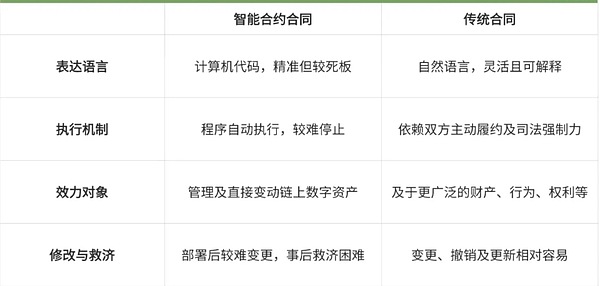
These characteristics profoundly affect the parties’ rights, risks and remedies.
Taking the risk burden when technical flaws occur in smart contracts as an example, its determination needs to be considered in layers:
-
For both parties to the contract, Risk classification requires a comprehensive review of multiple factors, including the specific design of contract terms, the execution mechanism of smart contracts, the parties’ ability to understand relevant technologies, the depth of participation in the process, and the due diligence obligations.
-
For programmers, the key to determining liability usually lies in whether it is provided for a fee:
-
If the writer is a third party that provides paid services, his legal status is similar to that of a product provider and he must be held responsible for code defects.However, whether the scope of liability should be limited to service fees, or whether it can be extended to the transaction price involved in the contract, there is currently no unified standard in judicial practice.
-
If the code comes from open source projects or is provided free of charge, the possibility of the writer bearing legal liability is relatively low.
(2) The legal nature of smart contracts when used to build decentralized autonomous organizations
Smart contracts are widely used in decentralized autonomous organizations (DAO), and their role is mainly reflected in three levels:
1. Define organizational rules—— Agree on the governance mechanism, member rights and responsibilities and decision-making process;
2. Form a collective decision——Gather the will of members and make specific decisions;
3. Ensure automatic execution——Implement rules and resolutions in code.
From a legal qualitative perspective, different functions correspond to different legal properties:
-
If the contract is mainlyUsed to define organizational rules, it may be regarded asArticles of Association, Partnership Agreement or Regulations of Self-Governmentetc., its specific characterization depends on the content of the contract itself, and this content also shapes the legal attributes of the DAO.
-
If contractused to form collective decisions, is usually regarded asresolutionBehavior is binding on the organization and relevant participating members.
-
If the contract onlyas a tool for automated execution, then it may not have independent legal attributes in itself, but is regarded as a technical means to realize organizational functions.Even so, itThey will still be bound by laws, regulations or internal agreements within the organization.For example, it needs to be consistent with the existing charter, relevant functions should be disclosed, and implementation errors may lead to liability for developers or members, etc.
In practice, the same smart contract may assume one or more of these roles.The specific characterization should be comprehensively judged based on actual functions and usage scenarios.
(3) Smart contracts are used tomoney launderingThe legal nature of illegal operations
The application of smart contracts in illegal and criminal activities is not uncommon, and a variety of complex models have been derived in the field of money laundering alone.In such cases, the core dispute often does not lie in the legal nature of the smart contract itself, but in that once it is used for illegal purposes, the relevant developers, users and even node participants may face criminal liability or administrative penalties.
Take the Tornado Cash case mentioned above as an example: Although the U.S. Treasury Department’s sanctions have been declared invalid, its developer Roman Storm is still mired in legal troubles.Storm was charged with conspiracy to operate an unlicensed money transfer business, conspiracy to launder money, and conspiracy to violate U.S. sanctions against North Korea.On August 6, 2025, a jury in Manhattan Federal Court, New York, found him guilty of “conspiracy to operate an unlicensed money transfer business”, which carries a maximum sentence of five years in prison.
While post-trial motions filed by Storm’s defense attorneys and prosecutors are inconclusive, the case has made clear:In a context where the legal nature of smart contracts is still murky, judicial practice’s responsibility requirements for code developers go far beyond “maintaining technology neutrality” or “avoiding becoming the actual controller.”
(4) Smart contracts asIntellectual property protection objects
In today’s society, it has become a general consensus that intellectual achievements are protected by law, but forWhether a smart contract is an object protected by intellectual property rights, and what kind of intellectual property rights it can be protected as(Such as copyrights, patents, trade secrets) and other issues, practitioners still need to conduct detailed analysis based on their form of expression, innovative content and protection intentions.
1. The “text” and copyright of smart contracts
For most programmers, writing smart contract code is mainly to implement a certain function and may not pursue breakthrough innovation, but this does not mean that their intellectual achievements cannot be protected.
Copyright provides a protection path for smart contracts.Although the word “work” easily makes people think of books, paintings, etc., it actually protects the expression of intellectual achievements that meet the requirements of “work”, but does not protect the technical ideas or functional logic behind it, and has no special requirements for the “technical” level of the code.
Therefore,If the code expression of a smart contract satisfies originality, intelligence and tangible performance, it may be characterized as a “work” and protected by copyright.
-
Originality:The code is independently created by the developers and reflects their individual selection, arrangement and expression, rather than a simple copy of public domain code or general functionality.
-
Intelligence:Code is the result of developers using professional knowledge and logical thinking to design and write. It is a direct product of intellectual activities, rather than a mechanical or purely functional arrangement.
-
Tangible performance:Codes are fixed in textual form and can be perceived, copied and transmitted.It should be noted that the scope of copyright protection is limited to the textual expression of the code itself, and does not extend to the technical solutions, algorithmic ideas or functional logic it embodies.
If a smart contract is recognized as a work within the meaning of copyright law, the rights holder automatically enjoys a series of personal rights and property rights such as publication rights, signature rights, modification rights, reproduction rights, and information network dissemination rights for its code text.
Copyright is automatically generated when the creation of a work is completed. Although administrative registration is not required to take effect, copyright registration or the use of technical means such as trusted timestamps to preserve certificates can effectively strengthen the proof of ownership in the event of a dispute.
2. “Technology” and patents of smart contracts
If a smart contract not only contains code expression, but also implements a technical solution with innovative value, it may be characterized as a “patent” and can seek protection by applying for patent rights.
Unlike copyrights that arise automatically, patent rights mustAccess is subject to application, review and authorization.If the technical solution contained in the smart contract meets the following three characteristics at the same time, it has the basis to apply for a patent:
-
Novelty:This technical solution does not belong to the existing technology and has not been publicly disclosed or used.
-
Creativity:Compared with the existing technology, this solution has outstanding substantive features and significant progress.
-
Practicality:Capable of being manufactured or used and capable of producing positive technical effects.
Patents are divided into three categories: invention, utility model and design, corresponding to different protection scopes and application strategies.The core of the patent system is “disclosure in exchange for protection”, that is, the applicant fully discloses the technical content to the public in exchange for the exclusive right to implement it within a certain period of time.This means more difficult technical disclosures and a stricter review process, but it may also bring about a longer protection period and stronger commercial exclusivity.
Whether to apply for a patent for smart contract-related technologies needs to be comprehensively weighed based on factors such as the technology life cycle, market competition, and trade secret protection.In view of the highly professional nature of patent applications, the complexity of the process, and the far-reaching impact, it is usually recommended that a patent attorney assist in the layout and advancement.
3. “Information” and business secrets of smart contracts
If the technical solution or business information in the smart contract does not meet the protection conditions of patent or copyright, or the developer is unwilling to disclose its content, you can consider whether it falls into the category of “trade secrets”.
If a contract meets the following criteria, it may be characterized as a “trade secret” and protected as a trade secret.
-
Secrecy:The information is not made public or is not easily accessible to others legally.
-
Value:Can bring actual or potential competitive advantages or economic benefits to the holder.
-
Confidentiality measures:The rights holder has adopted reasonable and continuous confidentiality measures, such as access control, encrypted storage, signing of confidentiality agreements, etc.
The scope of protection of trade secrets is wide, including technical information and business information that are not known to the public, have commercial value, and for which the right holder has taken corresponding confidentiality measures.The core algorithms, unique architecture, business logic or undisclosed parameters in smart contracts can all be included in the scope of trade secrets.
The protection of trade secrets does not rely on registration or review. The main legal means is to sign confidentiality agreements with internal employees, partners, etc., restricting them from disclosing, using or allowing others to use relevant information. Although this method does not require technical disclosure, it highly relies on continuous internal management and compliance supervision to maintain the confidentiality of information.
(5) Smart contracts are used tolitigationthe legal nature of
Smart contracts are often regarded as an ideal electronic evidence due to their open, transparent and non-tamperable technical characteristics.However, in legal practice, it is used as evidenceBut it is more complex than traditional forms of evidence.This complexity mainly stems from the following technical characteristics:
1. Smart ContractWritten in code language.On the one hand,The professionalism and complexity of the code significantly increase the cost of understanding and argumentation in litigation, requiring public authorities and parties to invest more resources in interpretation.On the other hand,Code cannot express all the true meaning of the parties as completely and clearly as natural language, and the parties may also reach an agreement outside of the contract.Therefore, smart contracts often cannot be used alone as the basis for finalizing a decision, but need to be mutually corroborated with other evidence.
2. Smart ContractHas anonymity.In many cases, the identity of the subjects operating through smart contracts is difficult to directly trace.Although in major criminal cases such as money laundering, powerful public authorities can break through the anonymity barrier through technical means, in a large number of civil or non-criminal disputes,Identification remains a major challenge.
3. Smart ContractRuns on a decentralized architecture.Its execution does not rely on the real-time control of a single center, resulting inIt is difficult to determine the responsible party——Code writers, deployers, node participants and other parties may be involved, but there are no clear legal rules to delineate the boundaries of their responsibilities.
Therefore, although the evidentiary effect of smart contracts has not been legally negated, and the issues involved in the distribution of the burden of proof are still within the framework of traditional evidence rules, due to the particularity of its technical language and operating mechanism,The review and identification of smart contracts in judicial practice indeed places higher professional requirements on the parties, judicial authorities and related professionals.
Compliance advice to participants
Faced with the complexity of the legal nature of smart contracts, we can at least do the following:
-
Dare to protect rights and proactively comply with regulations:The development of the industry leads to social changes, which will inevitably produce many new legal issues.Regardless of risks or opportunities, practitioners cannot lack initiative.
-
Clear scenarios and precise definitions: In legal practice, especially in some important legal documents, the term “smart contract” should be avoided in general, but the concept should be explained when necessary.
-
When used for transactions,Comprehensive attention to legality issues,Technical details and reliefquestion: Both parties to the agreement should at least pay attention to whether the transaction scenario is legal, and should also pay attention to the security audit of the code, whether it accurately reflects the true intention, and the remedial measures and responsibility allocation in the event of subsequent disputes.
-
When used for specific functions, search for special itemslawregulations: The application scenarios of smart contracts are very wide and may involve completely different departmental laws.Especially when used in specific fields such as DAO, finance, and asset issuance, be sure to check whether there are special laws and regulations in this field or specific region, so as toProactive compliance.
-
Pay attention to jurisdictionquestionApplicable to law: Smart contracts are inherently transnational, but laws are regional.Even for the same smart contract dispute, there may be different regulations in different regions.Taking these issues into consideration at the outset of project design can go a long way toward reducing legal disputes.For example, participants canAgree in advance on the applicable law and the competent court or arbitration institution that will apply in the event of a dispute., clarify transnational legal risks.
Conclusion
Real application scenarios and legal practice are much more complex than what is presented in this article.Therefore, the author does not expect to “clarify” relevant legal issues through this article, but hopes to popularize relevant legal knowledge and convey the following concepts:
Faced with the complexity of smart contract applications, we shouldAbandon the simplistic thinking of “code is law” and instead adopt a more refined and pragmatic perspective of “scenario analysis”,OnlyThis way, can we clearly define rights while embracing technological innovationwithresponsibility, managementincome vs.risk.