
 jakiro
Author: Wu Yu, Jin Shi Data
On Tuesday, the U.S. non-farm payrolls increased by 64,000 in November after seasonally adjustment, an increase greater than the market consensus of 50,000.U.S. unemployment rate hits 4.6% in November, exceeding expectations by 4.4%, a new high since September 2021.The average hourly wage rate in the United States in November recorded an annual rate of 3.5% and a monthly rate of 0.1%., lower than the expected 3.6% and 0.3%.
U.S. non-farm employment fell by 105,000 in October, the largest decline since the end of 2020.In contrast, market expectations were for a decline of 25,000.Analysts noted that this reflects the departure of more than 150,000 federal employees who accepted deferred buyouts as part of the Trump administration’s efforts to shrink the size of the federal government.Most of them disappeared from the government payroll at the end of September.
Meanwhile, the U.S. Commerce Department said that due to weak auto sales,U.S. retail sales unexpectedly grew at zero monthly rate in October, missing expectations of 0.1%.The previous value was revised down from 0.2% to 0.1%.
After the release of U.S. employment and retail sales data,U.S. federal funds futures slightly increased the odds of a rate cut in January next year, rising to 31% from 22% previously..U.S. interest rate futures still predict two rate cuts in 2026; next year’s easing is expected to be 58 basis points.
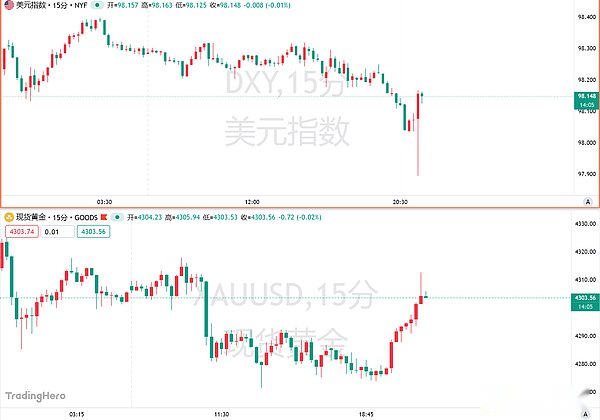
The U.S. dollar index fell below 98 for the first time since October 6 after hearing the news, and then rebounded quickly.Spot gold rose in the short term, once rising to above $4,310 per ounce.Non-US currency pairs rose, with the euro rising by more than 10 points against the US dollar; the pound against the US dollar rising by nearly 20 points; the US dollar against the Japanese yen falling by 30 points.
Before the release of non-farm data, former Federal Reserve economist and labor market expert Claudia Sam said,Investors should be cautious about November’s unemployment rate.In a post on X, she noted that the government has warned that its estimates of the labor force “will be slightly off than usual.”
Yared, acting chairman of the White House Council of Economic Advisers (CEA), also reassured that,The rise in unemployment is “statistically insignificant” and should not be read too much into.
Analyst Anstey quickly commented on the U.S. non-farm payrolls report and pointed out, “Rising unemployment may not be entirely bad news as labor force participation rate rises, we still need to take a closer look at the specific data.U.S. stock futures were higher and two-year U.S. Treasury yields fell as expectations grew for the Federal Reserve to further ease monetary policy based on weak non-farm payrolls data over the past few months.It should be noted that the data for August and September were also revised down by a total of 33,000.”
Nick Timiraos, “Fed’s mouthpiece” pointed out,Private sector employment increased by an average of 44,000 jobs in the past six months through November (the same as October).This is the slowest hiring pace in six months in the post-pandemic reopening cycle.Meanwhile, unrounded data showed the unemployment rate rose to 4.573% in November, up 13 basis points from 4.440% in September.Powell said last week that the Fed believes its policy settings will allow the unemployment rate to stabilize or “just rise another 0.1 or 0.2 percentage points.”
It is worth noting that the ADP weekly employment report earlier in the day showed thatAfter four weeks of job losses, hiring activity may be rebounding.In the four weeks ending November 29, 2025, U.S. private companies added an average of 16,250 jobs per week, highlightingThe job market continued to strengthen in the second half of November.However, these figures are preliminary and may change as new data is added.
CNBC pointed out that despite a series of complications, the latest non-agricultural report depicts labor market conditions similar to those in the past.The employment situation remains low with both hiring and layoffs low.From a policy perspective, the Fed faces difficult choices as it must try to prevent further weakness in the labor market while also preventing stubbornly high inflation from worsening.Fed officials have long insisted that the labor market is not the source of inflation, and today’s jobs report supports that assertion.
U.S. interest rate strategist Ira Jersey said, “While it is difficult to call the overall data strong, the lackluster reaction from the interest rate market is not surprising. WePay more attention to salary growth——The year-on-year growth rate has slowed to 3.5%, the lowest level in this cycle.ThereforeThe Fed could still take action, butWe need to see the non-farm and retail sales data in December to judge whether it will continue to take action.Given the lack of clear trend shifts in current data, we believe long-term interest rates will continue to remain range-bound.”