
 jakiro
Deng Tong, Bitcoin Vision
2025 is coming to an end, and on this occasion of bidding farewell to the old and welcoming the new, Bitcoin Vision launches a series of articles “Looking Back to 2025”.Reviewing the progress of the encryption industry during the year, I also hope that the industry will be over in the new year and the stars will be bright.
In 2025, the global encryption regulatory landscape will usher in new changes. Regulations in various regions no longer rely on law enforcement actions to shape the industry landscape, but instead formulate different regulatory frameworks.This article reviews the regulatory results achieved by the encryption industry in major countries and regions around the world in 2025.
Summary of encryption policies of major countries and regions around the world in 2025
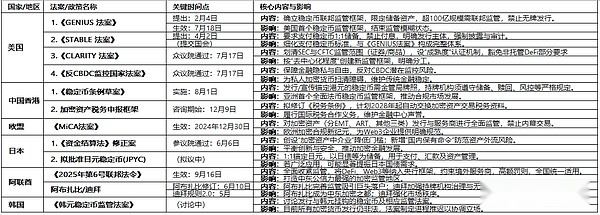
1. United States
Crypto regulation in the United States has enjoyed policy tailwinds since Trump returned to the White House, making significant progress after years of legislative stagnation.
1. “Guiding and Establishing a National Innovation Act for Stablecoins in the United States” (“GENIUS Act”)
On February 4, the bill was introduced by Republican Senator Bill Hagerty of Tennessee, Republican Senator Tim Scott of South Carolina, Republican Senator Cynthia Loomis of Wyoming, and Democratic Senator Kirsten Gillibrand of New York.On June 17, the U.S. Senate passed a bill that advances the U.S. federal government’s regulatory efforts on stablecoins and puts pressure on the House of Representatives to plan the next phase of the country’s efforts to regulate digital assets.On July 18, the bill was signed by Trump and came into effect.
The bill limits reserve assets to low-risk assets such as U.S. dollar cash and short-term U.S. Treasury bonds. Once the issuance scale exceeds 10 billion U.S. dollars, it will automatically be subject to federal supervision. In the event of bankruptcy, priority will be given to protecting the rights and interests of stablecoin holders. It also prohibits non-licensed institutions from issuing stablecoins.
The implementation of this bill marks the first time that the United States has formally established a regulatory framework for digital stablecoins.It clarifies the types of reserve assets that can be held for stablecoin issuance, and delineates the hierarchical regulatory responsibilities of the federal and state governments. It ends the previous “wild” state of ambiguous legal status and unclear regulatory rights and responsibilities in the field of stablecoins. It provides clear compliance guidelines for stablecoin issuance, custody and other aspects, and promotes the acceleration of the global stablecoin regulatory system.
For details, please view the Bitcoin Vision topic“Interpretation of the “U.S. Stablecoin Act” What impact will it have on the encryption industry?》
2. Stablecoin Transparency and Accountability for a Better Ledger Economy Act (STABLE Act)
The bill was formally proposed by Wisconsin Republican Representative Bryan Steil and Arkansas Republican Representative French Hill on April 2, and is committed to building a federal-level payment stablecoin issuance framework.Referred to Congress by the House Financial Services Committee.
The bill refines the regulatory standards for payment stablecoins, requiring issuers to allocate licensed reserve assets at a 1:1 ratio, and prohibits the payment of interest to users; it clarifies that legal issuers include three categories: federally regulated banks and approved non-bank entities; it also mandates issuers to disclose redemption procedures and monthly reserve reports. The reports must be reviewed by a certified public accounting firm, and false certification will face criminal penalties.
This bill complements the GENIUS Act and jointly builds a full-chain regulatory system for stablecoins.
Details can be viewed“Is the turning point for stablecoins coming?”The U.S. House of Representatives makes major adjustments to the STABLE Act》
3. Digital Asset Market Clarity Act (CLARITY Act)
On May 29, House Financial Services Committee Chairman French Hill proposed the Digital Asset Market Clarity Act, which aims to eliminate the long-standing ambiguity in digital asset regulation by clarifying the responsibilities of the U.S. Securities and Exchange Commission (SEC) and the Commodity Futures Trading Commission (CFTC).On June 23, the House Financial Services Committee and Agriculture Committee submitted the bill, which defines digital commodities as digital assets whose value is “intrinsically linked” to the use of blockchain.Passed by the House of Representatives on July 17.
The core of the bill is to delineate the regulatory scope of the SEC and CFTC. The SEC regulates “digital asset securities” and the CFTC regulates “digital commodities.”The bill classifies Bitcoin, Ethereum, etc. as digital commodities, and treats tokens in the ICO stage as investment contract assets; it sets up a blockchain “maturity” certification mechanism, and projects that meet the standards can subsequently be transferred to the supervision of the CFTC.In addition, it exempts non-custodial DeFi services from traditional registration requirements and relaxes SEC registration restrictions for small-amount fundraising projects.
The “CLARITY Act” no longer focuses on “whether a certain cryptocurrency is a security”, but focuses on maturity – “How decentralized is it?” It clarifies the division of labor between the SEC and CFTC and creates a new framework for digital asset supervision.
Details can be viewed“Focus on the CLARITY Act: Full analysis of content, significance and industry evaluation”
4. Anti-CBDC Surveillance State Act
In February 2023, Tom Emmer, the majority whip of the U.S. House of Representatives, proposed it for the first time.On March 26, 2025, Texas U.S. Senator Ted Cruz also introduced a bill of the same name in the Senate. On July 17, the House of Representatives passed the bill by a vote of 219 to 210.
The core significance of this bill is to protect citizens’ financial privacy and freedom.It also has positive significance in clearing obstacles to the development of private cryptocurrency, maintaining the stability of the traditional U.S. financial system, and avoiding the risk of politicization of monetary policy.
Details can be viewed“Detailed Explanation of U.S. Congressional Encryption: Summary of the Contents, Markets and Industry Opinions of the Three Major Bills”
2. Hong Kong, China
1. “Stablecoin Bill”
On May 21, the Hong Kong Legislative Council officially passed the Stablecoin Bill on the third reading.Officially implemented on August 1, it is Asia’s first comprehensive regulatory framework for fiat currency stablecoins.
The regulations stipulate that those who issue legal tender stablecoins in Hong Kong, or issue legal tender stablecoins outside Hong Kong that claim to be anchored to the Hong Kong dollar, must apply for a license from the Hong Kong Monetary Authority.Licensed issuers need to comply with requirements such as segregation of reserve assets and redemption based on par value, as well as a series of regulations such as anti-money laundering, risk management, and information disclosure.At the same time, only licensed institutions can sell fiat stablecoins in Hong Kong, and only stablecoins issued by licensed issuers can be sold to retail investors. The promotion of unlicensed stablecoins is illegal.The Hong Kong Monetary Authority simultaneously issued corresponding regulatory guidelines to clarify the license application process and transition period arrangements.
Details can be viewed“Hong Kong’s Compliant Stablecoin is Coming. A Quick Look at Its History and Main Contents”
2. Launch public consultation on the crypto asset reporting framework and revisions related to the common reporting standards
On December 9, the Hong Kong Special Administrative Region government launched a public consultation on the implementation of the crypto asset reporting framework and related revisions to the common reporting standards.The Secretary for Financial Services and the Treasury, Mr Hui Ching-yu, said that in order to demonstrate Hong Kong’s determination to promote international tax cooperation and combat cross-border tax evasion and fulfill its international obligations, we will amend the Inland Revenue Ordinance (Chapter 112) (the Ordinance) to implement the reporting framework and the newly revised common reporting standards.This move is also vital to maintaining Hong Kong’s reputation as an international financial and business centre.The government plans to complete the required local legislative amendments within next year, with the aim of automatically exchanging tax information related to crypto-asset transactions with relevant partner tax jurisdictions from 2028, and implementing the newly revised common reporting standard from 2029.Hong Kong will automatically exchange tax information with suitable partners on a reciprocal basis, and partners must meet standards related to protecting data confidentiality and security.
Details can be viewed“Hong Kong: Plans to automatically exchange tax information related to crypto-asset transactions with relevant partner tax jurisdictions from 2028”
3. European Union
On December 30, 2024, the EU’s Crypto-Asset Market Supervision Act (“MiCA Act”) officially came into effect, marking a new era for the European crypto-asset compliance framework.
The bill establishes a refined classification supervision system, which not only sets out clear requirements for crypto asset issuance and related service providers, but also sets regulatory exemption rules and market integrity guarantee provisions.MiCA defines encrypted assets as digital representations of value or rights transmitted and stored through distributed ledger technology, and is divided into three categories: Electronic Money Tokens (EMT); Asset Reference Tokens (ART); other encrypted assets, such as non-stable currencies such as Bitcoin.The bill focuses on differentiated supervision of the issuance of crypto assets, stipulates the access and operation specifications for crypto asset service providers (CASP), delineates the scope of regulatory exemptions to avoid excessive regulation and inhibits innovation, and the bill to prevent and control market violations clearly prohibits insider trading.
Details can be viewed“The EU MiCA Act officially comes into effect: One article explains the new norms for Web3 enterprise development”
4. Japan
1.Amendment to the Fund Settlement Law
In March this year, the Japan Financial Services Agency submitted an amendment to the bill to Congress. The core is to build a strong market security defense line and moderately lower industry entry barriers.
On June 6, the Japanese Senate passed an amendment to the “Funds Settlement Act” to establish a new system for the “crypto-asset intermediary industry”, allowing companies to engage in matching services without registering as crypto-asset exchange operators, aiming to lower market entry barriers and promote crypto-financial innovation.The amendment also adds a “domestic retention order” clause, giving the government the power to order the platform to retain some user assets in Japan when necessary to prevent the risk of asset outflows caused by events similar to FTX’s bankruptcy.The new law is expected to be officially implemented within one year from the date of promulgation.
Details can be viewed“The Japanese Senate passed the amendment to the Fund Settlement Act and established a new system for the crypto-asset intermediary industry”
2. Plan to approve the issuance of Japanese Yen stable currency
The Japanese yen stable currency will be named JPYC, with 1 JPYC fixed at a fixed exchange rate of 1 yen (approximately 0.05 yuan), and will be supported by highly liquid assets such as Japanese yen deposits and Japanese government bonds as reserves.Individuals, businesses and institutional investors can apply to purchase JPYC stablecoins and make payment transfers. The stablecoins will then be transferred to their electronic wallets. Application scenarios include remittances to overseas students, corporate payments, and blockchain-based asset management services.
The yen stablecoin could have a significant impact on the Japanese bond market.If JPYC is widely used, it will boost the demand for Japanese government bonds, and JPYC is likely to start purchasing large amounts of Japanese government bonds in the future.
Details can be viewed“Japan intends to approve the issuance of yen stable currency”
5. United Arab Emirates
On September 16, Federal Decree No. 6 of 2025 came into effect, which can be regarded as a major integration in the history of financial supervision, comprehensively tightening supervision in encryption and related fields.Specific policies include: for the first time, the decree brings all blockchain infrastructure such as DeFi, Web3 projects, stablecoin protocols, decentralized exchanges, and cross-chain bridges into the central bank’s regulatory framework; even if encryption service providers are located outside the UAE, as long as their service targets include UAE residents, they must comply with the law and apply for relevant licenses; entities that carry out relevant business without permission may be fined 50,000-1 billion dirhams (approximately 13,600-27,200 dirhams)fines of USD 100 million), and in some cases will be accompanied by imprisonment penalties; the decree provides a one-year transition period for existing operators in encryption and related fields, requiring relevant projects to complete compliance license applications and other adjustments before September 2026, and the central bank can extend the transition period at its discretion; previously, financial free zones in places such as Dubai could issue virtual asset licenses on their own, but the new decree clearly stipulates that its provisions also apply to financial free zones, and licenses issued by free zones cannot be exempted from the compliance requirements of the new law.
The UAE is striving to build itself into the cryptocurrency regulatory region with the most complete structure and the strongest international credibility in the Middle East.
1.Abu Dhabi
On June 10, the Abu Dhabi Global Market Financial Services Authority announced that it would implement revisions to its digital asset regulatory framework with immediate effect.The revisions focus on modifying the process for the acceptance of virtual assets (VA) by Abu Dhabi Global Market (ADGM) for use as recognized virtual assets (AVA), as well as setting corresponding capital requirements and fees for authorized persons (virtual asset companies) engaged in regulated activities related to virtual assets.The amendments also introduce product-specific intervention rights for virtual assets and establish rules to confirm the existing prohibition on the use of privacy tokens and algorithmic stablecoins within ADGM.Finally, the revisions expand the investment scope of venture capital funds.
Due to Abu Dhabi’s continuously improving encryption regulatory environment, many encryption companies such as Circle, Tether, Binance, Ripple, Animoca Brands, GFO-X, and Bitcoin Suisse have obtained licenses in Abu Dhabi during the year.Abu Dhabi is becoming the crypto capital of the Middle East.
Details can be viewed“Is Abu Dhabi the Crypto Capital?”Why Binance, Tether, Circle and other crypto giants gathered together to choose Abu Dhabi》
2.Dubai
In May this year, Dubai’s Virtual Asset Regulatory Authority (VARA) released version 2.0 of its rulebook, expanding governance and reporting standards for all licensed virtual asset activities.VARA also continues to take significant civil enforcement action against unlicensed operators in Dubai, issuing cease and desist orders and fines on multiple platforms.
6. South Korea
In May this year, Lee Jae-myung formally proposed a plan to issue a stable currency linked to the Korean won at a policy discussion meeting.
In early December, South Korea’s ruling party called on ministries and the Financial Services Commission (FSC) to submit a Korean won stable currency regulatory bill before December 10, but the FSC failed to submit the bill on time.A spokesperson for the FSC said that the FSC needs more time to coordinate its position with relevant agencies. Rather than rushing to complete the proposal before the prescribed deadline, it is better to publish its proposal at the same time as the bill is submitted to the National Assembly.The FSC said the move was to protect the public’s right to know about the matter.
As a result, all forms of cryptocurrency and stablecoin issuance remain illegal in South Korea.