 jakiro
Author: Chen Mo, source: X, @cmdefi
The recent heated debate between Aave DAO vs Aave Labs and the dispute over governance rights at the protocol layer and product layer are behind the industry-wide governance dilemma.Sorted this issue out.Who is the owner of Aave?
1. The cause of the incident
Aave Labs replaced the front-end integrated ParaSwap with CoW Swap, and the fees generated thereafter flowed to the Labs private address.Anonymous DAO member EzR3aL exposed this matter on the governance forum, accusing Labs of “privatizing” the value of the protocol. Labs’ position is that this belongs to the front-end and product layer income, belongs to Labs, and has nothing to do with the core of the protocol.
2. First, let’s break down who Aave DAO and Aave Labs are.
-
DAO stands for Protocol (protocol layer)
-
Labs represents Project (product layer)
The core dispute is whether Aave is a Protocol (managed by DAO) or a Project (built by Labs)?and the impact on income rights.
Aave DAO is easy to understand. It is a governance organization unique to the Crypto world. It is composed of AAVE token holders who vote to exercise power in the DAO organization.Almost 90% of crypto projects have this structure, which is where the definition of “governance token” comes from.Its greatest power is to vote on project proposals and decide whether the project will undergo certain updates and developments, as well as its future development direction.
Aave Labs is a development team responsible for building, updating and maintaining the protocol.(such as front-end interface, mobile App), usually they also maintain the Aave brand and IP, so on social media and in the market, Aave Labs is usually Aave by default.Its founder is also influential on social media.
Generally speaking, Aave Labs and Aave DAO need to work together. For example, Labs will formulate many development plans, optimize certain functions, and even version upgrades to V3 V4. These plans are led by Aave Labs, but are ultimately decided by DAO voting.Usually, when the two have the same interests, they have a mutually supportive relationship and together form Aave.
3. Which core resources do they control?
Once there is a conflict of interest, if the two roles are separated, it can be separated, because they are two independent individuals. Let’s look at the core resources and powers possessed by the two:
Aave DAO controls the underlying core, such as smart contracts and treasury control. Although Labs can propose development plans, they need to be voted by the DAO before they can be implemented.So it is a Protocol, and the upper layer can be any product that can operate. In theory, multiple front-end products can be built on one Protocol, Aave?Bave?Cave is fine.
Aave Labs masters front-end, branding, product marketing, and partners.So it communicates directly to the user and he represents a good product.
Therefore, Labs supporters generally believe that the integration of CoW Swap is entirely a front-end behavior and has nothing to do with Aave’s underlying architecture. Labs can even decide unilaterally not to integrate it, and whether it generates income will naturally belong to Labs.The corresponding DAO supporters believe that this is a plunder, because with the existence of the AAVE governance token, all benefits should flow to AAVE holders first, or remain in the treasury to be voted on by the DAO.In addition, before, ParaSwap’s revenue would continue to flow into DAO. The new CoW Swap integration has changed this situation, making DAO think this is a plunder.
Both have their own opinions.
4. Governance Dilemma
What is reflected here is a rather embarrassing governance and power dilemma. From the perspective of AAVE holders, they usually side with the DAO, because the income entering the treasury is beneficial to the token holders. Although Labs has corresponding annual expenses, it can be reimbursed through the DAO. If it can make a separate profit, it seems that the power of the community is gradually being swallowed up.
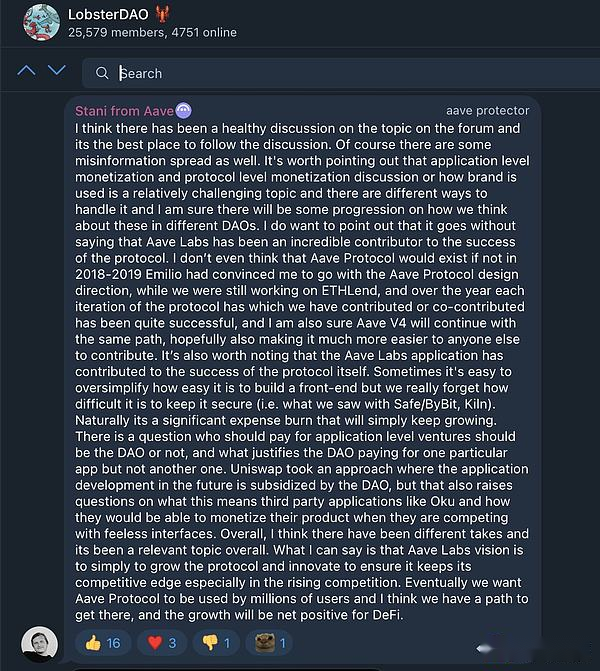
But from the perspective of Aave Labs, although in theory the core control power lies with the DAO, and the plan can only be implemented after it is finally voted through, from the first version of Aave to the present, Labs has played a united role in the overall situation and has made a huge contribution to the growth of the project.As Stani said, “If Emilio hadn’t convinced me to adopt the design direction of the Aave protocol in 2018-2019, when we were still working on ETHLend, I think the Aave protocol might not have existed at all.”
Who is the real owner of Aave.
5. Power struggles
This kind of governance dilemma exists in most projects. Governance tokens are bought by everyone with real money. Ideally, these holders jointly decide the future of the project. When the team no longer holds voting rights, Labs can even be forcibly replaced.
But there is a big gap between reality and the ideal state. Even projects with a certain market share will inevitably lose the market when problems, disputes, and farce occur within the team. For example, Sushi is a good example. DAO can exercise power and the project can also replace people. Although thanks to the design of smart contracts, even if a project undergoes a major overhaul, it can perfectly retain the original stability at the product function level.But judging from past cases, the result of division is usually a bad ending.
The core problem here is that the DAO is currently a decentralized organization. Although it has voting rights, it is difficult to operate efficiently. There may be independent developers, VCs, and big players in the community. Once each role begins to fully exercise its power, a proposal may go through multiple iterations of formulation, modification, and gaming from the beginning.The success of a project requires a professional team and continuity. DAO can hire a new team, but it may be difficult to quickly connect and iterate, and it is easy to lose its market position.Therefore, the existence of Labs is more like an entity that can “control” the protocol (requires cooperation with DAO).
Personally, I prefer that the two eventually reach a solution to weigh the distribution of benefits.But everything is currently under discussion and there has been no governance vote.The possible hidden danger behind this is that even if a settlement is eventually reached, this incident has exposed the differences in expectations between the founding team and token holders.
In the long term, I am still optimistic about the development of Aave, because it is one of the few DeFi projects that has been verified by the market and has a strong moat, and the conflict of governance power is a problem that the entire industry needs to face. How Aave handles this incident may become a model case for the industry in the future.
6. Voice and discussion
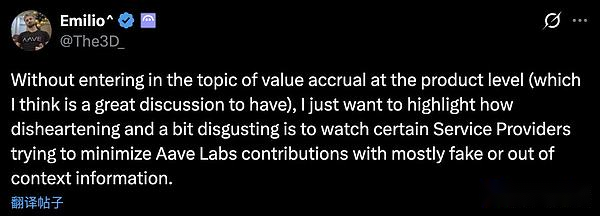
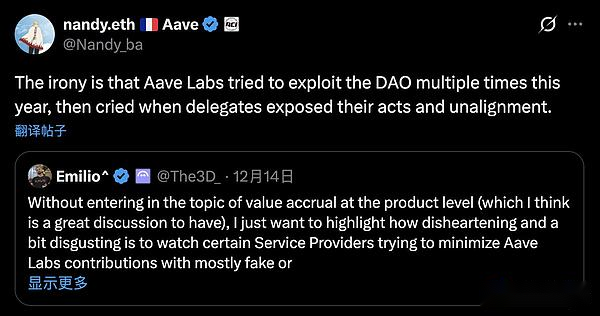
There was a quarrel, and Emilio believed that someone was maliciously belittling the contribution and value of Aave Labs.ACI team members pointed out that Aave Labs has tried to exploit DAO many times and was exposed.
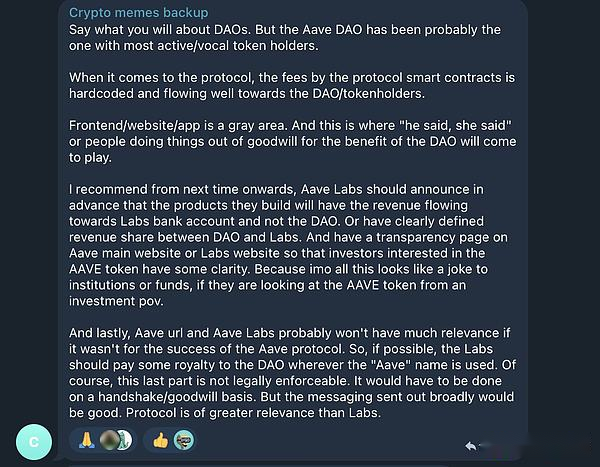
Community members’ suggestions for Labs:
-
In the future, Labs should announce in advance that the revenue from the products they build will flow to Labs, not DAO.
-
Or clearly define the revenue sharing ratio between DAO and Labs.
-
Set up a transparent page on the Aave main website or Labs website to provide clear information to help investors (especially institutions or funds) interested in AAVE tokens make judgments.
Although the DAO model is highly controversial, Aave DAO’s token holders are the most active and vocal group, which shows its community vitality.The front-end, website and application are the focus of controversy. It is easy for “everyone’s opinion” to appear here and there is a lack of clear definition.
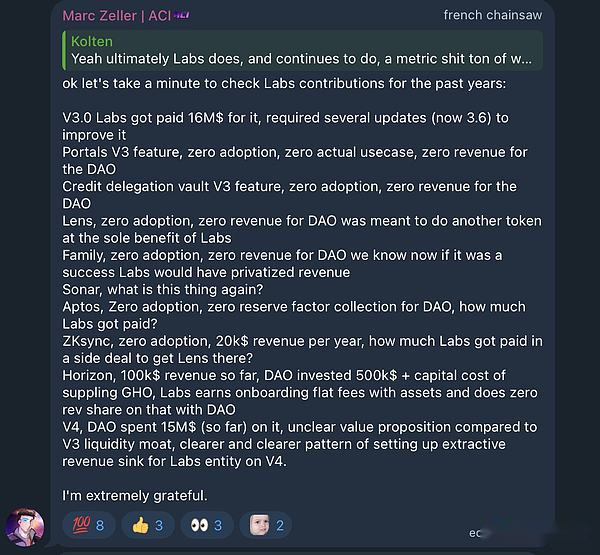
Some of Zeller’s accusations against Labs for extracting value from the protocol:
The projects it lists (Portals, Credit Delegation Vault, Lens, etc.) do show that many of Aave Labs’ exploratory initiatives have not directly translated into revenue or significant adoption of the protocol.
The V4 version was also mentioned. The DAO has spent $15 million so far. Compared with the liquidity moat of V3, the value proposition is unclear, and there are concerns about whether this is a new trap to extract revenue.
In the process of innovation, failure is inevitable.Not every feature or product will be successful.The DAO is, to some extent, investing in the research and development capabilities of Aave Labs. From my understanding, Zeller is not denying the contribution, but is calling for the establishment of higher standards of accountability, transparency, and value alignment.