 jakiro
Author: Trend Research
Since the 1011 market crash, the entire crypto market has been bleak. Market makers and investors have suffered heavy losses, and it will take time for funds and emotions to recover.But what the crypto market is most indispensable for is new fluctuations and opportunities, and we remain optimistic about the market outlook.Because the trend of integrating mainstream crypto assets and traditional finance into new business formats has not changed, but has rapidly accumulated a moat during the market downturn.
1. Strengthening of Wall Street consensus
On December 3, US SEC Chairman Paul Atkins said in an exclusive interview with FOX at the New York Stock Exchange: “The entire U.S. financial market may move on-chain within the next few years.“
Atkins said:
(1) The core advantage of tokenization is that if the assets exist on the blockchain, the ownership structure and asset attributes will be highly transparent.Currently, listed companies often don’t know who their shareholders are, where they are, and where their shares are.
(2) Tokenization is also expected to achieve “T+0” settlement, replacing the current “T+1” transaction settlement cycle.In principle, the delivery payment (DVP)/receipt payment (RVP) mechanism on the chain can reduce market risks and improve transparency. The current time difference between clearing, settlement and fund delivery is one of the sources of systemic risks.
(3) It is believed that tokenization is an inevitable trend in financial services, and mainstream banks and securities firms are already moving in the direction of tokenization.It may not even take 10 years for the whole world to happen…maybe it will be a reality in a few years.We are actively embracing new technologies to ensure that the United States remains at the forefront of areas like cryptocurrency.
In fact, Wall Street and Washington have built a deeply encrypted capital network, forming a new narrative chain:American political and economic elite → U.S. debt (treasury bonds) → Stablecoin/crypto treasury company → Ethereum + RWA + L2
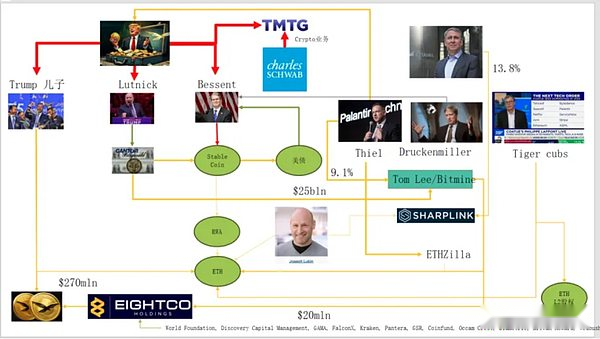
From this picture, you can see that the Trump family, traditional bond market makers, the Ministry of Finance, technology companies, and encryption companies are intricately connected, with the green oval connection becoming the backbone:
(1) Stable Coin (USD assets behind USDT, USDC, WLD, etc.)
The bulk of reserve assets are short-term U.S. Treasury bonds + bank deposits, held through brokers such as Cantor.
(2) US Treasuries
Issuance and management by Treasury / Bessent
Palantir, Druckenmiller, Tiger Cubs, etc. are used to make low-risk interest rate positions
It is also the income-generating asset pursued by stablecoins/treasury companies.
(3)RWA
From U.S. debt, mortgages, accounts receivable to housing finance
Tokenization is done via the Ethereum L1/L2 protocol.
(4)ETH & ETH L2 Equity
Ethereum is the main chain that undertakes RWA, stablecoins, DeFi, and AI-DeFi
L2 equity/Token is a claim for equity in future transaction volume and fee cash flow.
This chain expresses:
U.S. dollar credit → U.S. debt → stable currency reserves → various crypto treasury/RWA protocols → eventually settled on ETH/L2.
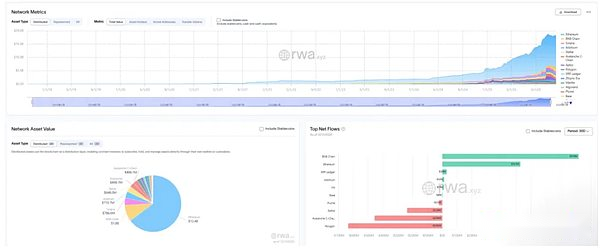
From the TVL of RWA, compared with the decline of other public chains in 1011, ETH is the only public chain that quickly repaired the decline and rose. The current TVL is 12.4 billion, accounting for 64.5% of the total encryption volume.
2. Ethereum explores value capture
The recent Ethereum Fusaka upgrade has not caused too many waves in the market, but from the perspective of the evolution of the network structure and economic model, it is a “milestone event.”Fusaka is not just expanding capacity through EIPs such as PeerDAS, but is trying to solve the problem of insufficient value capture on the L1 mainnet caused by the development of L2.
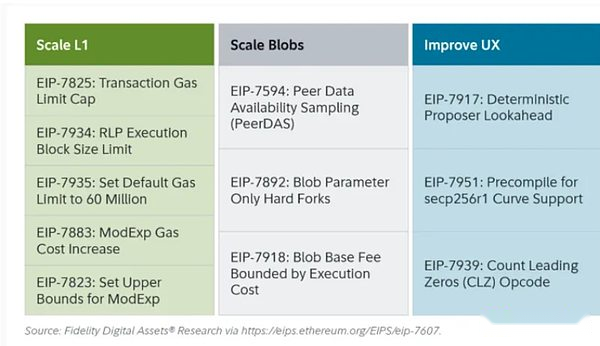
Through EIP-7918, ETH introduced the blob base fee into a “dynamic floor price”, binding its lower limit to the L1 execution layer base fee, requiring blobs to pay DA fees at least at a unit price approximately equal to 1/16 of the L1 base fee; this means that Rollup can no longer occupy blob bandwidth for a long time at nearly zero cost, and the corresponding fees will be flowed back to ETH holders in the form of burning.
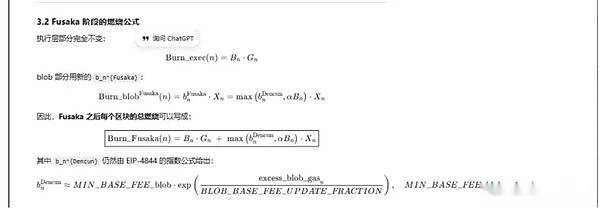
Among all the upgrades of Ethereum, there are three related to “burning”:
(1) London (single dimension): Only the execution layer is burned, and ETH begins to have structural burning due to L1 usage.
(2) Dencun (dual dimension + blob market independent): Burning the execution layer + blob, L2 data writing to the blob will also burn ETH, but when demand is low, the blob part is almost 0.
(3) Fusaka (double dimension + blob bound to L1): To use L2 (blob), you must pay at least a fixed proportion of the L1 base fee and be burned. L2 activity is more stably mapped to ETH burning.
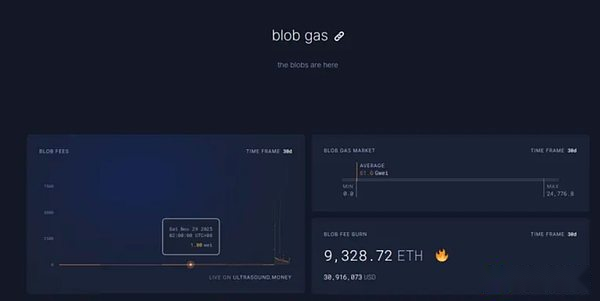
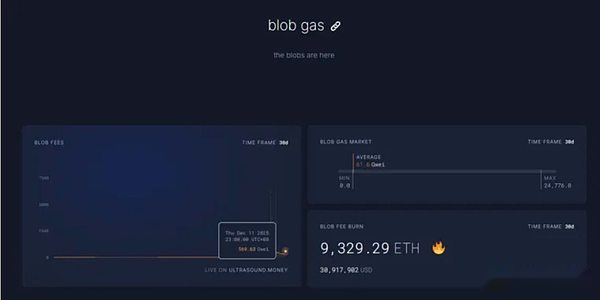
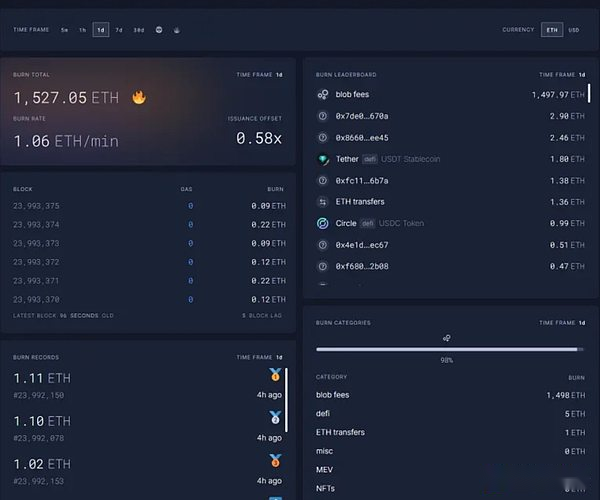
At present, the cost of blob fees at 12.11 23:00 1h has reached 569.63 billion times that before the Fusaka upgrade. 1,527 ETH are burned in one day. Blob fees have become the part with the highest burning contribution, as high as 98%. When ETH L2 is further active, this upgrade is expected to return ETH to deflation.
3. Ethereum’s technical strength
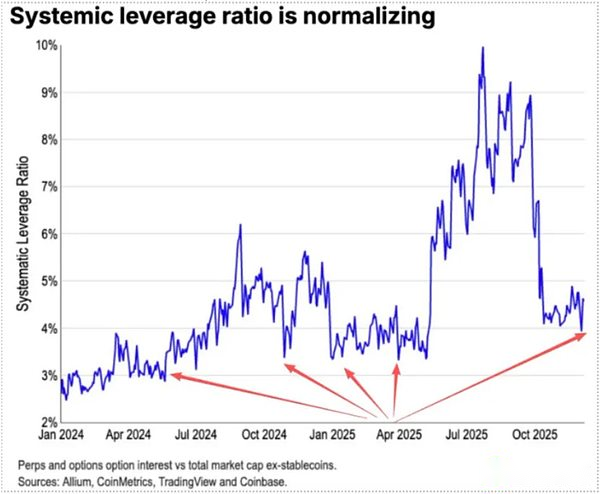
During the decline of 1011, the futures leverage market of ETH was fully cleared, and finally reached the spot leverage market. At the same time, many people lacked faith in ETH, which caused many ancient OGs to reduce their positions and run away.According to Coinbase data,The speculative leverage in the currency circle has dropped to a historical low of 4%.
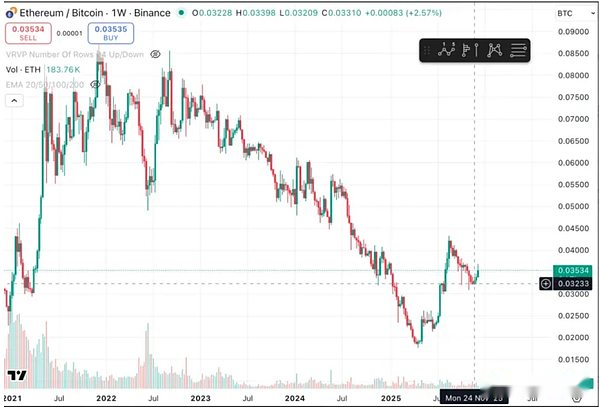
In the past, an important part of ETH’s short positions came from the traditional Long BTC/Short ETH pair trading. In particular, this pairing generally performed very well in the past bear markets, but something unexpected happened this time.The ETH/BTC ratio has maintained a sideways resistance since November.
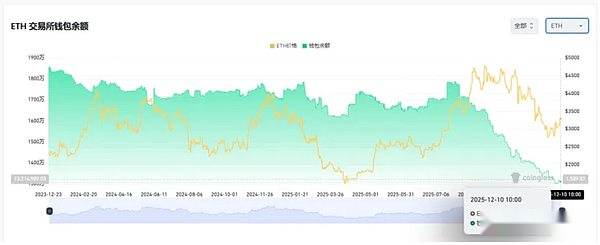
The current stock of ETH on exchanges is 13 million, about 10% of the total, which is at a historical low. As the Long BTC/Short ETH pairing begins to expire in November, when the market is extremely panicked, “short squeeze” opportunities may gradually appear.
With the interaction in 2025–2026, the future monetary and fiscal policies of China and the United States have released friendly signals:
The United States will be active in the future, cutting taxes, cutting interest rates, and relaxing encryption regulations, while China will be appropriately relaxed and maintain financial stability (suppressing volatility).
Under the scenario of relatively loose expectations from China and the United States, which suppresses the downward volatility of assets, and when there is extreme panic and funds and emotions have not yet been completely restored, ETH is still in a better buying “strike zone”.