
 jakiro
Author: Felix, PANews
The recently popular x402 protocol has made new progress recently.x402, an open source payment protocol incubated by Coinbase and built specifically for AI agents, launched the V2 version on December 11.This version is optimized based on V1 and expands from single call payment to a unified Internet payment layer.
Originally released in May 2025, the idea behind x402 is to embed payments directly into HTTP, leveraging the long-idle 402 status code.x402 has processed over 100 million payments from APIs, applications and AI agents in just a few months, supporting a variety of use cases from paid API calls to autonomous agents purchasing compute and data on demand.
Coinbase said this update restructures the protocol to make it more versatile, flexible, and easier to scale across networks, transports, identity models, and payment types.It marks a shift from “what the protocol can do” to “how it can seamlessly integrate with existing services.”
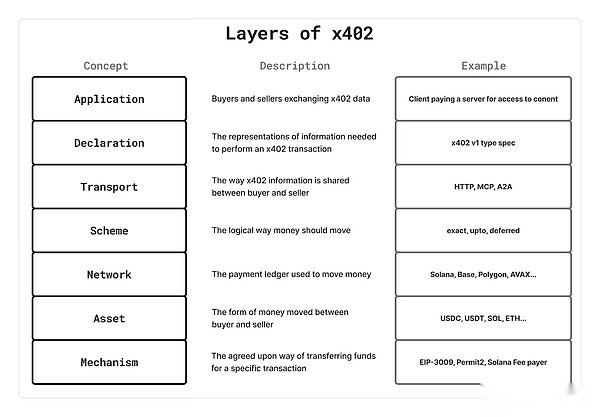
Unified payment interface
x402 V2 introduces a standardized payment interface that connects blockchain networks and traditional payment systems.It supports multiple blockchains including Base and Solana, while maintaining compatibility with ACH and card networks.
x402 V2 simplifies developer integration by creating a single format for identifying networks and assets.Developers can build cross-chain payment processes without complex adjustments or custom logic.This unified architecture supports flexible payment models including subscription, prepaid and multi-step billing.
The update also introduces dynamic “payTo” routing, which can route funds to specified addresses, roles, or callback-based payment logic upon request.This feature is ideal for marketplace platforms and multi-tenant APIs.Additionally, it enables dynamic pricing based on input data.
Scalable architecture and compatibility
The modular architecture introduced in the V2 version separates protocol specifications, SDK implementation and payment service providers.This structure makes x402 V2 plug-in driven, allowing developers to add new blockchains or payment behaviors without changing the core protocol.
x402 V2 integrates Lifecycle Hooks, allowing builders to insert custom logic at key points in the payment process (such as before/after payment sending, before/after settlement verification).These hooks support complex functionality such as conditional routing, failure recovery, and metric monitoring.In this way, x402 V2 improves efficiency and reliability in a variety of financial environments.
The updated SDK can support multiple payment service providers at the same time, and developers can set the priority of networks or assets according to their preferences.This flexibility ensures smoother payment routing across blockchains and platforms.x402 V2 enhances interoperability, stability, and developer productivity in a unified framework.
Wallet access and developer experience
x402 V2 also refactors wallet and identity management.By introducing reusable wallet sessions, duplicate payment verifications are eliminated for returning users or AI agents.This feature reduces transaction latency and increases cost-effectiveness in high-frequency payment environments.
The system includes a modular paywall component package that supports EVM and custom payment backends for the Solana network.This modular design encourages developers to build and adapt paywalls to suit different business models.It also lays the foundation for future wallet-based identity standards such as “Log in with X.”
The x402 V2 update automates service discovery and metadata management through its Discovery extension.This allows service providers to index services, update prices and manage routing without manual intervention.
Coinbase stated that the launch of the V2 version of the x402 protocol represents another important milestone for value to flow as easily as information on the Internet.By expanding compatibility, simplifying the developer experience, and supporting new payment and identity models, V2 transforms x402 into a more flexible payments layer supporting human, app, and agent-driven payments.