 jakiro
The December Fed meeting statement is out.
Cut interest rates by 25 basis points, bringing the federal funds rate to 3.5-3.75%.
However, in this interest rate cut, 3 of the 12 Fed members voted against it. Among them, Chicago Fed President Goolsby and Kansas Fed President Schmid opposed the interest rate cut. They believed that inflation is so high now and has not dropped at all in a year. Employment is also very good. Why cut interest rates?
On the contrary, Milan, who once drafted the infamous “Mar-a-Lago Agreement”, believes that interest rates should be cut by 50 basis points. Employment has begun to weaken. We must cooperate with the strategic goal of making America great again. If we don’t cut interest rates now, when will we have to wait?
From this time the bitmap(Mainly reflecting the views of each voting committee on future interest rate cuts)It appears that the current 12 voting committee members overall believe that there will be one interest rate cut in 2026 and another in 2027.
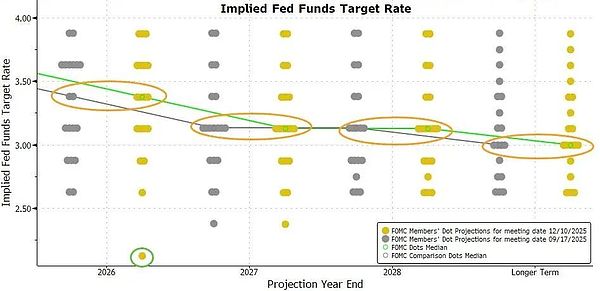
In terms of economic forecasts for the United States, the growth forecast is slightly raised, the inflation rate forecast is slightly lowered, and other forecasts are basically the same as in September.
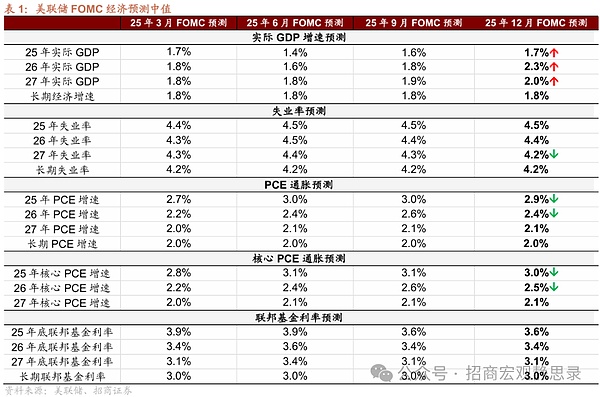
The pace and magnitude of interest rate cuts are basically what the market expected.
However, I have said many times in previous articles that both the dot plot and this economic forecast are basically useless. They can only represent the current views of the 12 Federal Reserve voting committee members on market interest rates in the next year. However, their views will also change at any time with the passage of time and changes in economic data.
In particular, after this interest rate cut, investors who invested in the market with real gold and silver used interest rate futures to predict interest rate cuts in the next two years. This is not the case – CME’s Federal Reserve Interest Rate Observation Tool shows that the market believes that there will still be two interest rate cuts in 2026.
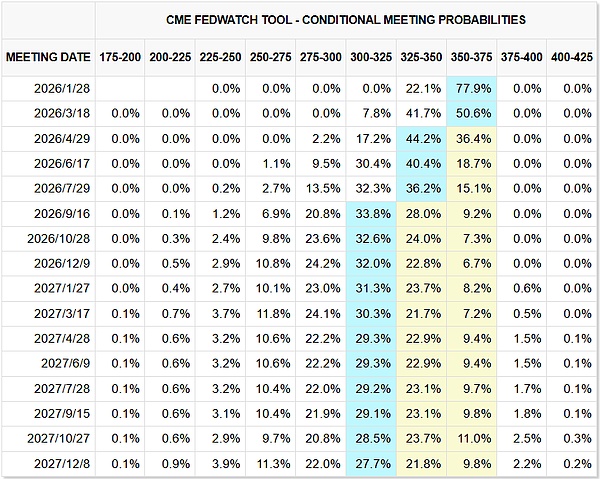
What the market did not expect the most,It was at this interest rate meeting that Fed Chairman Powell quickly announced to the market that starting from December 12 (that is, the first day after the December interest rate meeting), the Fed will purchase US$40 billion in treasury bonds within 30 days to supplement market liquidity.
Of course, Powell emphasized that this is not a new QE, but to manage the liquidity of the money market and maintain the stability of the bank reserve system. Anyone who has read my article should know that even this little idea of the Federal Reserve was correct in my article. The term must be changed. Otherwise, QE will be started again immediately after the end of QE. Isn’t it crazy?So, just change the name, RMP(Reserve managed bond purchases), I am not printing money, I am managing the monetary system…
Yes, all central banks are virtuous. They print money at every turn, and they constantly change their names to show that they are not printing money, but “managing the financial system.” From head to toe, every pore is dripping with sweat from working hard to serve the people…
As for us, how do we identify this?
Just don’t listen to his clever new words, just look at the size of his balance sheet to see whether it has expanded or shrunk.If there’s a single currency indicator to look at, it’s the size of the Fed’s reserves:
From 2008 to August 2014, large-scale money printing was carried out;
From September 2015 to August 2019, water was collected (but very slowly and very little water was collected);
From September 2019 to March 2022, ultra-large-scale money printing and waste will be released;
April 2022-December 2025, water collection);
2026- , small-scale money printing and water release.
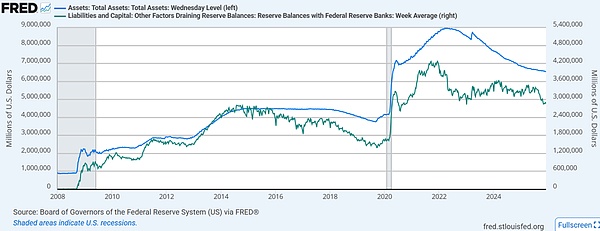
In this way, the expansion of the Federal Reserve’s balance sheet, which has been shrinking since April 2022, stopped, and the Federal Reserve returned to the path of balance sheet expansion.
I guess you must want to ask, what impact will the Fed’s release of water this time have on the prices of major asset classes?
This may be a little different from what you think.
As for the U.S. stocks that everyone is most concerned about, interest rate cuts have actually been fully priced in by the market, but restarting the money printing valve will be greatly beneficial to the valuation expansion and rise of U.S. stocks. However, according to my personal judgment (detailed analysis in my weekly asset model report), U.S. stocks have been overwhelmed by the market’s enthusiasm in the past few weeks. The benefits of restarting the money printing valve this time are likely to be only reflected in the long term. In the short term, U.S. stocks are likely to experience a round of turmoil.
There is not much to say about gold and silver. Cutting interest rates and printing money is naturally a big benefit, but the price of gold and silver has risen significantly. What happens next depends on the sustainability of this money printing, as well as the influence of other more critical factors…
Regarding U.S. debt, because the US$40 billion a month of bond purchases are mainly short-term Treasury bonds, it is of course good for short-term Treasury bonds, but long-term Treasury bonds depend more on expectations of future interest rate cuts and U.S. inflation expectations. Therefore, if you look at the news of the Fed cutting interest rates and printing money, both short-term Treasury bond prices and long-term Treasury bond yields have declined (meaning Treasury bond prices have increased) – but overall, since the end of November, the yields on medium and long-term Treasury bonds have actually increased significantly.
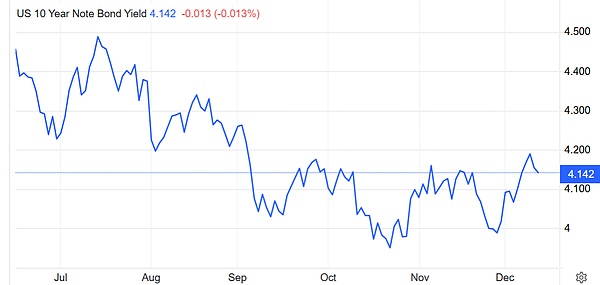
As for A-shares and Hong Kong stocks, although they will also benefit from U.S. interest rate cuts and money printing, because the scale of this RMP money printing (US$40 billion a month) is not large compared to the current balance sheet size, the spillover effect will not be obvious. Moreover, the valuations of A-shares and Hong Kong stocks, is more subject to the yields on medium- and long-term treasury bonds in the United States. Therefore, overall, this news can only be regarded as a weak benefit to A-shares and Hong Kong stocks – if the yields on medium- and long-term treasury bonds in the United States do not fall, A-shares and Hong Kong stocks will most likely continue to be under pressure;
…
Overall, cutting interest rates and printing money is a good thing, but whether it is U.S. stocks, A shares or Hong Kong stocks, their valuations are near their highest levels in recent years, and market sentiment is also near highs. Cutting interest rates and printing money is certainly a big benefit in the short term, but after the Fed statement, asset prices have quickly reflected it – whether it will tend to rise or fall in the future, there are other more critical factors in the short term.