 jakiro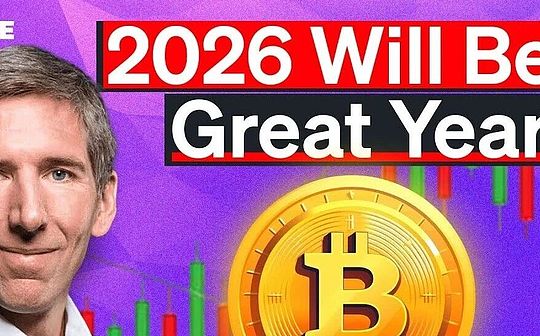
Podcast source: Empire,Broadcast time: December 8.Guests:BitwiseChief Investment Officer (CIO)Matt Hougan
The content of this article is compiled from the latest episode of the encryption podcast Empire, “Institutional Flows Will Overpower the 4-Year Cycle”.The guests areBitwise Chief Investment Officer (CIO) Matt Hougan.
During the program, Matt conducted in-depth discussions on key issues such as “whether the influence of Bitcoin’s four-year cycle is weakening”, “accelerating the entry of institutional funds”, and “whether Strategy has a real risk of being forced to sell Bitcoin”. He also gave his own judgment on the Haseeb-Santi debate on the valuation of the L1 public chain, and also shared his views on the growth momentum of the crypto market in the next stage.
(The following is the summary of the interview)
Q1: The market has been experiencing violent fluctuations recently, especially with sharp drops on weekends. What do you think?
Matt Hougan:
Short-term volatility doesn’t mean much on its own, but the past few months have certainly created a “weekend panic pattern.”Since the crypto market trades around the clock all year round, and humans do not stay awake all year round, market liquidity is naturally weak on weekends. In addition, some major macro policies are often released on Friday afternoons, which makes the crypto market must digest news in advance, which is often amplified on weekends.
So I don’t think this is a fundamental change.In fact, what we are discussing now is aA market that remains flat overall this year, but the emotions were amplified to the point of experiencing a crash.Many investors are nervous now just because in their memory, “accidents often happen on weekends.”This is not a sign of a long-term trend.
Q2: From a more macro perspective, how do you judge the market in 2025–2026?Is the four-year cycle still valid?
Matt:
I have said many times that I think the so-called “four-year cycle” has basically expired.It used to be true because of a combination of certain factors that no longer have enough influence.
The supply shock caused by the halving is affecting the market at a decreasing rate; the interest rate environment is completely different from the past two “cyclical correction years” (2018, 2022), and now is an interest rate cutting cycle; the risk of “systemic thunderstorms” that caused huge corrections in the previous cycle has also been significantly reduced.In other words, the original forces driving cycles are now weakened.
But on the other side, there is a force that is getting stronger and stronger——Entry of institutional capital.In the past six months, traditional giants such as Bank of America, Morgan Stanley, UBS, and Wells Fargo have successively opened up crypto asset allocation, with a total scale of more than $15 trillion.This is a ten-year-level force that is enough to overwhelm the so-called four-year cycle.
So I say it very clearly:I don’t think 2026 will be a down year, on the contrary I think it will be strong.
Q3: You mentioned that a lot of “Old Leek selling pressure” does not come from on-chain addresses, so where does this selling pressure come from?
Matt:
Many OG currency holders have not sold coins directly in the past few years, so the on-chain data does not show “old wallet movement”, but they have carried out another equivalent selling pressure:Covered call.
To put it simply, if they don’t want to sell the Bitcoins they have held for many years (because of the high tax burden), but want to cash out the gains, they will mortgage the Bitcoins and write options in exchange for an annualized return of 10%–20%.This operation essentially involvesFuture upside gains are “sold” to the market, the pressure on the price is equivalent to partial selling, but it will not be marked on the chain as “old address transferring assets”.
This type of business is growing very fast at Bitwise, and we’re not the only provider.I speculate that there may already be some on the marketBillions of dollars of implicit selling pressure come from this structural selling.
Q4: Is there really a risk that Strategy will be forced to sell coins?Why is the market worried repeatedly?
Matt:
There is absolutely no need to worry.I even think this is a misunderstanding.
MicroStrategy’s annual interest expense is about $800 million, and it has $14.4 billion in cash on hand, enough to cover the next 18 months.It has about $8 billion in debt and more than $60 billion worth of Bitcoin holdings.More importantly, the earliest debt it needs to repay is2027Just expired.
Unless the price of Bitcoin plummets by 90%, there is no such thing as a “forced selling” situation.And if it really fell 90%, the entire industry would be in worse shape than MicroStrategy.
So the correct concern is not “will they sell” but “will they not buy as much in the future”.This is the marginal impact.
Q5: Which companies or institutions are you more worried about due to selling pressure?
Matt:
If we draw on the “missionaries and mercenaries” model, I think:
-
Missionary (e.g. Saylor): Almost impossible to sell.
-
Mercenaries (small companies imitating MicroStrategy): They will leave the market in the future, but their scale is too small. Even if they are all sold off, they will not cause a systemic impact.
Q6: In your meetings with large financial institutions, what are they most concerned about?
Matt:
I now spend a lot of time communicating with these organizations.The questions they ask are very basic: Why is Bitcoin valuable?How to value?How relevant is it to existing assets?What is the role in the portfolio?
A key fact is often overlooked:Institutional decision-making is very slow.
The average institutional client of Bitwise tends to require8 meetingsOnly then will they actually buy, and these meetings are sometimes quarterly, so you can understand why Harvard University is only adding a position in Bitcoin now – they started researching the ETF from the day it was listed to actually approving it, exactly one year.
A giant like Bank of America manages $3.5 trillion in assets, and even a 1% allocation would be $35 billion, which is more than the current net inflows of all Bitcoin ETFs.
That’s why I say:Institutional adoption is the most important force in the market in the coming years.
Q7: Why have financial advisors (FA) been so slow to embrace cryptoassets?
Matt:
Because their goal is not to pursue the highest return on the portfolio, but to:
“Avoid being fired by your clients for losing money.”
If FA allocates customer funds to Bitcoin in 2021, and the FTX incident in 2022 causes assets to fall by 75%, customers will definitely fire them immediately.
AI stocks such as Nvidia may also fall by 50%, but the market narrative is “the trend of the future” and the media narrative of cryptocurrency is still questioned, so the “risk of being fired” is higher.
Cryptoassets are becoming more “acceptable” to professional advisors as volatility declines and the stablecoin and tokenization of assets (RWA) narrative strengthens.
Q8: Regarding L1 such as Ethereum and Solana, how do you explain their differences to institutions?
Matt:
The strategy is simple:
-
Emphasize differences first(Technical path, speed, cost, design concept)
-
Then he suggested “buy a little of them all”
The reason is that the average amount of time an advisor spends studying a portfolio each week is only5 hours, of which the only allocations to crypto-assets may be3 minutes.
Matt said:
“If I only have three minutes a week to study crypto, there’s no way I can tell which chain will win, so the most logical approach is to diversify.”
In terms of understandability:
-
Uniswap and Aave are easiest to understand, because it is “decentralized Coinbase” and “encrypted version of lending bank”
-
Chainlink is also very popular with institutions, because we can directly say:
“Chainlink is the Bloomberg data terminal of the blockchain world.”
Q9: What do you think about Haseeb or Santi’s argument about L1 valuation?
(Bitpush note:Haseeb QureshiHe is a partner of Dragonfly Capital, a crypto venture capital institution. He represents a long-term perspective and believes that the marketSeriously underestimated the future transaction scale and network effects of the public chain (L1), using current data to value it now will underestimate its long-term potential.
Santi SantosHe is a crypto investor and researcher, representing the rational valuation school that prefers traditional finance, emphasizing that public chains must ultimately useRevenue, fees and real economic valueTo price, we believe that the current valuation of part of L1 overdraws future expectations.)
Matt:
I think both of them are right, but they have different focuses.
From a long-term structure perspective, I’m definitely closer to Haseeb’s view.Our current assumptions about the scale of on-chain transactions, economic activity, and frequency of asset settlement are too conservative.To give a simple example: Why are wages paid every two weeks?It is entirely possible to settle by the hour or even by the minute, and this shift means that on-chain transaction volume will increase exponentially.
But I also agree with Santi, which is:Ultimately all L1 must be valued in terms of real economic indicators.Income, fees, and protocol capture value cannot be circumvented.It’s just that the financial data we see now are far from enough to reflect the future scale of the network.
I would sum it up like this –
Valuations will ultimately be based on financial performance (Santi is right), but future economies will be much larger than today’s models (Haseeb is right).
Q10: If you are a founder of a token project, what do you think you should do now to make tokens more attractive for investment?
Matt:
I think crypto projects are moving from the “pure community narrative era” to the “quasi-listed company era”.This means that project parties need to learn from the mature practices of traditional capital markets, such as:
-
Regularly publish transparent operational and financial data
-
Host quarterly update calls
-
Build an investor relations (IR) team
-
Clearly explain the protocol’s revenue, economic model, and long-term vision
In the past few years, many foundations have over-financed and used funds inefficiently.I think future project parties should, like Arbitrum, manage the treasury as a real investment portfolio rather than a short-term subsidy mechanism.
These measures are not formalism, but effective communication methods that have been proven in the capital market for hundreds of years.
Q11: What do you thinkWhat changes will happen to ICO and token issuance models in the future?
Matt:
I have always believed that the ICO in 2017 was a “premature but correct” attempt. Its concept itself was not wrong, but the economic model was immature and supervision was unclear at the time, which resulted in a large number of projects failing to fulfill their promises.
I think the futureICOs will make a comeback,And the scale will be much larger than in 2017.ICOs are faster, more democratic, and less expensive than traditional IPOs, and the current regulatory environment allows tokens to be directly linked to protocol economic activities, giving tokens real economic value.
In the long term, I even think that the way companies go public will gradually shift from IPO to native token issuance, or a combination of the two.
Q12: What do you think of the institutional landscape of privacy coins such as Zcash?
Matt:
Zcash’s narrative is very clear, but currentlyThe regulatory end is still relatively sensitive, especially on the compliance discussion of “default privacy vs optional privacy”.
Therefore, it is difficult for ETFs and institutional products to touch Zcash.
However, he emphasized: “In the future, the encryption field will expand from one narrative to ten narratives, and privacy will be one of them.”
It’s just that now is not the time for institutions to lay out privacy assets.
Q13: What is your final judgment on 2026?
Matt Hougan:
I think 2026 will be very strong.Institutional inflows are accumulating momentum, the regulatory environment has turned from headwinds to tailwinds, and new narratives such as stablecoins, asset tokenization, and on-chain finance are spreading.The market may be disappointed by these narratives at some stages, but that’s just a matter of pace, not direction.
If you sum it up in one sentence:
We are now just at the threshold of the next huge growth cycle.