
 jakiro
Author: Dilip Kumar Patairya, Source: Cointelegraph, Compiler: Shaw Bitcoin Vision
Key takeaways
-
The halving-driven price pattern of Bitcoin’s early history is gradually losing its influence.The relative impact of each halving decreases as more Bitcoins enter circulation.
-
Grayscale said today’s Bitcoin market is more influenced by institutional capital rather than retail speculation as it was in earlier cycles.
-
Unlike the surges in 2013 and 2017, Bitcoin’s recent price rise has been more stable.Grayscale noted that the subsequent 30% drop resembled a typical bull market correction.
-
Interest rate expectations, bipartisan progress on cryptocurrency regulation in the United States, and the integration of Bitcoin into institutional investment portfolios are increasingly influencing market behavior.
Bitcoin’s price movements have followed predictable patterns since its inception.A predetermined event will cut the supply of Bitcoin in half, creating scarcity.This is often followed by a price spike and subsequent pullback.This recurring cycle, widely known as the four-year cycle, has had a strong impact on investor expectations since Bitcoin’s inception.
Grayscale’s recent analysis based on Glassnode’s on-chain data and Coinbase Institutional’s market structure insights offers a different perspective on Bitcoin’s price trend.The analysis suggests that Bitcoin’s price action in the mid-2020s may be moving beyond traditional price patterns.Bitcoin’s price fluctuations appear to be increasingly influenced by factors such as institutional demand and broader economic conditions.
This article explores Grayscale’s view that the four-year cycle framework has gradually lost its ability to fully explain price movements.The article discusses Grayscale’s analysis of the Bitcoin cycle, the supporting evidence provided by Glassnode, and why some analysts believe Bitcoin will still follow a four-year cycle.
traditional four-year cycle
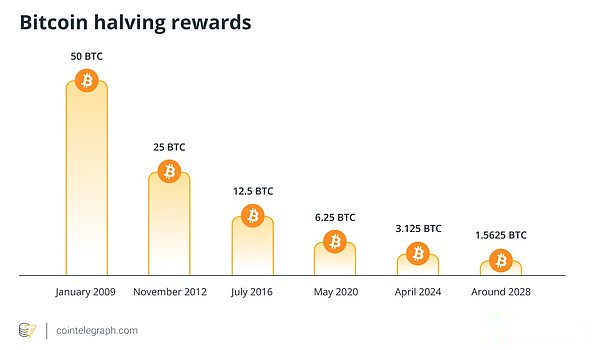
Bitcoin halvings occur approximately every four years, and each halving reduces the issuance of new Bitcoins by 50%.In the past, these supply reductions have preceded major bull markets:
-
Halving in 2012 – peaking in 2013;
-
Halving in 2016 – peaking in 2017;
-
Halving in 2020 – peaking in 2021.
The emergence of this model stems not only from the inherent scarcity mechanism but also from investor psychology.Retail investors are the main driver of demand, while reduced supply has led to strong buying power.
However, as a significant portion of Bitcoin’s fixed supply of 21 million coins has entered circulation, the relative impact of each halving is gradually decreasing.This raises the question: Can supply shocks alone continue to dominate Bitcoin’s cycles?
Grayscale’s assessment of the Bitcoin cycle
Grayscale concluded that the current market differs significantly from past cycles in three ways.
Institutional-led demand, not retail fanaticism
Previous cycles relied on strong buying from retail investors on the platform.Today, capital flows are increasingly driven by exchange-traded funds (ETFs), corporate balance sheets and professional investment funds.
Grayscale observes that institutional investors are able to attract patient, long-term capital.This is a far cry from the fast-paced, emotion-driven retail trading seen in 2013 and 2017.
The decline was not preceded by a rebound
Bitcoin’s peaks in 2013 and 2017 were both accompanied by extreme and unsustainable price spikes and subsequent sharp declines.Grayscale pointed out that the price increase of Bitcoin in 2025 will be more stable, and the subsequent 30% drop looks more like a normal correction of the bull market rather than the beginning of a multi-year bear market.
The macro environment is more important than halving
Bitcoin’s early price movements were largely unaffected by global economic trends.But by 2025, Bitcoin’s price began to be affected by liquidity conditions, fiscal policy, and institutional risk sentiment.
The main influencing factors pointed out by Grayscale include:
-
expected interest rate changes
-
U.S. cryptocurrency legislation gains growing bipartisan support
-
Bitcoin is included in diversified institutional investment portfolios.
The impact of these macro factors exists independently of the halving plan.
Glassnode data shows classic cycle pattern has broken down
Glassnode’s on-chain research shows that Bitcoin prices have deviated from historical normals multiple times:
-
Bitcoin supply is at all-time high for long-term holders: Long-term holders control a higher proportion of the circulating supply than ever before.Continued accumulation limits the number of Bitcoins available for transactions and reduces the supply shock effect typically associated with halvings.
-
Volatility lower despite pullback: Despite a significant price correction in late 2025, realized volatility remains well below levels seen at previous cycle turning points.This suggests that markets are more able to respond to large swings, often thanks to increased institutional participation.
-
ETF and custody demand reshape Bitcoin supply distribution: On-chain data shows that more and more funds are flowing into custodial wallets related to ETFs and institutional products.The Bitcoins in these wallets tend to lie dormant, reducing the number of Bitcoins actively circulating in the market.
A more flexible, macroeconomic Bitcoin cycle
According to Grayscale, Bitcoin’s price action is gradually moving away from the four-year cycle model and becoming more influenced by the following factors:
Stable long-term institutional capital
-
Stable long-term institutional capital
-
Improve the regulatory environment
-
Global Macroeconomic Liquidity
-
Ongoing ETF-related demand
-
A growing group of long-term holders.
Grayscale emphasized that the market correction is still inevitable, and the magnitude may still be large.However, a pullback does not necessarily mean the beginning of a long-term bear market.
Why some analysts still believe in the halving model
Some analysts, who often cite Glassnode’s historical cycle analysis, still believe that the halving is the main driver.They think:
-
The halving remains a fundamental and irreversible supply cut.
-
Trading activity among long-term holders remains concentrated around the halving period.
-
Even with increasing institutional participation, there is still a chance that retail-driven trading activity will re-emerge.
These different perspectives show that the discussion is far from over.The debate over whether Bitcoin defies the four-year cycle reflects the continued evolution of the market.
Understanding Bitcoin’s evolving framework
Grayscale’s argument against the dominance of the traditional four-year cycle is based on a clear structural shift.These shifts include increased institutional engagement, deeper integration with the global macroeconomic environment, and lasting changes in supply dynamics.Data from Glassnode and Coinbase Institutional also confirm that today’s Bitcoin market operations are subject to more complex factors than previous cycles dominated by retail investors.
As a result, analysts are placing less emphasis on time models based on fixed halving cycles and instead focusing on on-chain indicators, liquidity trends, and institutional fund flow indicators.This more granular approach better reflects Bitcoin’s transformation from a fringe digital asset to a recognized component of the global financial landscape.