
 jakiro
Author: Jack Inabinet, Source: Bankless, Compiler: Shaw Bitcoin Vision
Cryptocurrency staking is gradually penetrating into traditional finance through spot exchange-traded funds (ETFs).Long hampered by unclear securities rules, this breakthrough finally brings native cryptocurrency returns to the masses.
Grayscale pioneered the Ethereum staking feature in early October, becoming the first company to enable staking on its spot Ethereum ETF.Two months later, the asset management firm has pledged more than 70% of the $4.7 billion in Ethereum assets it manages.Meanwhile, BlackRock has joined the bandwagon, taking the first regulatory steps by filing a potential “iShares Staking Ethereum ETF” trust application.
The Ethereum ETF has total assets of $18 billion, accounting for more than 5% of ETH’s market capitalization, and controls nearly as much ETH as Lido, the network’s largest staking provider and largest single holder of ETH.
Today, we’ll explore the winner-take-all situation in the cryptocurrency staking market, assess who will benefit most from ETF staking demand, and analyze the concentration risks these staking inflows may create.
winner takes all market
Two core dynamics in cryptocurrency staking naturally push the system toward a winner-take-all outcome that could ultimately lead to a single provider dominating the market.
Liquidity advantage
For a given crypto asset, the largest staking providers can provide superior liquidity to their stakers, which is critical for many price-sensitive institutional holders, including ETF managers who must handle redemptions.
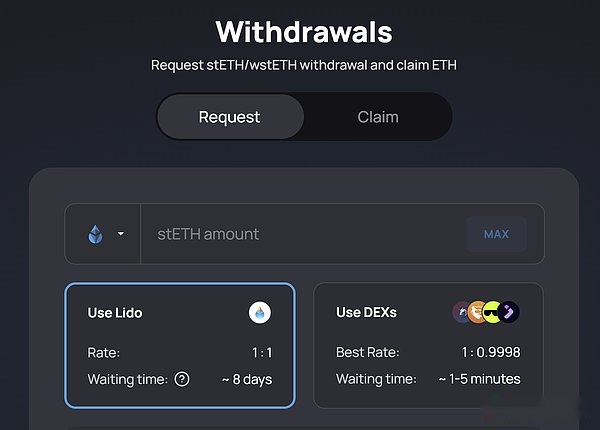
For example, staking at Lido (which controls 24% of ETH pledges) can earn stETH, a fungible certificate of deposit that can be instantly redeemed at market prices or redeemed for ETH at a 1:1 ratio within days.Whether exchanging or redeeming, holders of stETH typically receive better execution than otherwise due to its deeper liquidity and larger validator base – factors that can increase exchange prices and speed up redemptions.
economies of scale
Lido currently charges a 10% commission on customers’ ETH staking rewards, which is lower than any other well-known staking service provider.
While Lido has never lowered commissions as part of a low-cost strategy, top staking providers can attract more stakers by lowering fees, thereby increasing profits at lower prices than competitors as users pursue higher returns.
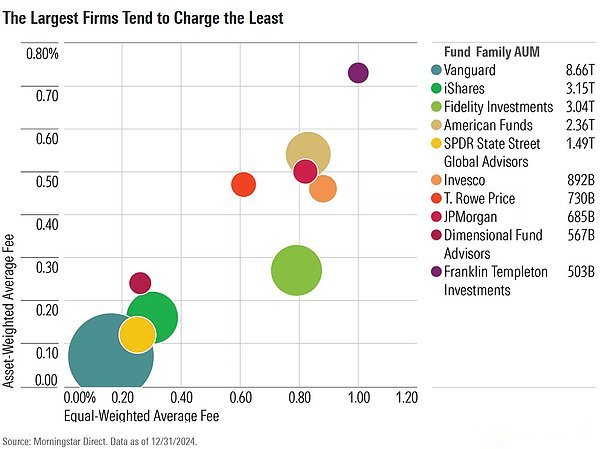
There are many clear examples of this dynamic in traditional finance.Ironically, Vanguard got a late start in cryptocurrency ETF trading, but it solidified its pioneering status in the 1980s by launching low-cost passive index investing products.These products offered better returns than the high-fee active strategies that were prevalent at the time.
Vanguard’s success is evident in the numbers, and the asset management space is now dominated by low-cost passive index funds.The chart below clearly shows the strong link between lower fees and greater AUM.
Who will win?
Although Lido is currently the leader in the Ethereum staking space, as more Ethereum staking ETFs enter the market, the current pattern may be disrupted.
Coinbase still lags far behind the leading Ethereum staking providers, with only a quarter of Lido’s staking share at 6.3% of total staked ETH, but it remains the clear giant in the institutional cryptocurrency custody space.
As of June, Coinbase hosted 81% of all U.S. crypto-asset ETF holdings.
Logically though, one might think that Lido would leverage its liquidity advantages and economies of scale to further expand its staking dominance by incentivizing ETF managers to use Lido.But Coinbase may be better positioned to attract these flows.
In traditional finance, relationships are crucial.
ETF managers need a trustworthy custodial staking partner with a solid reputation and credibility that can withstand regulatory scrutiny, provide audited assurances and, in the worst case scenario, be summoned to court.
Coinbase has spent years building relationships on Wall Street, and in the process has managed to become the default cryptocurrency custodian for institutions.So when these institutions are looking for a staking partner, Coinbase may be their natural first choice.
concentration risk
If BlackRock, which manages the largest Ethereum ETF, takes Ethereum staking through Coinbase, in which it holds a 7% stake, Coinbase could quickly surpass Lido as the main provider of Ethereum staking.
When Coinbase’s staking product receives inflows from ETFs, the liquidity available for redemptions naturally increases.Additionally, Coinbase could solidify its dominance in the staking market by lowering staking commissions, thereby providing financial incentives for more stakers to switch to Coinbase.
In the Ethereum network and many other proof-of-stake (PoS) blockchains, there are three key staking dominance thresholds.As a staking group crosses each threshold, its influence on the chain increases and it earns higher staking rewards.In turn, these higher yields help solidify the leader’s position, disincentivize staking elsewhere, and accelerate centralization.
These systemic centralization risks will exist regardless of which operator is dominant, but the consequences would be particularly dire if Coinbase exceeded these thresholds—effectively handing the entire power of a blockchain designed to be decentralized to a centralized company answerable only to its shareholders.