 jakiro
Author: Mars_DeFi Source: X, @Mars_DeFi Translation: Shan Oppa, Bitcoin Vision
Ethereum’s Fusaka upgrade is the latest step in a ten-year engineering plan that has steadily reshaped Ethereum from a fragile experiment into a global settlement platform.
To understand why the Fukasaka upgrade is so significant, and why the network has little choice but to move forward with such an upgrade, we first need to look back at Ethereum’s history.
Phase One: The Birth of Ethereum (2015-2017)
Frontier
Ethereum was launched in July 2015 with the “Border” version.Core results:
-
The first programmable blockchain
-
Production-ready smart contracts
-
Gas-based fee model
-
Proof of Work (PoW) consensus mechanism
The status at that time:
-
Walletless App
-
No Decentralized Finance (DeFi)
-
Nothing Non-Fungible Token (NFT)
-
Ecosystem without supporting tools
Only in the developer native experimental stage.Ethereum (ETH) is trading in the $1-$3 range.No one can predict what form Ethereum will grow into in the future.
Homestead 2016:
This upgrade marks the maturity of Ethereum.Core results:
-
Improved protocol stability
-
Added opcodes
-
Safer upgrade mechanism
-
Optimized network performance
Key events of the same year:
-
Decentralized Autonomous Organization Collapse
-
Millions of ETH stolen
-
Ethereum undergoes hard fork
-
Ethereum and Ethereum Classic part ways
The painful lessons brought about by this upgrade have made security an unshakable norm.Auditing has since become mandatory, which has slowed innovation but made Ethereum more robust.
Byzantium: 2017
This is an important upgrade in encryption technology. The core highlights include:
-
zk-SNARKs
-
Reduce ETH issuance
-
Security optimization
-
Difficulty bomb scheduling mechanism
Meaning of upgrade:
-
Ethereum builds privacy protection infrastructure
-
Contract execution is safer
-
ETH supply tightening
The second stage: the era of expansion pressure (2018-2020)
During this period, user demand for Ethereum exploded, and it came earlier than expected.The direct consequences are blocks filling up, handling fees soaring, and frequent application failures.Therefore, Ethereum has to meet the challenge through efficiency upgrades.
Constantinople and St. Petersburg: 2019
Core optimization:
-
Encryption operation cost reduction
-
Deterministic contract address (CREATE2 instruction)
-
Issuance volume reduced (from 3ETH to 2ETH per block)
-
Gas cost optimization
Ironically, a security vulnerability triggered the St. Petersburg fork on the day it went online.This incident made the Ethereum team determined: the upgrade must be carried out steadily and never rush for success.
Istanbul: 2019
Ethereum has quietly shifted its focus to Rollup.Upgrade content includes:
-
Reduce calling data charges
-
Strengthen zk support
-
Replay protection mechanism
-
Cross-chain function optimization
Hidden achievements: The Rollup solution is feasible, and Ethereum has begun to lay out L2.
Muir Glacier: 2020
Ethereum has once again delayed the triggering time of the difficulty bomb.Key reasons:
-
The proof-of-stake mechanism is highly complex
-
Ethereum refuses to rush forward
-
Preparations for the merger continue
The third stage: decentralized finance, non-fungible tokens and fee hell (2021-2022)
Ethereum has become the core ecological position of decentralized finance (DeFi), ERC-20 tokens, non-fungible tokens (NFT) and decentralized autonomous organizations (DAO).Along with growth comes high gas fees and frequent transaction failures. Only giant whales can operate smoothly.
London Upgrade: 2021
This upgrade completely reconstructs the economic engine of Ethereum and introduces the core:
-
Fee burning mechanism (EIP-1559)
-
Dynamic basic handling fee
-
Predictable gas pricing model
Long term effects:
-
ETH enters a deflationary state during peak demand periods
-
Supply and usage tend to match
-
Ethereum implements congestion (converting congestion into value)
Paris upgrade: 2022
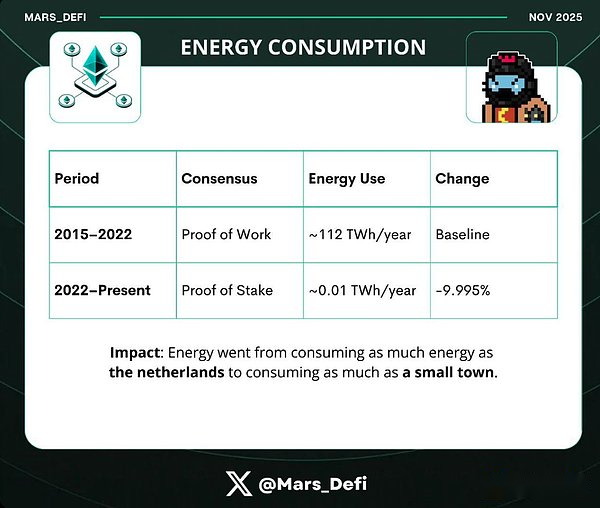
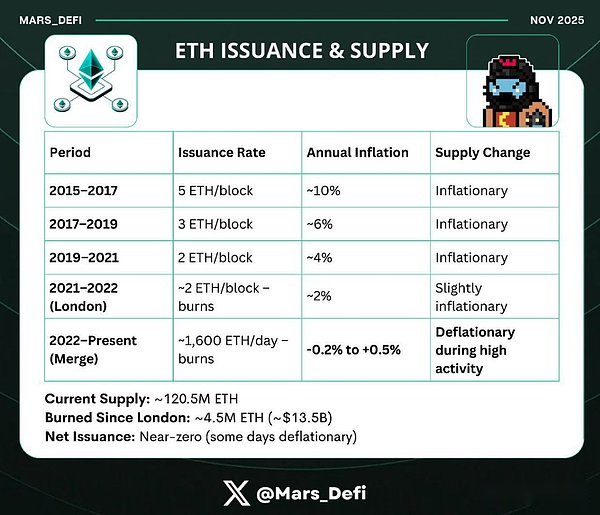
Ethereum has accomplished a feat that no mainstream network in history has dared to attempt: replacing the Proof of Work (PoW) consensus mechanism with the Proof of Stake (PoS) during the operation of the main network.This event is called a merger.This bold move has had far-reaching positive consequences for Ethereum:
-
Energy consumption reduced by 99.95%
-
Circulation reduced by 90%
-
ETH becomes a scarce capital asset
Phase Four: Rollup Era (2023-2025)
Ethereum no longer pursues “taking care of all executions” but turns to “focusing on all settlements”.
Shapella: 2023
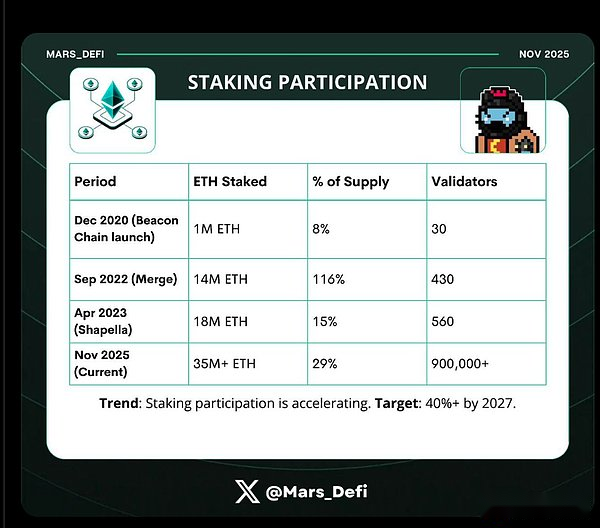
This upgrade enables the unlocking of pledged ETH.Core results:
-
Increase in pledge amount
-
Panic selling reduced
-
The number of validators is growing steadily
As of now:
-
About 30% of ETH is pledged
-
The number of validators approaches 1 million
Dencun: 2024
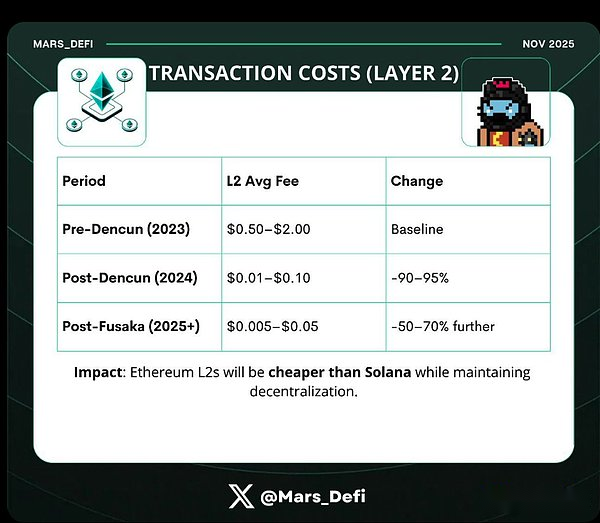
The Danksharding upgrade introduces “prototype Danksharding” (sharding leader scheme) through EIP-4844.Instead of directly implementing complete sharding, a special transaction type has been added that can carry “data blocks”.These temporarily stored rollup data are cheaper than calling data and will be automatically pruned and cleaned.
Core results:
-
L2 handling fee reduced by 90%
-
Rollup Ecosystem Explosive Growth
-
Ethereum achieves “low cost” without changing the core architecture
Pectra: 2025
This stage is the “user experience optimization era” of Ethereum, which makes Ethereum truly valuable.Core introduction:
-
Smart wallet function
-
Gas abstraction (no need to hold ETH directly to pay handling fees)
-
Validator integration
-
Unification of execution layer and consensus layer
The accessibility of Ethereum has been greatly improved and is more in line with the needs of investors.
Upcoming Fusaka upgrades:
To be clear, Vitalik Buterin divided the development of Ethereum into five stages:
-
Expansion: Improve network throughput
-
MEV Resistance: Resist Maximum Extractable Value (MEV) attacks
-
Stateless: achieve statelessness
-
Cleaning: Historical data cleaning
-
Optimization: User experience upgrade
The Fusaka upgrade fully covers these five stages at the architectural level and is known as a “breakthrough upgrade in capacity expansion.”The upgrade, scheduled to launch on December 3, 2025, is the most far-reaching upgrade since the merger.
If the merger redefined the way Ethereum reaches consensus, then the Fukasaka upgrade reshaped its data processing model.This transformation is achieved through four core pillars:
-
Node Data Availability Sampling (PeerDAS)
-
blob capacity expansion in stages
-
Gas limit increased
-
Turn to Verkle tree for state representation and optimize the block proposer selection mechanism
1. Node data availability sampling:
In the Dencun upgrade model, Rollup submits data to Ethereum in the form of blobs, and full nodes need to download and store these data blocks within the data availability window.
As Rollup usage increases, the amount of data in each block may increase dramatically, causing validators’ bandwidth requirements to skyrocket.Without intervention, this trend will either lead to validation centralization (only well-resourced operators can keep up) or limit the capacity of Rollup.
Solution:
PeerDAS solves this problem by redefining “data availability verification”.Instead of requiring each full node to completely download all data blocks, validators collaborate with other nodes to randomly sample data fragments.If enough independent sampling is successful, the probability of missing or anomaly data is reduced to a very low level.
Core impact:
-
Bandwidth consumption reduced by 70%-80%
-
Reduced node operating costs
-
Increased decentralization
-
Rollup implements safe expansion
2. blob capacity expansion:
When the Fusaka upgrade is launched, the upper limit of blobs will maintain the standards of the Dengkun upgrade (the target value and maximum value per block remain unchanged), but the roadmap plans for the subsequent “BPO” hard fork to gradually increase the upper limit to 10 per block, and eventually reach 14 data blocks.
With PeerDAS easing bandwidth pressure, Ethereum can withstand this expansion without squeezing small node operators out of the network.
Blob expansion route:
-
Number of data blocks per block: 6→10→14
-
Data volume increased by over 67%
-
Rollup congestion problem alleviation
-
Handling fees further reduced
An exciting economic cycle is thus formed:
-
More data blocks → more rollups → more transactions
-
More transactions → more fees burned → less supply
In short, while Ethereum is expanding, it will further deflate.
3. Gas limit increase:
In addition to the data layer changes, the Fusaka upgrade increased the block gas limit from 45 million to 60 million.This does not mean that Ethereum will become a high-frequency execution engine, but it does increase execution capacity by about a third.Complex DeFi transactions, NFT minting, and other high gas consumption operations will receive more space, reducing transaction failures due to block saturation.
The trade-off is that a higher gas limit will accelerate state growth, increase the computational load of each block, and may put pressure on nodes with weaker performance.But this cost will be alleviated through the companion application of Verkle trees – Verkle trees can greatly compress state proofs and support new models of lightweight verification.
4. Verkle tree and state efficiency:
Currently, Ethereum uses Merkle Patricia trees to represent the global state (ie, the mapping relationship between addresses, storage slots and their corresponding values).Although Merkle trees are conceptually simple, the resulting proof files are relatively large, typically around 1 megabyte (MB).This results in high costs for light clients to verify specific account status, and also poses challenges in implementing stateless or semi-stateless nodes.
Verkle trees compress a large number of key-value pairs into concise promises through vector promises.The size of the certification file corresponding to a single key will be reduced by an order of magnitude, from megabytes to tens of kilobytes (KB).This allows clients to verify state with extremely low bandwidth and storage costs.
Core results:
-
Document size reduced by 90%
-
Light clients become a reality
-
Mobile verification is feasible
-
Stateless nodes are gradually implemented
Certainty Proposer Preview
The Fusaka upgrade also improves the predictability of block proposer selection.Allowing participants to know in advance which validator will propose a specific block, this mechanism creates the possibility for “forward-looking pre-confirmation” and more advanced transaction ordering and MEV resistance solutions.Rollups that rely on Ethereum block ordering (such as projects using “lookahead-based ordering” schemes) can collaborate more efficiently with L1 validators.At the same time, a more transparent proposer scheduling mechanism helps reduce the incentives for manipulative behavior related to transaction ordering.
Summary
Judging from the upgrade history of Ethereum and Vitalik Buterin’s roadmap, the Fusaka upgrade is not a one-time optimization, but the final implementation of design decisions made many years ago.
-
PeerDAS and blob expansion push the “expansion” stage forward and improve Rollup’s data throughput;
-
More predictable proposer selection and Rollup supporting infrastructure help the “anti-MEV” stage and become an important part of the MEV governance tool library;
-
Verkle tree is the core of the “stateless” stage, providing support for stateless nodes and light clients;
-
The gas limit increase, state efficiency optimization and subsequent historical data cleaning are closely related to the “Purge” stage;
-
The account abstraction and user-oriented optimization initiated by the Pectra upgrade continue into the “Splurge” stage, and these optimizations all rely on the expansion capabilities and state efficiency improvements unlocked by the Fukasaka upgrade.
strategic significance
-
Technical level: The Fusaka upgrade allows Ethereum to support rollup traffic that far exceeds the current scale without sacrificing decentralization;
-
Economic level: By allowing transaction volume to grow much faster than supply growth, it deepens the relationship between network usage and ETH value;
-
Governance and ecological level: Continuing the development model of Ethereum – research-driven and prudent upgrades, sacrificing short-term convenience for long-term stability;
-
Competition level: Ethereum in the Fusaka era will be positioned as a “settlement and data availability layer” to provide support for many high-throughput Rollups, rather than an all-purpose single chain.
High-speed, low-fee layer 1 (L1) networks that compete directly on underlying throughput may still have specific market segments, but Ethereum’s bet is that a highly decentralized, robust economic model, and institutionally recognized settlement layer, superimposed on thousands of Rollup ecosystems, will form a more durable architecture.
The Fusaka upgrade is by no means another hard fork in a long list of upgrades.It marks Ethereum’s first decade of research and incremental upgrades, culminating in a coherent, high-capacity, institutional-grade one-tier settlement platform—enough to support the global financial and computing system for decades to come.