
 jakiro
1. Introduction
The official website of the U.S. government shows that the Internal Revenue Service (IRS) officially submitted a proposal to the White House on November 14.The proposal is called “Broker Digital Transaction Reporting” and its core content is to implement the “Crypto-Asset Reporting Framework” (CARF) launched by the OECD.Once CARF is implemented, the IRS will be able to obtain data on overseas crypto asset accounts held by U.S. citizens.Currently, the White House is reviewing the proposal. Taking this incident as an opportunity, this article will sort out and introduce the CARF framework – what is CARF?How did it develop?Has it been implemented yet?

2. What is CARF
The “Crypto-Asset Reporting Framework” (CARF) is a global tax transparency standard proposed by the Organization for Economic Cooperation and Development (OECD) in 2022.Its core mechanism is to require member states to automatically exchange information about their citizens’ crypto-asset holdings and transactions to effectively curb cross-border tax evasion.
The regulatory body of CARF is very clear. It does not regulate the crypto-assets themselves, but “the entities that provide crypto-asset services.”Under its framework, any institution that provides commercial services such as trading, custody, exchange, and management of transferable crypto assets to the public may be regarded as Reporting Crypto-Asset Service Providers (RCASPs) and must bear reporting obligations.Typical RCASPs include centralized exchanges, custodial wallet service providers, OTC and brokers, issuers that provide stablecoin buying and selling or redemption services, and those institutions that are named after DeFi but have identifiable and operational entities behind them (such as centralized front-ends, revenue management platforms).
According to the CARF framework, RCASP needs to carry out the following work for users (including institutional users and individual users): (1) Customer due diligence to identify their tax residency status, etc.; (2) Record and track user accounts, and conduct classified statistics on exchange, disposal, acquisition and transfer transaction information related to crypto assets. These records and data must be retained for at least five years.Each year, RCASP will submit due diligence information and asset information to the tax authorities in the jurisdiction where it is located.Then, tax authorities will automatically exchange international information – this is equivalent to building a global tax information network in the field of crypto assets, filling the shortcomings of the existing automatic exchange standard for financial account tax-related information (CRS) in the field of encryption.
The CARF rule system consists of three parts:
(1) CARF rules and related comments
These rules and commentary are designed around four key elements: i) the scope of crypto-assets covered; ii) entities and individuals subject to data collection and reporting requirements; iii) reportable transactions and reportable information related to such transactions; iv) due diligence procedures for identifying users and controllers of crypto-assets and determining the relevant tax jurisdictions for reporting and exchange purposes; countries can translate the rules into domestic law for the collection and exchange of relevant reporting information of domestic crypto-asset service providers with other countries that have treaty relationships.
(2) Bilateral or multilateral tax treaties
An agreement or arrangement between bilateral or multilateral competent authorities on the automatic exchange of information reached in accordance with the CARF Code and related commentaries.
(3) Electronic declaration format
The electronic format used by competent authorities to exchange CARF information (XML format), and the electronic format used by reporting cryptoasset service providers to report CARF information to tax authorities (as specified in domestic law).
3. Development and implementation of CARF
From initial launch to widespread acceptance, CARF’s development reflects the international community’s embrace of the trend toward crypto tax transparency.
2022: In early 2022, the OECD released a consultation document on the proposed rule scheme, and then released the final version of the Crypto-Asset Reporting Framework in October, proposing a globally unified standard for cross-border information exchange of crypto assets, marking the initial formation of the CARF rules.
2023: OECD releases the first version of XML Schema, FAQ, due diligence and reporting operation guidelines to establish executable technical and process rules for CARF.
2024: OECD releases the final version of CARF XML Schema, and countries begin to prepare domestic legislation and docking work.
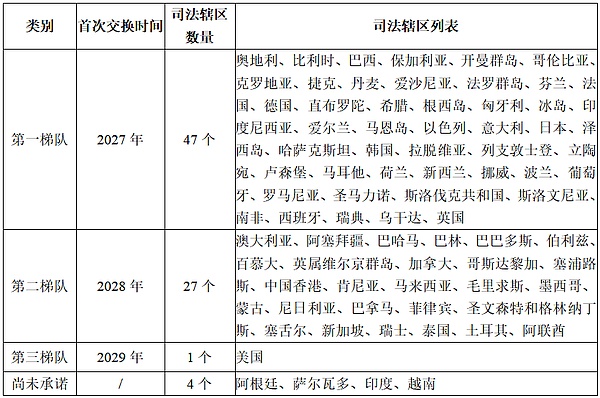
CARF itself is an international standard formulated by the OECD and does not have direct legal effect. It must be implemented through the commitment of countries to join, legislative transformation and system docking.In other words, the timing of CARF implementation in different countries/regions depends on each country’s specific commitments.OECD data shows that as of November 2025, 74 jurisdictions have formally committed to implement CARF in 2027 or 2028, and 53 of them have signed the CARF Bilateral or Multilateral Competent Authority Agreement (CARF MCAA).Among them, the EU has passed the DAC8 Directive (Administrative Cooperation Directive No. 8) in 2023, requiring EU member states to start collecting information from January 1, 2026, and complete the first round of cross-border information exchange by September 30, 2027. Other countries/regions are also gradually advancing CARF.
According to official disclosures from the OECD, as of November 24, 2025, the commitments of each jurisdiction are as follows:
4. Conclusion
CARF is known as the CRS of the crypto world. Its goal is to establish a unified global tax information exchange framework, solve the issue of tax supervision of crypto assets, and provide tax authorities of various countries with more third-party data on the crypto activities of tax residents.The framework requires RCASPs to comply with detailed KYC requirements and ensure accurate and timely reporting of relevant information to tax authorities.The gradual implementation of CARF shows the trend of global encryption tax transparency and gradual clarity of encryption supervision. While promoting tax fairness, enhancing public trust and increasing government revenue, it also imposes higher compliance requirements on intermediaries and tax residents.