 jakiro
x402 Hot Background: Paying for the Absent AI Economy
The rapid development of the AI industry has promoted the rise of the concept of agents, but most AI agents are still unable to complete autonomous economic behaviors.They can generate content, call models, and perform tasks, but they cannot pay for their own services or data calls.The existing payment system relies on account systems and credit institutions, but AI cannot meet prerequisites such as KYC, API Key management, and account binding.This flaw prevents the AI economy from closing the loop.
After Google launched the Agent Payments Protocol (AP2) focusing on AI payment solutions, the x402 protocol previously released by Coinbase also entered the public eye, trying to provide a more crypto-native underlying solution to this problem.x402 is based on the long-reserved but never popular status code “402 Payment Required” in the HTTP protocol. By embedding payment logic into the HTTP request/response process, any API or agent can instantly complete value exchange upon access.Its essence is an Internet-native payment standard, rather than an application interface in the traditional sense.
Both AP2 and x402 are committed to realizing automated payments for AI, but the former focuses on building a centralized API payment standard and relies on platform account systems; the latter takes decentralization as its core and embeds encrypted payments into the HTTP protocol to achieve account-free, cross-chain real-time settlement.
x402 protocol design: making encrypted payments a native function of the Internet
x402 is an open payment standard based on the HTTP native status code 402 Payment Required.Its core goals are:“Allow any AI, API or IoT device to conduct real-time, per-time value exchange at minimal cost.“
Technically, x402 embeds “payment” into the HTTP protocol stack – developers only need one line of code: paymentMiddleware(amount: “0.10”, address: “0x…”) to realize the ability to make AI calls and pay.
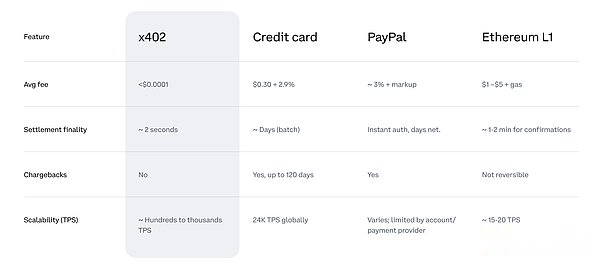
Compared with traditional payment solutions (such as bank cards, Stripe, PayPal, or OpenAI prepaid points system), the structure of x402 is closer to the underlying Internet standards.
This design brings three major features:
•No account: The payer and the service provider interact through the blockchain address, without the need for a traditional account system.
•Instant settlement: Payment and access are completed almost simultaneously, and the payment time reaches “≤ 2 seconds” on some L2 networks.
•Support micropayment: Can support unit transactions as low as $0.0001, suitable for high-frequency small-amount scenarios such as content, data, and APIs.
In addition, the protocol chain is token-neutral. Currently, stablecoins (such as USDC on Base) are used as the main settlement assets, and it can be expanded to multi-chain solutions in the future.
x402 Application Prospects: Value Network from Pay-Per-View to Machine Economy
The greatest significance of x402 is to enable “machine/agent” to have economic interaction capabilities, not just to call functions.Its application directions include:
•Pay-per-Use: AI models, data APIs, and computing power portals can be billed based on the number of calls, and no subscription is required.
•Intelligent agent autonomous payment: Intelligent agents can freely call services and pay without manual pre-recharge or account management.
•Content and data micropayments: It is possible to pay by article, by second, and by data volume, breaking through the traditional advertising/subscription model.
•Machine-to-machine (M2M) payments: IoT devices and automation systems can complete spontaneous value exchange through x402.
From an industrial perspective, with the rise of the AI Agent economy, this type of protocol provides a new “value layer” infrastructure.
The application space for x402 is not limited to payments.Its core value lies in giving machines the ability to interact economically.
x402 development trends and practical challenges
x402 is still in the early stages of promotion.Coinbase promotes it as an AI-native payment standard through its many partners, as well as the very popular Ethereum L2 Base network and USDC stablecoin ecosystem.If this standard is widely adopted by developers, x402 is expected to become the “TCP/IP of the AI economy” and become the value transfer protocol for all agents to interact with the API layer.
However, the challenges facing the x402 are equally clear.The supervision and cross-border compliance issues of stablecoins have not yet been fully clarified; HTTP 402 as a network layer standard still needs to be widely adopted by mainstream developers and platforms; the performance and cost of on-chain micropayments also need to be further optimized.Overall, these problems are more like transitional obstacles in the early stage of infrastructure popularization, rather than fundamental obstacles.At present, x402 is still mainly in the proof-of-concept and developer testing stages. There are no very urgent application scenarios, and it will take time before large-scale commercialization.
x402 ecological layout and investment perspective
•Ecological builder:
The long-term development of x402 is inseparable from the improvement of ecological construction and investment coordination.At the ecological level, we need to focus on three major directions:
Ecological construction layer:Major institutions such as Coinbase and Circle are the core driving force for x402 to promote standardization and industrial implementation.Coinbase is responsible for protocol development and integration ecology, and Circle provides circulating assets and compliant stablecoin support. Together, they build the operating base of x402.
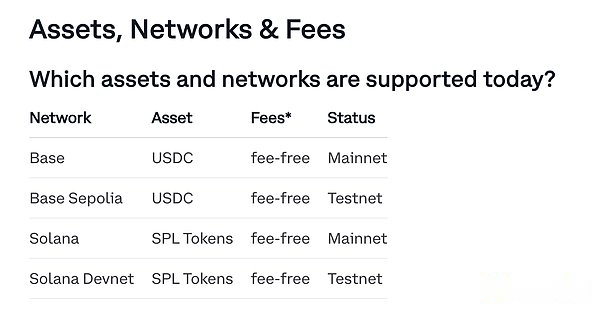
Public chain base layer:Currently, only two public chains, Base Chain and Solana, support the x402 protocol. The former, as the core transport network of the Coinbase ecosystem, natively supports USDC settlement; the latter provides potential expansion space for AI payment and micro-transaction scenarios with its high performance and low cost.
Product application layer:The application layer consists of the Facilitator, Wallet and Bazaar, which together form the service and interaction center of x402.The Facilitator is responsible for payment matching and settlement, making the flow of funds more efficient; the Wallet is responsible for signatures and payment execution, and is the identity entrance between users and AI Agents; the Bazaar, as the discovery layer, aggregates callable services and resources, allowing the agent to independently search and pay for access, and ultimately builds a complete application closed loop.
•Related concept tokens:
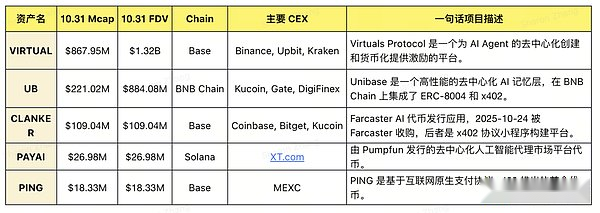
Combined with the previous announcement of Binance Alpha delisting Solana Memecoin, it can be speculated that Binance will still exclusively support related projects on BNB Chain, while Coinbase’s currency listing rhythm is expected to remain relatively cautious.Referring to the situation when the concept of Solana AI Agent emerged last year, if this type of project wants to gain the attention of CEX, it usually needs to achieve a market value of about US$100 million in DEX transactions alone in the early stages before it has the opportunity to be included in the watch or activity list.
When investing in the x402 track, you need to pay attention to the protocol adoption rate, continued growth in transaction volume, the implementation of ecological projects, and changes in regulatory policies.