 jakiro
Author: Ekko An & Ryan Yoon, Source: Tiger Research, Compiler: Shaw Bitcoin Vision
TL;DR
-
The global digital asset custody market will expand by more than 50%, from US$447.9 billion in 2022 to US$683 billion in 2024, evolving from a basic custody function to a core infrastructure for institutional participation.
-
Hosting service providers can be broadly divided into three models: traditional hosting agencies focus on regulatory trust and compliance; hybrid models pursue service diversification; and technology providers compete through security and API-based infrastructure.Jurisdictions such as Singapore, Hong Kong, Japan and South Korea have each developed unique local custody frameworks.
-
The future of the custody business depends not only on the growth of assets under custody, but also on how service providers deliver financial services on top of custody infrastructure.In-depth regulatory understanding and local adaptability will remain decisive factors in global expansion and the success of new entrants.
1. Why the hosting market is so important
The digital asset custody industry has grown rapidly since entering the regulated financial system.Initially, custody services played a limited role, primarily holding digital assets for exchanges.However, as institutional needs have grown, the customer base has become more diverse and broad.The rise of digital asset exchange-traded funds (ETFs) and digital asset treasury reserve (DAT) companies has further driven institutional participation, causing the overall size of assets under custody to rise significantly..
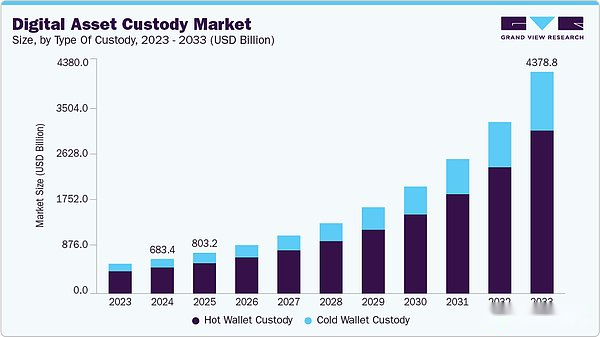
This trend is reflected in market data:The global digital asset custody market will grow from approximately US$447.9 billion in 2022 to US$683 billion in 2024, an increase of more than 50% in just two years.Growth is accelerating, with multiple reports predicting thatThe average annual growth rate of the digital asset-centered custody market will reach 17% to 25%.Given the current wave of institutional capital inflows and the continued expansion of regulatory infrastructure, actual growth is likely to exceed these forecasts.
As the size of assets that need to be managed continues to grow, so does the need for safe and reliable service providers.This report examines the evolution of the custody market and examines how different jurisdictions structure and regulate their custody frameworks.
2. The custody industry spawned by the crisis
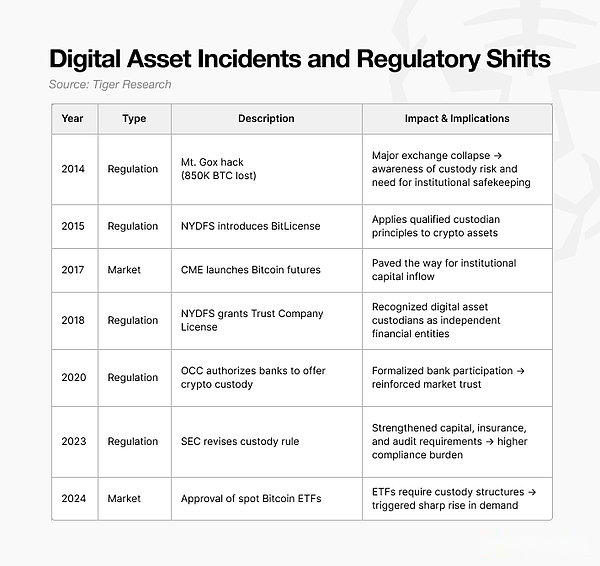
The hosting industry emerged out of a crisis.The turning point was the Mt. Gox incident in Japan in 2014, about 850,000 Bitcoins were stolen at that time, causing huge losses to users.This incident has sounded a wake-up call to the entire industry: without institutional mechanisms to ensure the security of digital assets, it is impossible to conduct sustainable business in the market.
This realization drove regulatory advances.After the Mt. Gox incident, the regulatory framework for digital asset custody was gradually improved.The United States, in particular, has developed custody guidelines similar to those in the traditional financial sector.These regulatory developments lay the foundation for a clearer and more robust structure, allowing the custody industry to develop under clear standards.
3. Types of hosting services
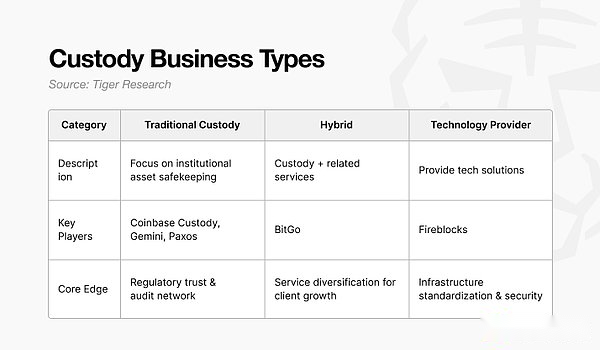
While most custody service providers focus on core asset custody functions, their market positioning and competitiveness vary significantly depending on their strategic focus.Generally speaking, hosting business can be divided into three models:
-
Traditional hosting model: Focus on asset custody, similar to traditional financial custody institutions.
-
blend mode: Go beyond custody to provide value-added services such as staking, settlement or reporting.
-
technology provider model: Provides hosting infrastructure as a SaaS-based solution, enabling institutions to operate their own hosting systems.
Each model targets different customer groups and needs and competes based on its operational strengths and service depth.
3.1. Traditional hosting
Traditional custody service providers primarily focus on asset custody.Its core value is to build trust through reliable operating records, thereby becoming a trustworthy custodian for institutional investors.Coinbase Custody is one of the best.
Coinbase’s strength is clearly demonstrated in the U.S. spot ETF market.As of 2025, 9 of the 11 U.S. Securities and Exchange Commission (SEC)-approved Bitcoin spot ETFs are hosted by Coinbase; of the 9 Ethereum ETFs, 8 are hosted by Coinbase.This strong market share makes Coinbase Custody the most trusted institutional custodian in the industry.
The company’s credibility stems from its early regulatory compliance.In 2018, Coinbase Custody received a limited purpose trust charter from the New York Department of Financial Services (NYDFS).In 2025, the company was also recognized by the SEC as a qualified custodian that complies with asset custody regulations.This qualification gives it the same legal authority to hold client assets as banks and broker-dealers.
While many competitors have just received similar licenses, Coinbase has accumulated years of experience operating under regulation.This experience has become a decisive factor in attracting institutional clients.In managed services, technical maturity is important, but proven operational history remains a key measure of trust.
In the final analysis,The core advantage of the traditional hosting model is its proven performance.Even technologically advanced new entrants will find it difficult to surpass existing custodians whose reputation is based on regulatory history and operating records.
3.2. Hybrid hosting
The hybrid custody model is based on basic custody services and expands into comprehensive services integrating custody, trading and asset management.Essentially, they provide institutional clients with a one-stop solution from storage to usage.BitGo is a typical example.
BitGo’s service portfolio goes well beyond custody and includes staking, over-the-counter (OTC), lending, and real-world asset (RWA) tokenization.Through institutional-grade wallets and APIs, BitGo integrates custody and fund management systems, and its staking services are directly linked to custody accounts.BitGo’s OTC business has been licensed by the German Federal Financial Supervisory Authority (BaFin).
BitGo has achieved rapid global expansion with its diversified services.Through early entry into flexible regulatory environments such as Hong Kong, Singapore and Abu Dhabi, BitGo established a strong local presence and quickly accumulated an institutional client base.
The core advantage of the hybrid model is hosting-based diversification.It is not limited to storage, but provides interconnected services covering trading, asset management and tokenization.Traditional custodians thrive through regulatory trust, while hybrid models gain momentum through service expansion.
3.3. Technology providers
basically,The technology provider model does not hold digital assets directly.on the contrary,They provide SaaS infrastructure that enables banks, exchanges and fintech companies to manage their own custody systems.The leader in this field is Fireblocks.
Fireblocks’ technical strength makes it the preferred partner for building secure digital asset infrastructure.Major clients such as Bank of New York Mellon, Galaxy Digital and Crypto.com demonstrate its market credibility.As of 2025, its platform manages more than $200 billion in assets and serves more than 1,800 institutions.Extensive experience and technical reliability make Fireblocks the preferred provider of institutional hosting solutions.
In 2024, Fireblocks received a limited purpose trust charter from the New York State Department of Financial Services (NYDFS), granting it the legal authority to directly hold assets.However, the company remains primarily focused on technology services.The license does more to build trust with institutional clients than a change in business direction.While Fireblocks has evolved into an infrastructure company capable of directly hosting assets, it has strategically used this position to solidify its leadership as a technology-first provider.
4. Local strategies under different national regulations
Financial regulations vary widely between jurisdictions, and custody services must adapt to these local frameworks.As regulatory standards vary from country to country, the need for local compliance service providers continues to grow.Even in less developed markets than the US (where ETFs and DATs are already quite mature), specialized local custody solutions have emerged to adapt to each country’s regulatory environment.
4.1. Singapore
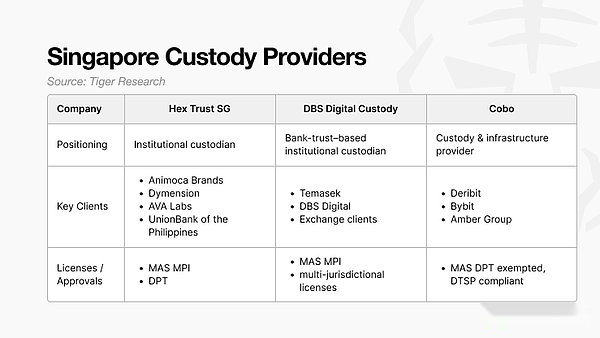
Since June 30, Singapore has expanded the scope of application of the Financial Services and Markets Act (FSMA) to include custody in the definition of digital asset services.Under the revision, custody companies that only serve overseas clients must obtain approval from the Monetary Authority of Singapore (MAS) even if they operate locally.The MAS has said it will strictly enforce licensing standards for custody services, meaning market participants will mainly be limited to banks and institutional-level entities.
4.2. Hong Kong
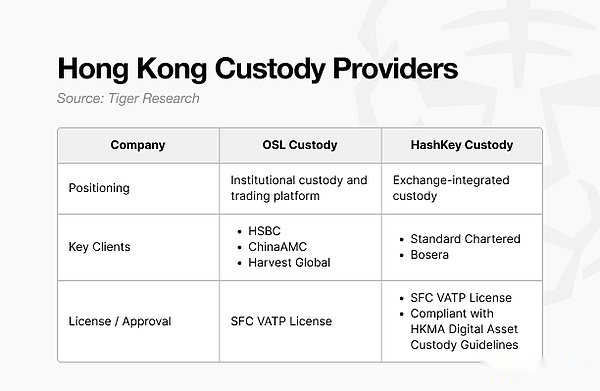
In 2023, the Hong Kong Securities and Futures Commission (SFC) launched the Virtual Asset Trading Platform (VATP) system to integrate trading and custody functions under a single regulatory framework.This architecture goes beyond a simple registration system and requires dual authorization for both the trading platform and custody functions.
OSL provides comprehensive custody, OTC trading and tokenization services, and operates its exchange business.Currently, OSL provides custody services for three of the four approved spot digital asset ETFs in Hong Kong.HashKey cooperates with Standard Chartered Bank to provide legal currency deposit and withdrawal services for institutional customers and improve the efficiency of settlement between digital assets and legal currency through its proprietary infrastructure.
Hong Kong’s regulatory direction is clear: emphasizing the “supervision + bank cooperation” model.Singapore’s custody ecosystem has developed through local companies partnering with global service providers, while Hong Kong centers on traditional financial institutions partnering with local custody institutions to attract institutional capital.
4.3. Japan
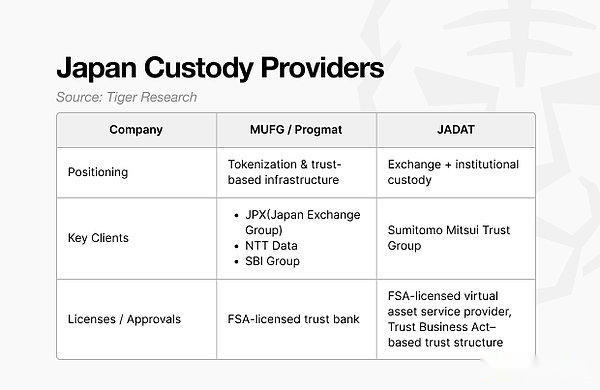
The Financial Services Agency (FSA) of Japan implements a strict custody framework and prioritizes the protection of customer assets.Custodians must store at least 95% of client assets in offline cold wallets.The remaining portion is stored in the hot wallet and must be fully collateralized with equivalent legal currency or bonds.Additionally, external audits are mandatory.
Due to strict regulatory requirements,Japan’s hosting market is dominated by traditional financial groups rather than Web3 native companies.Only institutions with adequate capital and strong infrastructure can meet the FSA’s standards.
Mitsubishi UFJ Financial Group (MUFG)/Progmat focuses on tokenization and trust-based infrastructure and leverages its FSA-licensed trust bank status.JADAT adopts a hybrid model that combines exchange and institutional custody functions.It holds both a virtual asset exchange license and a trust business license under the Trust Business Act, allowing it to provide comprehensive trading and custody services.
Japan’s example shows how strict regulation amplifies the influence of traditional finance.High mortgage thresholds and mandatory audits have made banks and trust companies the dominant custodians in the market.
4.4. South Korea
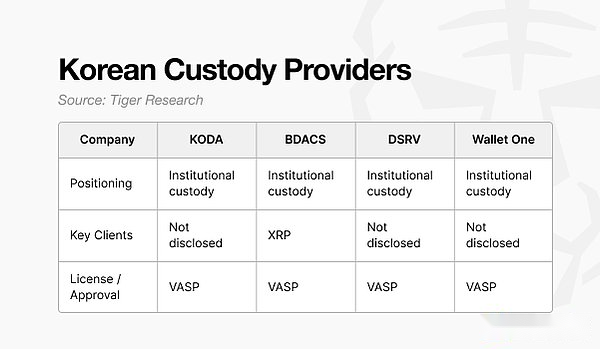
The Korean custody industry is regulated by the Specified Financial Transaction Information Reporting and Use Act (“Specified Financial Transaction Information Act” or “VASP Framework”), which regulates virtual asset service providers.The Korean market presents two parallel development trends: a cooperation model led by financial institutions and a technology-driven specialization model.Its models range from joint ventures led by traditional financial institutions, such as KODA, to start-ups that differentiate through security and infrastructure innovation.
Recently, in order to cooperate with the advancement of the second phase of the Financial Supervisory Commission (FSC) corporate digital asset trading roadmap, various exchanges have begun to actively compete to attract corporate customers.It is expected that demand from institutional customers will grow after the corporate trading market is officially opened.
A recent turning point in the Korean custody industry will be the participation of approximately 3,500 qualified professional investors.If institutional investors start to enter the market in large numbers, the industry may move towards the tokenization of security token offerings (STOs) and real-world assets (RWAs).Therefore, regulatory consolidation can not only satisfy compliance requirements but also act as a catalyst for the formation of new markets.
5. The hosting industry is just getting started
The hosting industry is still in its early stages.其竞争策略大致可分为两种。
The first is early market entry, such as Coinbase Custody, has established market dominance by building institutional trust and a strong customer base ahead of its competitors.
The second is service diversification, such as BitGo, which achieves differentiated competition by providing services such as staking, RWA tokenization and lending.
As digital asset markets shift from retail dominance to institutional participation, custody service providers are working to develop bank-grade infrastructure and audit frameworks that meet institutional standards.At the same time, technology infrastructure providers that can help new entrants build compliant hosting systems are also receiving increasing attention.
However, successful market entry depends on a deep understanding of local regulatory frameworks and ecosystem dynamics.
-
in the united states, obtaining regulatory approval is critical to establishing institutional credibility, although new entrants must compete with Coinbase Custody’s strong position.
-
in Hong Kong and Singapore, success relies on a cooperative model with banks under clear supervision.
-
in Japan, strict customer asset protection rules make establishing partnerships with large domestic financial institutions a prerequisite for entering the market.
-
in korea, the players are diverse, but institutional involvement is still evolving and there is still room for growth once regulatory transparency improves.
Ultimately, companies seeking to enter the hosting market must prioritize precision over speed.Sustainable growth depends on accurately analyzing local regulations and designing robust partnership structures with financial institutions.Even latecomers can find meaningful opportunities as long as their business models comply with regulatory requirements and they build reliable local partnerships.