
 jakiro
Author: Zhang Feng
Recently, the U.S. House of Representatives passed an important new “market structure” bill, namely the CLARITY Act, trying to establish a clear regulatory framework for the digital asset market.The bill has now entered the Senate’s deliberation phase, which is developing its own version of market structure legislation, and the CLARITY Act will provide reference for it.

The core value of the CLARITY Act is to provide compliance paths for decentralized projects, but it is not a direct improved version of the traditional “Safe Harbor Act”, but it has introduced a “Safe Harbor” exemption mechanism in cryptocurrency regulation and built a more systematic regulatory framework on this basis.Its core is to provide a compliance path for decentralized projects through a “control-based maturity framework” and DeFi exemptions, while optimizing the shortcomings of previous bills.
one,Main contents of the “safe harbor” mechanism
DeFi developers exemption.It clearly exempts the compliance obligations of the following roles and forms a safe harbor protection: blockchain underlying code developer; node operators and oracle service providers; DeFi protocol front-end interface developer; non-custodial wallet service provider.
For example, companies such as Uniswap Labs that only provide interfaces do not need to register as exchanges and avoid being classified as “unregistered securities intermediaries.”
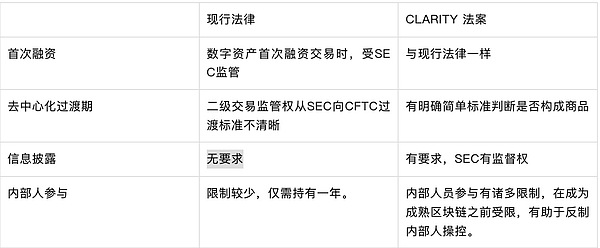
“Maturing Blockchain System” certification.The project can achieve regulatory conversion from securities to commodities by proof that it meets three standards:Decentralized control(No single entity dominates);Open source code; automatic operation.After certification, the tokens are regulated by CFTC and the SEC is withdrawn from jurisdiction. The essence is to provide a regulatory exit path for compliant projects.
The current law and the CLARITY Act (if passed) are compared with the unique attribute specifications of blockchain systems as follows.
two,Improvements to the traditional safe harbor proposal
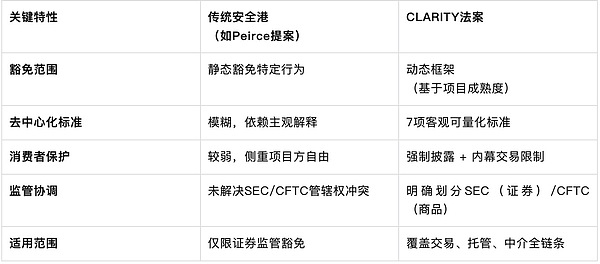
Compared with previous safe harbor proposals such as the Blockchain Regulatory Certification Act, the breakthrough of the CLARITY Act is:
Dynamic regulatory framework.Traditional safe harbors only offer static exemptions (such as the Hester Peirce proposal), while CLARITY introduces the concept of “control-based maturity” to adjust regulatory intensity according to the project development stage:Early stage of centralizationSEC strict disclosure and insider trading restrictions apply;Mature decentralization stageConvert to commodity supervision and reduce obligations.Set up seven objective standards (such as governance rights distribution and code control rights) to avoid subjective judgment.
Strengthen consumer protection.Project parties are required to force disclosure of key information (such as token economics, risks) in the early stages; internal personnel are restricted from selling tokens before the project matures, and preventing profits from using information asymmetry.
Fill in regulatory loopholes.It is clearly required that centralized exchanges (such as Coinbase) be registered with the CFTC, comply with capital reserves and anti-fraud rules, and solve the problem of lack of regulation similar to FTX.
three,Areas not fully covered
State-level supervision is not given priority exemption.Although the DeFi agreement is exempt from federal intermediary regulation, state-level regulation (such as BitLicense, New York) may still apply, resulting in fragmentation of compliance.
Non-digital commodity assets are not covered.The bill only applies to “digital goods” (such as Bitcoin, Ethereum), and tokenized securities, derivatives, etc. are still under the jurisdiction of the SEC and no conversion path is provided.
Anti-money laundering (AML) challenge.The anonymity of DeFi conflicts with the traditional KYC mechanism, and the bill does not propose an adaptation plan, which may lead to illegal funding risks.
4. Coexistence of innovation and limitations
The CLARITY Act can be regarded as an advanced version of the safe harbor mechanism: through dynamic frameworks and objective standards, the ambiguity of traditional safe harbors is solved, and innovation and protection is balanced; but there are also regrets that the challenges of state-level supervision and anti-money laundering are retained, which require subsequent legislation to supplement.
Its core value lies in providing a predictable compliance path for decentralized projects, while forcing centralized institutions to undergo strict supervision, which is expected to end the long-term split state of crypto regulation in the United States.If passed by the Senate, it will be a key step in reshaping the global crypto-competitive landscape after the GENIUS bill.