
 jakiro
Proposal for “anti-related incentives”
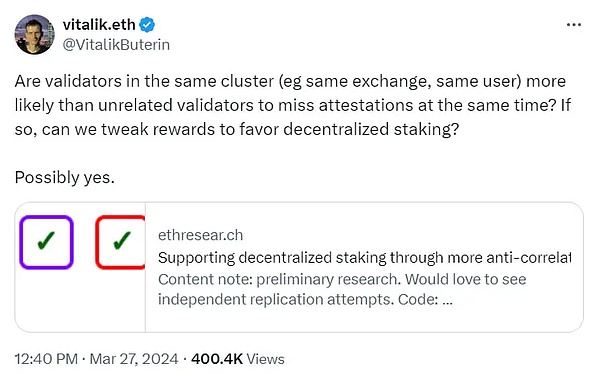
While Vitalik Buterin recognizes the advantages that large validators provide to the Ethereum network, he still tries to balance the requirements of large validators with the decentralized and resilient networks.On March 27, he proposed an innovative plan of “anti-related incentives” aimed at dealing with the problem of centralization of validators, increasing the punishment for failures of large validators, and enhancing the decentralization and fairness of the Ethereum staking mechanism.sex.
The correlation failure of the Ethereum network may undermine the decentralized nature of the system due to control over multiple validators from a single location.To solve this problem,The Anti-Related Incentive Program will punish validators for related failures, incentivizing them to expand the scope of their validators’ activity.
Vitalik Buterin believes that if multiple validators controlled by the same entity fail together, they will be fined higher than individual validators’ failures, because any errors made by large validators will be copied in all identities they control.For example, validators in the same cluster, such as Staking Pool, are more likely to experience related failures, possibly due to shared infrastructure.
The proposal recommends that validators who deviate from the average failure rate be punished accordingly.If many validators fail in a given slot, the penalty for each failure will be higher.
Simulations show that this approach can reduce the advantages of large Ethereum staking platforms, as large entities are more likely to cause a soar in failure rates due to related failures.The potential benefits of the proposal include incentivizing decentralization by establishing a separate infrastructure for each validator and making solo staking more economically competitive relative to the staking pool.
Beyond this, Vitalik Buterin has proposed other options, such as different penalties, to minimize the advantages of large validators and to examine the impact on geography and customer decentralization.
Although Ethereum has punishment mechanisms such as slashing to deal with serious violations, these mechanisms are often used to deal with extremely malicious or serious behavior.The proposal incorporates penalties into regular network operations, emphasizing promoting authentic diversity among validators.The goal of this strategy is to ensure efforts to improve decentralization and facilitate substantial transformation rather than merely superficial compliance.